

Alternatives to Store-Bought Coffee Beans for Espresso
Table of Contents
- Why Store-Bought Coffee Beans Fall Short for Espresso
- Fresh Roasted Coffee Beans for Espresso: The Freshness Factor
- Specialty Coffee Beans for Espresso: Blends vs. Single-Origin
- Single-Origin Espresso Beans: Origin, Altitude, and Flavor Profile
- Light Roast Coffee for Espresso: Acidity, Origin Clarity, and Extraction
- Roast Levels and Their Impact on Espresso Shots
- Whole Beans vs. Pre-Ground: Grinding for Espresso Consistency
- Comparison Table: Espresso Bean Options by Roast, Origin, and Use Case
- Frequently Asked Questions
Last Updated: October 5, 2026
Why Store-Bought Coffee Beans Fall Short for Espresso
Store-bought coffee beans for espresso often sit on shelves for months, losing brightness and complexity. The roast date is either missing or too old, and the beans have already begun fading into staleness.
Fresh-roasted specialty coffee delivers the flavor clarity, crema development, and consistency that grocery store options cannot match. Brewtiful Coffee US sources and roasts beans specifically for espresso extraction, delivering richer aroma, smoother body, and satisfying crema.

Store-bought beans are optimized for shelf life, not flavor. They're roasted weeks or months before purchase, stored in conditions that accelerate oxidation, and lack roast dates. For espresso, which demands precise extraction, this approach fails.
Fresh Roasted Coffee Beans for Espresso: The Freshness Factor
Fresh roasted coffee beans for espresso release CO2 immediately after roasting, peaking at 3-5 days post-roast, when espresso extraction works best. CO2 creates golden crema and ensures even water penetration.
Store-bought beans lose CO2 and oxidize, dulling origin character and introducing flat notes. Fresh-roasted beans retain volatility for complexity and sweetness.
Roast Date and Flavor Development
The roast date is the most important information on any bag. Unlike "best by" dates, it tells you exactly when the beans were roasted.
Espresso amplifies both good and bad in beans. A bean roasted three days ago will have brighter acidity, more pronounced origin flavors, and better crema than one roasted three weeks ago.
Specialty roasters print roast dates on the front. Beans roasted 1-3 weeks before brewing are ideal for espresso; beyond four weeks, quality declines significantly.
Storage and Shelf Life
Storage matters as much as freshness at purchase. Beans in an open bag decline within two weeks; sealed in an opaque, airtight container, they stay vibrant for 3-4 weeks.
Buy whole beans in quantities you'll use within a month (typically half-pound to one pound). Freezing extends shelf life but risks condensation, so avoid unless storing several months.
Specialty Coffee Beans for Espresso: Blends vs. Single-Origin
Blends are engineered for consistency and balance; single-origins showcase unique regional character. Both work for espresso but demand different expectations.
Blended Espresso Beans for Consistency
Blends combine beans from multiple origins to hit a flavor target and ensure consistency. A roaster might blend African beans for brightness with South American beans for body and sweetness.
Blends are forgiving. This is why espresso bars often rely on blends, they need to pull hundreds of shots a day with minimal variation. Specialty Coffee Association guidelines on espresso recognize blends as a deliberate craft choice, not a shortcut.
For home brewers, blends like Brewtiful Coffee US's Blonde or African Espresso offer a reliable entry point. You get the freshness advantage of specialty coffee without the precision demands of single-origin espresso.

Single-Origin Espresso Beans for Character
Single-origin beans come from one country, region, or farm and taste like where they grew. They're less forgiving than blends but reward precision with clarity and complexity.
A medium roast highlights origin character, fruity notes, and floral aromatics; a darker roast emphasizes chocolate and caramel. The same bean roasted two ways tastes like two different coffees.
Single-Origin Espresso Beans: Origin, Altitude, and Flavor Profile
Geography shapes espresso flavor. Altitude, soil, rainfall, and processing method all influence the final cup and help you choose beans matching your taste and machine.
African Origins: Kenya, Tanzania, Ethiopia
African coffees are known for brightness, complexity, and fruit-forward profiles with higher acidity, crisp and clean in espresso but sharp if over-extracted.
Kenya offers berry and citrus notes; Tanzania brings similar brightness with tea-like texture; Ethiopia's natural-processed beans produce wild, fruity flavors.
Brewtiful Coffee US's African Espresso blends Kenya, Tanzania, and Ethiopia into a medium-dark roast that balances the region's natural brightness with body and sweetness. For single-origin African espresso, the Ethiopia Natural delivers milk chocolate, fruity, and caramel notes that work beautifully in milk-based drinks.
Central and South American Single-Origins
Central and South American coffees are the backbone of most espresso blends, balanced, approachable, and naturally sweet with cocoa, chocolate, and caramel flavors.
These origins have lower acidity than African coffees, making them more forgiving if extraction timing is slightly off, and produce reliable crema.
Brewtiful Coffee US offers Colombia with dried orange, berry, and chocolate notes; Guatemala with dark chocolate, bright fruit, and butterscotch; and Brazil Santos with elegant cocoa notes.

Asian and Pacific Origins
Indonesian and Pacific coffees bring earthy, full-bodied character with lower acidity and heavier body, excellent for thick, syrupy shots with substantial crema.
Sumatra's wet-hulled processing produces herbal, spicy notes; Bali offers chocolate and brown sugar sweetness. Both shine in darker roasts with milk.
The Best Sellers Sample Pack includes Bali as a med-dark roast, showcasing dark chocolate, molasses, and brown sugar flavors that create rich, indulgent espresso.
Light Roast Coffee for Espresso: Acidity, Origin Clarity, and Extraction
Light roast espresso is misunderstood. A well-executed light roast delivers origin clarity and complexity that darker roasts cannot match.
Light roasts are removed before the second crack, preserving more original character.
Light roasts require precise grind, tamping, and temperature. If dialed in correctly, they produce stunning, clean, complex shots refreshingly different from typical dark roasts.
Brewtiful Coffee US's Ethiopia Natural is roasted med-light and works beautifully in espresso for those willing to dial in their grind.
Roast Levels and Their Impact on Espresso Shots
Every roast level tells a different story. Understanding how roast affects espresso extraction helps you choose beans that match your machine and your taste preferences.
Light Roasts: Preserving Origin Character
Light roasts preserve origin character and require finer grind. They produce lighter espresso with brighter acidity and fruity, floral notes.
Medium Roasts: Balance and Versatility
Medium roasts balance origin character with body and sweetness, making them forgiving and easier to extract consistently.
Most of Brewtiful Coffee US's single-origins are roasted medium: Brazil Santos, Colombia, and Guatemala. They work in straight espresso, milk drinks, and everything in between.
Dark Roasts: Body and Crema Development
Dark roasts develop deep chocolate and caramel flavors, producing thicker crema and heavier body. They're the most forgiving for espresso and ideal for beginners.
The Best Sellers Sample Pack includes the 6Bean Blend roasted dark, a house blend of beans from around the world, specifically engineered for espresso consistency and crema.
Whole Beans vs. Pre-Ground: Grinding for Espresso Consistency
This is non-negotiable: whole beans always outperform pre-ground coffee for espresso. The moment you grind coffee, you expose the interior to oxygen, and oxidation begins immediately. A bag of pre-ground coffee has already lost much of its flavor complexity before you open it.
Whole beans stay fresh for weeks. Pre-ground coffee stays fresh for days, sometimes less. For espresso, which demands precision and highlights every flaw, this difference is critical.
Why Whole Beans Deliver Better Results
Whole beans maintain their volatile compounds, the aromatics and flavor oils that make espresso taste great. When you grind immediately before brewing, you capture those compounds in your shot. Pre-ground coffee has already lost them to oxidation.
Whole beans also allow you to adjust your grind size based on your espresso machine and your dialing-in process. If your shots are running too fast, you grind finer. If they're running too slow, you grind coarser. With pre-ground coffee, you're stuck with whatever size the manufacturer chose.
Grind Size and Espresso Machine Compatibility
Espresso requires a fine, consistent grind, much finer than pour-over or French press. The ideal particle size is around 0.75 millimeters, though this varies slightly based on your machine, your beans, and your extraction goals.
A burr grinder, either conical or flat, produces more consistent particle size than a blade grinder.
Different espresso machines also demand slightly different grind sizes. A superautomatic machine with a built-in grinder will handle a slightly coarser grind than a manual lever machine.
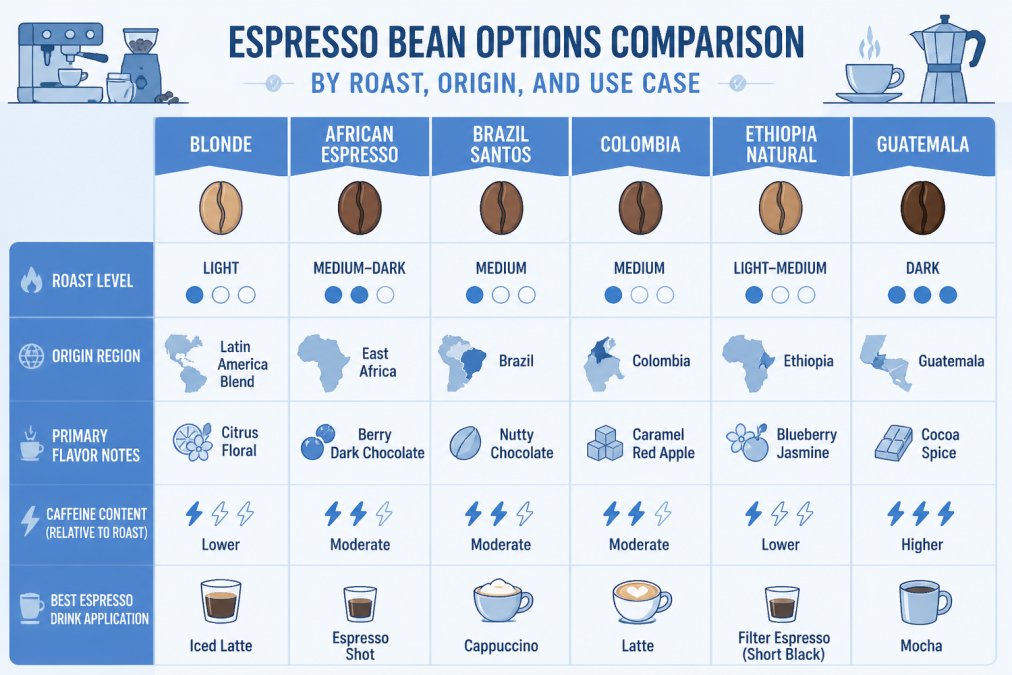
Comparison Table: Espresso Bean Options by Roast, Origin, and Use Case
| Bean Option | Roast Level | Primary Origin | Flavor Profile | Best For | Price |
|---|---|---|---|---|---|
| Blonde | Light-Medium | Central America & Africa | Sweet, balanced, approachable | Espresso beginners, milk drinks | $22.99 |
| African Espresso | Medium-Dark | Kenya, Tanzania, Ethiopia | Bright, complex, fruit-forward | Balanced shots, milk-based drinks | $22.99 |
| Brazil Santos | Medium | Brazil | Cocoa, smooth, elegant | Straight espresso, cappuccino | $22.99 |
| Colombia | Medium | Colombia | Orange, berry, chocolate | Versatile, milk drinks, straight shots | $22.99 |
| Ethiopia Natural | Med-Light | Ethiopia | Fruity, caramel, milk chocolate | Specialty espresso, flat whites | $22.99 |
| Guatemala | Medium | Guatemala | Dark chocolate, bright fruit, butterscotch | Rich espresso, lattes | $22.99 |
| 6Bean Blend (Best Sellers Pack) | Dark | Multiple origins | Cocoa, caramel, vanilla | Espresso consistency, crema | $25.99 (6 x 2oz) |
| Single Origin Favorites Pack | Varied | Brazil, Colombia, Ethiopia, Costa Rica, Honduras, Tanzania | Varied by origin | Exploration, dialing in | $24.99 (6 x 2oz) |
The sample packs offer an excellent way to explore alternatives without committing to full bags. The Best Sellers Sample Pack includes six 2-ounce varieties, letting you taste the difference between blends and single-origins, light and dark roasts, and different origins. The Single Origin Favorites Sample Pack focuses entirely on single-origins from six different countries, perfect for understanding how geography shapes flavor.
For teams looking to upgrade their office kitchen or corporate pantry, Brewtiful Coffee US offers wholesale options that deliver cafe-quality espresso to your break room. Employees notice the difference immediately, and the freshness advantage means better flavor from day one.
Choosing alternatives to store-bought coffee beans for espresso means committing to freshness, understanding roast levels and origin character, and investing in whole beans you grind yourself. It's a small shift with outsized impact.
Frequently Asked Questions
Can I use regular grocery-store coffee beans for espresso?
Regular grocery-store beans often lack the freshness and consistency espresso demands. Most supermarket coffee sits on shelves for weeks or months, losing the bright aromatics and clean extraction espresso requires. Stale beans produce flat, bitter shots with thin crema. Fresh-roasted specialty coffee beans for espresso are roasted within 1-4 weeks of brewing, preserving the complexity and body that makes espresso shots shine. Freshness alone transforms your shots from harsh to smooth.
What makes single-origin espresso beans different from blends?
Single-origin espresso beans come from one region or farm, expressing distinct flavor notes tied to altitude, soil, and processing. They highlight origin character: Ethiopian beans bring fruity, floral notes, while Brazilian beans offer cocoa smoothness. Blends combine beans from multiple origins to achieve consistency, balance, and crema development. Blends are ideal if you want predictable, forgiving shots; single-origin beans are best if you want to explore specific flavor profiles and don't mind dialing in your machine for each new bean.
Are freshly roasted coffee beans better for espresso than pre-ground?
Yes. Whole beans preserve volatile aromatics and oils that degrade quickly once ground. Pre-ground coffee loses flavor and extraction clarity within hours of grinding. Whole beans roasted fresh (within 1-4 weeks) allow you to grind just before brewing, capturing maximum flavor and crema. If you're serious about espresso quality, whole beans are non-negotiable. Grind size also matters: espresso requires a fine, consistent grind that pre-ground coffee rarely achieves.
Can light roast coffee work for espresso?
Yes, light roast coffee for espresso works well, especially for single-origin beans where you want to taste the origin's unique characteristics. Light roasts preserve acidity and origin clarity, producing brighter, more complex shots. They require precise dialing in because they extract faster and can taste sour if underextracted or bitter if overextracted. Medium and dark roasts are more forgiving for beginners, but light roasts reward careful technique with exceptional flavor depth and clarity.
How do I know if espresso beans are actually fresh when they arrive?
Check the roast date on the bag. Espresso beans are optimal 3-7 days after roasting and remain good for up to 4 weeks if stored properly in an airtight container away from light and heat. If no roast date is printed, the beans are likely old. Reputable roasters always print the roast date. Fresh beans smell vibrant and aromatic; stale beans smell flat or musty. When you open a bag of fresh beans, the aroma should be immediate and rich.