

10 Best Coffee Beans for Cold Brew 2026: Ranked
Table of Contents
- Our Top Picks for the Best Coffee Beans for Cold Brew
- Why Bean Choice Matters for Cold Extraction
- 1. Cold Brew Coffee Blend: The Coarse-Ground Champion
- 2. Sumatra: The Syrupy, Earthy Classic
- 3. Colombia: Bright Fruit Meets Smooth Chocolate
- 4. Bali Blue: Heavy Body with Molasses Sweetness
- 5. Guatemala: Butterscotch and Dark Chocolate Depth
- 6. Peru: Silky Sweetness with a Citrus Lift
- Frequently Asked Questions
Last Updated: September 6, 2026
Our Top Picks for the Best Coffee Beans for Cold Brew
Finding the 10 best coffee beans for cold brew 2026 has to offer starts with one simple truth: cold extraction rewards beans with deep chocolate, low acidity, and a heavy body. The wrong roast turns a 16-hour steep into a bitter, muddy mess. The right one delivers a smooth, sweet concentrate that tastes like it came from a specialty cafe.
At Brewtiful Coffee US, we roast in small batches and ship nationwide, so we have a front-row seat to which beans actually shine when brewed cold. This guide ranks our top 10 picks based on roast profile, tasting notes, and how they perform during a long, cold immersion. Below, we will show you exactly how each bean behaves in the brewer, so you can match one to your palate.
Cold brew coffee is a slow extraction process that uses time instead of heat, which naturally reduces bitterness and acidity. That means the flavor clarity of your final cup depends almost entirely on the bean you choose.
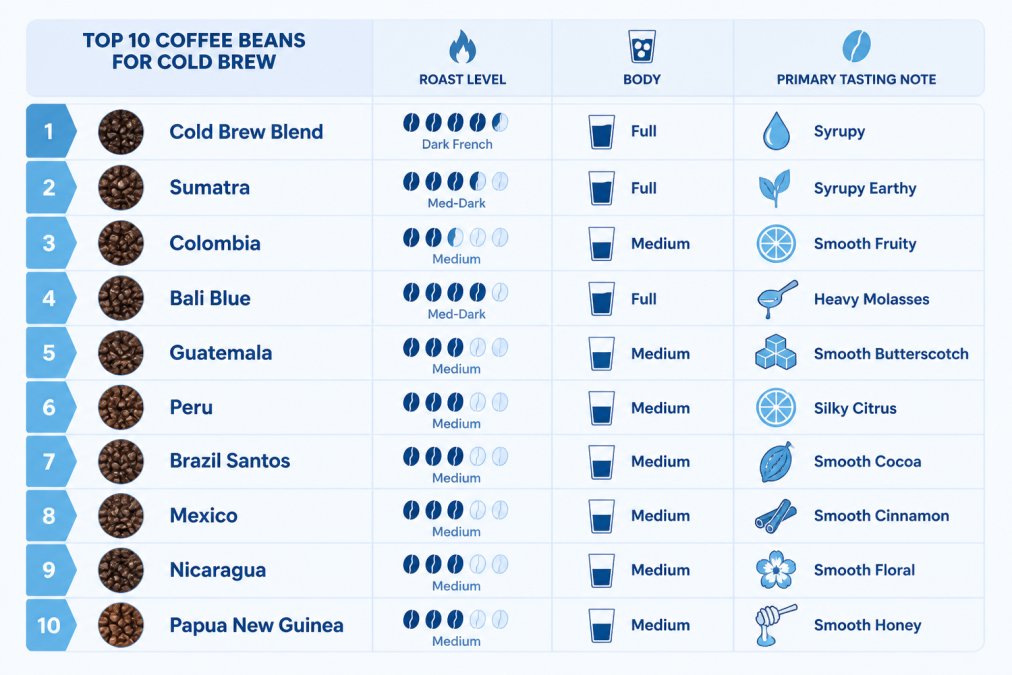
Quick Picks:
- Best Overall: Cold Brew Coffee Blend, a dark French roast ground coarse, built for this method
- Best for Chocolate Lovers: Sumatra, syrupy body with earthy, dark chocolate depth
- Best for Bright Fruit: Colombia, dried orange and berry notes with a smooth chocolate base
The list below moves from the most versatile to the most specialized. Every bean here is freshly roasted and ships free, but they are not interchangeable in the brewer.
Why Bean Choice Matters for Cold Extraction
Cold extraction is a forgiving brewing method, but it is also a revealing one. Heat masks flaws; cold water does not. A bean with high acidity or a thin body will produce a concentrate that tastes sour or hollow, no matter how long you steep it.
The ideal coffee beans for cold brew share three traits: low acidity, a heavy or syrupy mouthfeel, and tasting notes that lean toward chocolate, caramel, or nuts. These characteristics survive the long steeping time and come through with clarity and sweetness. According to guidance from the National Coffee Association on brewing methods, cold brewing produces a coffee that is lower in acidity than hot brewing, which makes the flavor profile of the bean the deciding factor.
The pH Science Behind Your Cup
Cold brew's reputation as a stomach-friendly coffee is not just anecdotal. Research published by the American Chemical Society shows that cold brewing can produce coffee with pH levels between 4.85 and 5.13, compared to hot brewed coffee which typically lands between 4.85 and 4.98. That difference of roughly 0.2 to 0.3 pH units may sound small, but on the logarithmic pH scale, it represents up to 50% lower acid concentration. This is why many people who experience heartburn or acid reflux with hot coffee can tolerate cold brew.
Roast profile directly influences this pH balance. Darker roasts contain less chlorogenic acid, the primary acid in green coffee, because the roasting process degrades it. A dark French roast like our Cold Brew Blend will naturally produce a lower-acid cup than a light roast from the same origin. If your primary reason for choosing cold brew is digestive comfort, skip the light roasts entirely and look for beans labeled dark or French roast.
The Ratio Problem Most Guides Ignore
The water-to-coffee ratio is not a one-size-fits-all number. It should shift based on the bean's roast profile and density. Dark roasts are less dense and extract more readily in cold water, so they can handle a slightly stronger ratio of 1:5 (coffee to water) without becoming bitter. Medium roasts, which retain more density and acidity, often perform better at a more diluted 1:7 or even 1:8 ratio, allowing the fruit notes to emerge without turning sharp.
A common pattern among specialty cold brewers is to start with a 1:6 ratio for dark roasts and 1:7 for medium roasts, then adjust based on the concentrate's strength. If your cold brew tastes hollow or thin, the bean is not the problem, your ratio likely is.
Roast profile matters more than origin here. Darker roasts bring out the oils and reduce bean density, which makes them easier to extract in cold water. Lighter roasts keep more of their fruity acidity, which can turn sharp after hours of steeping.
A common mistake is buying pre-ground coffee for cold brew. Whole bean coffee retains its aroma profile and sweetness far longer than ground coffee, which loses volatile compounds within minutes of grinding. If you want a smooth, sweet concentrate, start with whole beans and grind them coarse yourself right before you brew.
1. Cold Brew Coffee Blend: The Coarse-Ground Champion
Our top pick is the Brewtiful Coffee US Cold Brew Coffee Blend, a dark French roast specifically blended for this method. It is 100% coffee with no additives, and the grounds arrive very coarse so you can skip the grinder entirely and start steeping immediately.
The flavor is bold and satisfying, with a heavy body that stands up to milk or water without turning thin. Because it is a dark roast, it extracts quickly and evenly during a long cold steep, delivering a cup with no bitterness and a rich, dark chocolate sweetness. The coarse grind also means less sediment in your final brew, so you get a cleaner cup.
This blend is priced at $21.99 for a 12-ounce bag. The freshness is a key benefit: it is roasted to order and shipped within days, so the aroma and flavor are intact when it reaches your door.
Grind Size: The Variable That Makes or Breaks This Bean
Because this blend arrives pre-ground, the grind size is already dialed in for cold extraction. But if you buy the whole-bean version, you need to know exactly what "coarse" means. Most home grinders have settings labeled 1 through 20, and the coarse range typically falls between 18 and 20 on a Baratza Encore or similar burr grinder. The target is particles between 800 and 1,000 microns, roughly the size of raw cane sugar or coarse sea salt (ncausa.org).
If your grind is too fine, below 600 microns, you will over-extract during a 16-hour steep, pulling out bitter tannins that no roast profile can hide. If it is too coarse, above 1,200 microns, you will under-extract, leaving you with a weak, sour concentrate that tastes more like coffee-flavored water than cold brew. A simple test: pinch the grounds between your fingers. They should feel gritty, not powdery, and should leave no fine dust on your skin.
The Decaf Gap in Cold Brew
Decaf beans can produce a cold brew worth drinking, but only with the right roast. Many decaffeinated beans are processed using the Swiss Water Method, which removes caffeine while preserving the bean's structural integrity. However, decaf beans are often roasted darker to compensate for flavor loss during processing, which means they can turn bitter more quickly in cold water.
For a decaf cold brew that actually tastes good, look for a dark roast decaf with a heavy body and chocolate notes, the same profile that works for regular cold brew. Steep it for 14 to 16 hours, not longer, and use a slightly coarser grind than you would for regular beans. The result is a smooth, low-acid concentrate that delivers the cold brew experience without the caffeine jolt.
2. Sumatra: The Syrupy, Earthy Classic
Sumatra is the bean that made cold brew famous. This single origin from the Aceh region in Takengon is wet-hulled, a process that gives it a syrupy body and a long, lingering finish that feels almost creamy in the mouth.
The cupping notes tell the story: medium acidity, dark chocolate, dried fruit, and an earthy depth that anchors the cup. After a 16-hour steep, those earthy and chocolate undertones become the star, while the acidity fades into the background.
Sumatra is best for drinkers who want a coffee that tastes like dark chocolate with a hint of dried fruit, not a bright or floral cup. It also handles a longer steeping time well, up to 20 hours, without turning bitter.
3. Colombia: Bright Fruit Meets Smooth Chocolate
For drinkers who find Sumatra too heavy, Colombia offers a smoother, more balanced alternative. Grown by smallholder farmers in Medellin at 1300 to 1500 meters, this fully washed bean delivers a tasting profile of dried orange, berry, and chocolate.
Cold extraction tames the fruity acidity into a gentle brightness that lifts the cup without making it sour. The chocolate base keeps it grounded, so you get a cold brew that is refreshing and complex at the same time.
Colombia also holds up well to a shorter steep of 14 to 16 hours, which preserves more of its delicate fruit notes. Steep it longer and the berry character fades, leaving mostly chocolate.
4. Bali Blue: Heavy Body with Molasses Sweetness
Bali Blue is the dark horse of cold brew beans. This med-dark roast from Kintamani smallholders brings a heavy body with tasting notes of dark chocolate, molasses, and brown sugar that translate beautifully into a cold concentrate.
The processing is hand-picked and wet-hulled, similar to Sumatra, which gives it that dense, syrupy texture. In cold brew, Bali Blue produces a cup that tastes almost dessert-like, with a deep sweetness that needs no added sugar.
A common mistake is treating Bali Blue like a light roast. It is not. The med-dark profile means it extracts quickly, so keep your steeping time to 14 to 18 hours to avoid over-extracting the molasses notes into bitterness.
5. Guatemala: Butterscotch and Dark Chocolate Depth
Guatemala from the Antigua region is a medium roast grown at 1200 to 1616 meters in volcanic loam. Its tasting profile is dark chocolate, bright fruit, and butterscotch, a combination that makes for an exceptionally smooth cold brew.
The butterscotch note is what sets this bean apart. It adds a natural sweetness and a creamy mouthfeel that most coffees lack, even before you add milk.
This is a versatile bean that performs well in both cold brew and hot brewing methods like a French press.
6. Peru: Silky Sweetness with a Citrus Lift
Peru rounds out the top six with a medium roast that offers salted caramel, silky sweetness, and a citrus lift. Grown by the Cooperativa Agricola de Servicios Norandino in Piura and Amazonas, this bean is fully washed and sun dried.
In cold brew, the salted caramel note becomes the dominant flavor, giving the cup a rich, almost buttery texture. The citrus acidity is just enough to add a clean finish, preventing the sweetness from cloying.
Peru is also one of the more forgiving beans for steeping time. It holds its flavor profile between 15 and 20 hours without significant degradation.
Bean |
Roast Level |
Body |
Primary Tasting Notes |
Price |
|---|---|---|---|---|
Cold Brew Blend |
Dark French |
Heavy |
Chocolate, Smooth |
$21.99 |
Sumatra |
Med-Dark |
Syrupy |
Earthy, Dark Chocolate |
$21.99 |
Medium |
Smooth |
Dried Orange, Berry |
$21.99 |
|
Med-Dark |
Heavy |
Molasses, Brown Sugar |
$21.99 |
|
Guatemala |
Medium |
Smooth |
Butterscotch, Dark Chocolate |
$21.99 |
Peru |
Medium |
Silky |
Salted Caramel, Citrus |
$21.99 |
Choosing the right coffee beans for cold brew comes down to matching the roast profile and body to your preferred flavor. For most home brewers, the Cold Brew Blend is the safest and most satisfying starting point. If you want to explore single-origin character, Sumatra and Colombia offer the clearest contrast between earthy depth and bright fruit. Every bag from Brewtiful Coffee US is fresh-roasted and ships free, so your cold brew starts with beans at their peak. Get started with Brewtiful Coffee US and taste the difference that freshness makes in your next batch.
Frequently Asked Questions
What is the best type of coffee for cold brew?
The best coffee beans for cold brew are typically medium to dark roasts. These roasts offer deeper chocolate and nutty flavors that stand up well to cold extraction. A dark French roast, like our Cold Brew Coffee blend, is a classic choice because it yields a bold, full-bodied concentrate with low acidity. Single-origin beans from Sumatra or Bali also work well if you prefer a syrupy, earthy cup. Avoid light roasts if you want to minimize bright, acidic notes.
What is the best grind size for cold brew?
The best grind size for cold brew is a coarse grind, similar to breadcrumbs or raw sugar. A coarse grind is essential for cold extraction because it prevents over-extraction during the long steeping time, which would otherwise make the coffee taste bitter and muddy. It also makes filtering easier, leaving you with a cleaner cup and less sediment. If your grounds look like table salt, they are too fine.
How long should you steep cold brew for optimal extraction?
The ideal cold brew coffee steeping time is between 12 and 18 hours at room temperature or in the refrigerator. Steeping for 12 hours produces a milder, tea-like concentrate, while 18 hours extracts more caffeine and creates a bolder, more intense flavor. Steeping longer than 24 hours can pull out bitter compounds, ruining the smooth taste you want. After steeping, always filter the grounds promptly to stop the extraction process.
How much caffeine is in a cold brew coffee?
A standard 12-ounce serving of cold brew coffee typically contains between 150 and 200 mg of caffeine. Because cold brew is usually made as a concentrate with a higher coffee-to-water ratio, it often has more caffeine per ounce than regular hot coffee. The exact amount of caffeine in a coffee depends on the bean type and steeping time. Beans from higher altitudes, like our Colombia or Guatemala, can also have slightly different caffeine levels.
Can you use light roast beans for cold brew?
Yes, you can use light roast beans for cold brew, but the flavor profile will be very different. Cold extraction reduces acidity, so a light roast's delicate floral and fruity notes can become muted or flat. The result is often a less satisfying cup for those who value smoothness. For cold brew, a medium or dark roast is a better choice because it produces the chocolatey, low-acid, and full-bodied flavor that cold extraction is known for.