

Best Water Temperature for Green Tea: A Practical Guide
Last Updated: October 29, 2026
Quick Summary
The best water temperature for green tea is generally between 160°F and 180°F. Delicate teas like sencha and gyokuro do best on the cooler end, while hotter water can make the leaves taste harsh and bitter.
- Most green teas brew well between 160°F and 180°F.
- Gyokuro is best at 140°F to 160°F for 1 to 2 minutes.
- Sencha brews well at 160°F to 175°F for 1 to 2 minutes.
- Matcha is whisked at 175°F and needs no steeping.
- Cooler water usually needs a longer steep to pull out flavor.
Table of Contents
- Why Water Temperature Matters for Green Tea
- Green Tea Water Temperature by Type
- How to Reach the Right Temperature Without a Variable Kettle
- How Long to Steep Green Tea at Each Temperature
- How to Brew Green Tea Without Bitterness
- Cold Brew Green Tea: A Lower-Temperature Option
- Start Brewing Your Next Cup With Brewtiful Loose Leaf Green Tea
- Frequently Asked Questions
Why Water Temperature Matters for Green Tea
Green tea is one of the most temperature-sensitive teas you can brew. Get the water too hot and the leaves turn harsh. Keep it too cool and the flavor stays flat. Your best water temperature for green tea sits in a middle range, and hitting it is the single easiest way to improve your cup at home.
Here's the core idea: heat pulls flavor out of the leaves. Gentle heat pulls out the sweet, savory notes. Aggressive heat pulls out the bitter compounds, including tannins and astringent catechins. That's why the same tea can taste smooth in one cup and sharp in the next.
Most green teas brew well somewhere between roughly 160°F and 180°F. Delicate teas sit closer to the low end. Heartier, roasted, or flavored teas can handle a bit more heat. Think of temperature as the dial that controls the balance between sweetness and bitterness.
- Too hot: Harsh, grassy, or bitter cup
- Too cool: Thin, pale, under-extracted flavor
- Just right: Bright, sweet, smooth finish
Green Tea Water Temperature by Type
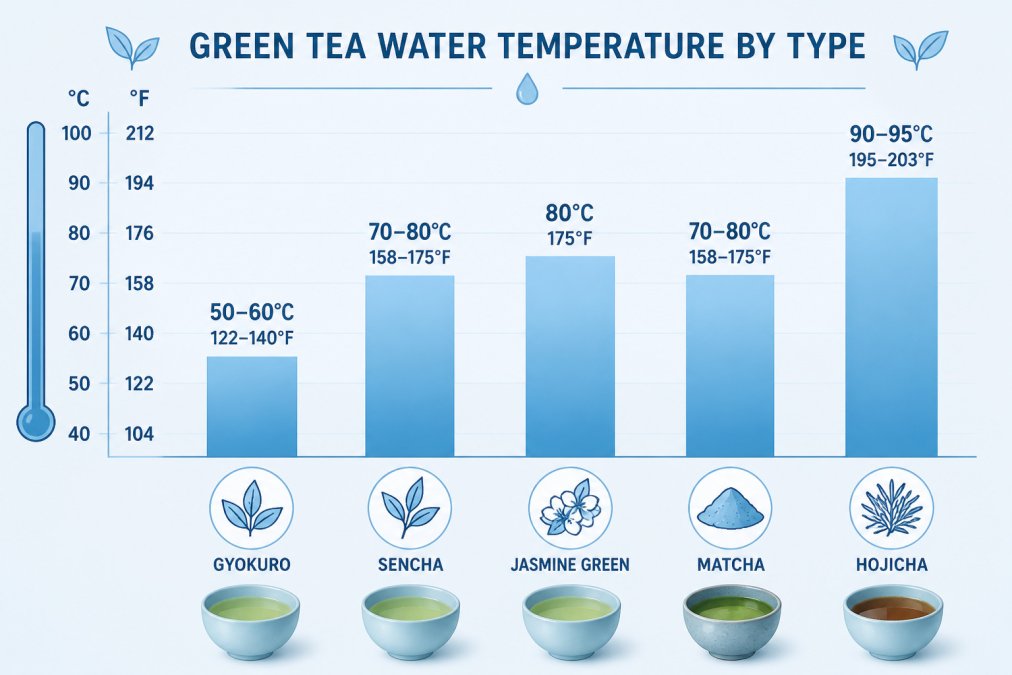
Not all green teas want the same water. Leaf structure, processing, and flavor profile all shape the ideal temperature. Use the ranges below as your starting point, then adjust to your taste. The single biggest variable is how much the leaf has been broken up and how much heat it has already seen during processing, whole, shade-grown leaves release their compounds slowly and punish hot water, while roasted or pan-fired leaves have sturdier cell walls and can take more heat.
Delicate Sencha and Gyokuro
Delicate Japanese greens respond best to cooler water. Sencha generally brews well around 160°F to 175°F. Gyokuro, which is shade-grown and prized for its sweetness, often does best at the low end of that range or cooler, many practitioners start gyokuro at 140°F to 160°F. Pushing these teas with boiling water tends to bring out bitterness fast because the shaded leaves are high in amino acids that turn harsh under aggressive heat. Use about 2 grams per 8 ounces and steep 1 to 2 minutes for gyokuro, 1 to 2 minutes for sencha at the cooler end.
Jasmine and Flavored Green Teas
Jasmine green tea is a little more forgiving. Our Jasmine blend, which pairs green tea with freshly harvested jasmine blossoms, brews at 175°F for 4 to 6 minutes using 2.5 grams per 12 ounces. The floral notes come through well at that temperature without tipping into harshness. Flavored blends generally sit in the mid-range because the base tea is chosen to hold up alongside the added botanicals.
Matcha Preparation Temperature
Matcha is different because you consume the whole powdered leaf rather than steeping and discarding it. Our Matcha is a ceremonial powder that brews best whisked at 175°F, using about 1 gram per 8-ounce cup. Water that is too hot can make the whisked result taste bitter, so let boiled water cool briefly before whisking. Because the powder stays in the cup, there is no steeping time to shorten, temperature is your only lever, which makes a thermometer or a short post-boil rest especially useful here.
Roasted Green Tea (Hojicha)
Roasted green tea is the outlier in the green tea family. The roasting process gives the leaves a toasty, nutty character and lowers the grassy, vegetal notes that turn bitter. Our Hojicha brews smoothly at 175°F using 2 to 3 grams per 8 ounces. If you find other greens too sharp, hojicha is a forgiving entry point.
A Quick Reference by Variety
- Gyokuro: 140°F to 160°F, 1 to 2 minutes
- Sencha: 160°F to 175°F, 1 to 2 minutes
- Jasmine and flavored greens: 175°F, 4 to 6 minutes
- Matcha: 175°F, whisked, no steep
- Hojicha (roasted): 175°F to 190°F, 2 to 3 minutes
Treat these as starting points. The leaf grade, how finely it is cut, and how fresh it is all shift the sweet spot by a few degrees, so taste the first cup of every new tin and adjust from there.
Here is a quick reference of the recommended temperature and steep time for each green tea type covered above.
| Tea type | Water temperature | Steep time |
|---|---|---|
| Gyokuro | 140°F to 160°F | 1 to 2 minutes |
| Sencha | 160°F to 175°F | 1 to 2 minutes |
| Jasmine and flavored greens | 175°F | 4 to 6 minutes |
| Matcha | 175°F, whisked | No steep |
| Hojicha (roasted) | 175°F to 190°F | 2 to 3 minutes |
How to Reach the Right Temperature Without a Variable Kettle
You do not need an expensive variable-temperature kettle to brew great green tea. Most home cooks can get close with a few simple habits, and the methods below are the same ones a small business can teach staff in an employee kitchen benefit program without buying new equipment.
Try these methods:
- Boil, then wait. Bring water to a full boil, then let it rest before pouring. As a rough guide, 1 minute off the boil lands near 190°F to 200°F, 2 to 3 minutes lands near 175°F to 185°F, and 4 to 5 minutes lands near 160°F to 170°F. The exact drop depends on your kettle, the room temperature, and how full it is, so time one batch with a thermometer and then trust the clock.
- Use a thermometer. A thermometer can help you check the water temperature.
- Pour into a mug first. Pouring water from one vessel to another cools it a bit and helps you dial in the temperature. A wider, shallower vessel cools faster than a tall, narrow one because more surface area is exposed.
- Use a cool-down step. Add a splash of cold water to hot water to bring the temperature down quickly. This is the fastest method but the least precise, since the amount of cold water needed depends on how much hot water you started with.
- Heat only what you need. A kettle full of water takes longer to cool than a small batch. Boiling just enough for your cup shortens the wait and makes the timing more predictable.
Once you know how your kettle behaves, you can usually guess the temperature by timing how long it rests after boiling. Keep a thermometer on hand for the first week, note the rest time that gives you the cup you like, and then repeat it.
How Long to Steep Green Tea at Each Temperature
Temperature and steeping time work together. Cooler water usually needs a longer steep to pull out enough flavor. Hotter water extracts faster, so it calls for a shorter steep to avoid bitterness.
As a rough guide:
- Cooler water (160°F to 170°F): 2 to 4 minutes
- Mid-range water (170°F to 180°F): 2 to 3 minutes
- Hotter water (180°F and up): 1 to 2 minutes
Our Moroccan Mint blend brews at 175°F for 3 to 4 minutes using 2.5 grams per 12 ounces. Taste as you go. If the cup is sharp, cut the steep time. If it tastes thin, steep a little longer.
How to Brew Green Tea Without Bitterness
Bitterness is the most common complaint about green tea, and it usually comes from water that is too hot or steeping that runs too long. A few simple fixes solve most problems.
- Lower the water temperature by 5 to 10 degrees
- Shorten your steep time by 30 seconds
- Use fresh water instead of water that has boiled repeatedly
- Clean your infuser, since old residue can taste bitter
Our Hojicha is a roasted green tea that brews smoothly at 175°F, using 2 to 3 grams per 8 ounces. Its toasty, nutty flavor is naturally less grassy, which makes it a good choice if you find other greens too sharp. For more on keeping your gear clean, see our guide to clean a tea infuser thoroughly.
Cold Brew Green Tea: A Lower-Temperature Option
Cold brewing skips heat entirely. Steep your leaves in cold water in the refrigerator for several hours, then strain. The result is naturally sweet and very smooth, with almost no bitterness. It is a great choice for warm days or for anyone sensitive to bitter flavors. Cold brew takes patience, but it asks for no temperature control at all.
Start Brewing Your Next Cup With Brewtiful Loose Leaf Green Tea
Now that you know the right temperatures, the next step is choosing good leaves. Our teas include Matcha, Jasmine, Moroccan Mint, and Hojicha. If you are still deciding what to buy, our guide to choosing premium loose leaf tea blends walks through the options.


Frequently Asked Questions
What is the best water temperature for green tea?
Brewtiful's Jasmine and Moroccan Mint call for 175F. The Matcha listing specifies whisking at 175F.
Why does green tea taste bitter?
Brewtiful's Jasmine is listed at 2.5 grams per 12 ounces.
Can you brew green tea with boiling water?
You can, but boiling water is usually too hot for green tea. At 212F, the leaves release bitter compounds quickly, and delicate flavors get lost. Letting boiling water sit for a few minutes before pouring, or mixing it with a splash of cold water, brings the temperature closer to the 158F to 180F range that suits most green teas. A simple thermometer makes this easy to check.
How long should green tea steep?
Brewtiful's Jasmine is listed at 4 to 6 minutes at 175F with 2.5 grams per 12 ounces, while Moroccan Mint is listed at 3 to 4 minutes. The Matcha listing specifies whisking rather than steeping.
