

Café-Quality Coffee at Home for Remote Professionals
Table of Contents
- Why Café-Quality Coffee at Home Matters for Remote Professionals
- Choosing the Right Coffee Beans and Freshness for Your Daily Ritual
- Coffee Brewing Methods That Deliver Results
- Coffee-to-Water Ratio and Grind Size for Brewing Methods
- How to Store Coffee Beans for Maximum Freshness
- Essential Equipment and Budget-Friendly Setup Options
- Building Your Repeatable Coffee Workflow for Busy Workdays
- Troubleshooting Common Brewing Problems by Taste
- Frequently Asked Questions
Last Updated: October 10, 2026
Why Café-Quality Coffee at Home Matters for Remote Professionals
When your office is your kitchen, café-quality coffee at home shifts from convenience to productivity tool.
A reliable coffee ritual sets the tone for focused work.
You don't need to be a coffee expert. You need fresh beans, a simple method, and understanding of a few key variables.
Choosing the Right Coffee Beans and Freshness for Your Daily Ritual
The foundation of café-quality coffee at home starts with one decision: fresh beans matter more than anything else you'll do.
Stale coffee tastes flat, bitter, or thin. Fresh beans taste bright, complex, and alive. Upgrading to fresh beans improves your coffee more than buying expensive equipment.
Understanding Roast Dates and Freshness
The roast date is the single most important number on a coffee bag.
Brewtiful Coffee US provides beans with clear roast dates, ensuring freshness whether you choose their Medium Blend or single-origin options from Peru or Kenya.

Check the roast date before you buy. If a bag doesn't have one, skip it.
Matching Beans to Your Flavor Preferences
Lighter roasts taste brighter with fruit and floral notes. Darker roasts taste deeper with chocolate and caramel notes. Medium roasts split the difference.
Bright, complex flavors work best black with lighter roasts. Smooth, balanced coffee with milk pairs well with medium roasts like Brewtiful's Medium Blend.
Coffee Brewing Methods That Deliver Results
Your brewing method is the second most important variable after bean freshness. Different methods extract coffee differently, producing noticeably different flavors from the same beans.
Filter and Pour-Over Brewing
Filter brewing (drip, pour-over, or AeroPress) is the most forgiving and consistent method for remote professionals needing reliable daily results.
Pour-over methods give you more control than automatic drip.
This method works exceptionally well with Brewtiful's lighter and medium roasts. The brightness and complexity of their single-origin beans shine through filter brewing.
French Press and Espresso Options
French press steeps grounds directly in hot water, then presses them down, producing a fuller-bodied, richer cup with more texture.
French press works beautifully with darker roasts.
Espresso requires more equipment and precision, but delivers intense, concentrated coffee for milk-based drinks. Fresh beans roasted for espresso outperform stale beans in any machine.
Coffee-to-Water Ratio and Grind Size for Brewing Methods
The standard ratio is one part coffee to sixteen parts water by weight. If coffee tastes weak, use more coffee or grind finer. If bitter, use less coffee or grind coarser.
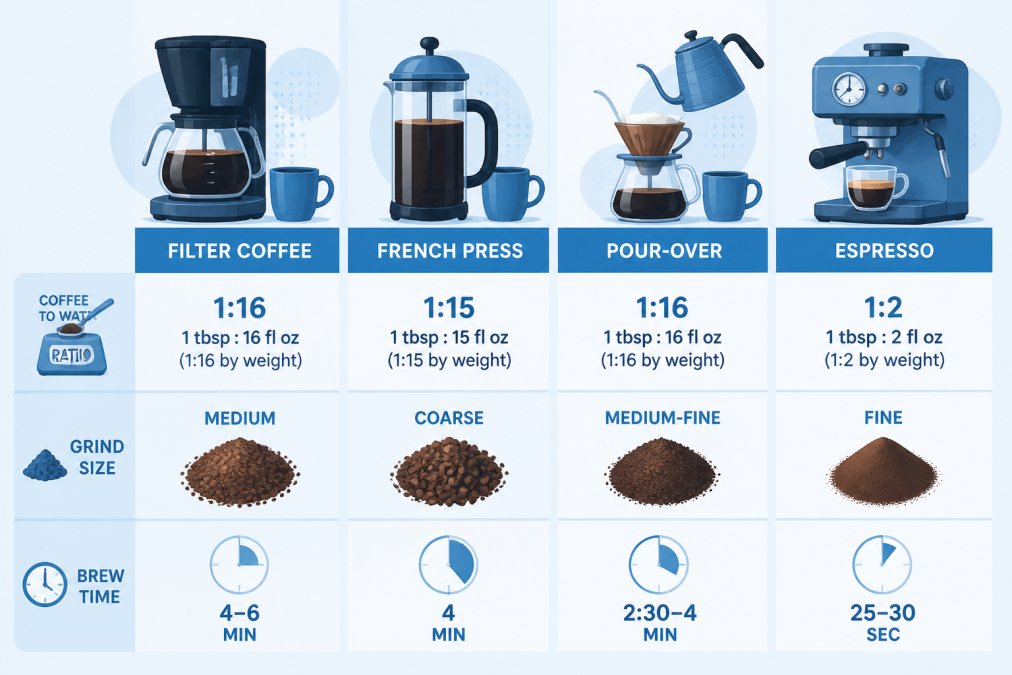
Dialing In Your Coffee Grind Size for Brewing Methods
Grind size determines extraction speed. Finer grinds expose more surface area for faster extraction; coarser grinds extract slower.
Match your grind to your brewing method:
| Brewing Method | Grind Size | Coffee-to-Water Ratio | Brew Time |
|---|---|---|---|
| French Press | Coarse | 1:16 | 4 minutes |
| Pour-Over | Medium | 1:16 | 2-3 minutes |
| Drip Machine | Medium | 1:15 | 5-10 minutes |
| Espresso | Fine | 1:2 | 25-30 seconds |
| AeroPress | Medium-Fine | 1:16 | 1-2 minutes |
Invest in a burr grinder, not a blade grinder. Burr grinders produce consistent particle size for consistent extraction and flavor, the second most important equipment purchase after fresh beans.
How to Store Coffee Beans for Maximum Freshness
Store beans in an airtight container away from sunlight and heat at room temperature. Avoid air, light, heat, and moisture.
Whole beans stay fresh 2-3 weeks after roasting if stored properly. Ground coffee loses freshness much faster, so grind only what you'll use in the next few days.
Essential Equipment and Budget-Friendly Setup Options
The right setup depends on your kitchen space, available time, and tolerance for cleanup.
Minimal Setup: $50-$100
What you need: A burr grinder, pour-over cone, paper filters, and fresh beans.
Why it works: Excellent coffee with minimal counter space. Cleanup is instant.
The trade-off: Hand-pouring requires attention and a gentle learning curve (one week).
Best for: Remote professionals with limited space or those who enjoy the ritual.
Mid-Range Setup: $150-$250
What you need: A burr grinder, gooseneck kettle, scale, and brewing vessel (pour-over, AeroPress, or automatic drip).
Why it works: A scale removes guesswork; a gooseneck kettle gives precise control. Automatic machines offer convenience: load the night before, press a button in the morning.
The trade-off: More equipment and counter space. Automatic machines need descaling every 3-6 months.
Best for: Remote professionals who value consistency and reliability.
Premium Setup: $400+
What you need: Mid-range setup plus an espresso machine.
Why it works: Unlocks milk-based drinks (lattes, cappuccinos, flat whites) with concentrated shots fundamentally different from filter coffee.
The trade-off: Most demanding equipment with steep learning curve (2-4 weeks). Requires precise grind, dosing, tamping, and temperature control.
Best for: Remote professionals who already love espresso and want to stop paying café prices.
The Grinder: Non-Negotiable
Invest in a burr grinder for uniform particle size and consistent extraction. Blade grinders chop unevenly and guarantee inconsistent results. Hand grinders work for one or two cups; electric burr grinders save time for daily grinding.
Counter Space and Kitchen Reality
Small kitchens benefit from the minimal setup: a pour-over cone and grinder produce café-quality results with minimal space. Dedicated counter space makes the mid-range setup worthwhile for consistency.
For corporate clients, small businesses building an employee kitchen benefit, or pantry selections, the mid-range setup (automatic drip machine plus fresh beans from Brewtiful Coffee US) offers the best balance of quality, ease, and minimal training.

The Real Hierarchy
Fresh beans matter more than equipment. Start with fresh beans and the minimal setup. Upgrade equipment only if you want more control or convenience. Equipment cannot fix stale beans.
Building Your Repeatable Coffee Workflow for Busy Workdays
Build a simple workflow you execute perfectly every morning:
- Grind fresh beans the night before (or morning). Use your scale to measure.
- Set up your brewing method while water heats (30 seconds).
- Brew while checking email (3-5 minutes).
- Pour and enjoy before your first meeting.
The entire process takes 5-10 minutes. Consistency matters: same beans, ratio, and method every day. After one week, you'll execute automatically.
For corporate clients and employee kitchen benefits, Brewtiful Coffee US offers wholesale options to stock break rooms with café-quality coffee. For small businesses, holiday gift ideas, or pantry selections, their variety of single-origin and specialty blends accommodates different preferences.
Troubleshooting Common Brewing Problems by Taste
Coffee tastes wrong for three reasons: old beans, inconsistent measurement, or incorrect water temperature.
Taste-to-Cause Mapping
Sour or under-extracted: Grind is too coarse, brew time too short, or water too cool.
Weak or thin: Using too little coffee. Measure beans by weight, not volume.
Flat or stale: Beans are old. Check the roast date.
Inconsistent cup-to-cup: Use a scale to measure beans and water by weight, not eyeballing.
Water Temperature and Quality
Water temperature should be 195-205°F. Above 210°F causes over-extraction and bitterness; below 190°F causes under-extraction and sourness. Let boiling water sit 30 seconds before pouring.
Water quality matters if heavily chlorinated or mineral-heavy. Tap water usually works fine. A pitcher filter solves off-flavors or mineral buildup.
Accessibility and Low-Effort Brewing
Certain brewing methods suit different physical abilities:
Easiest: Automatic drip machines. Load the night before, press a button in the morning. No technique required.
Moderate effort: AeroPress or pour-over. Both require pouring but are forgiving.
Higher effort: French press (requires pressing force) and espresso machines (demand precise hand movements).
If hand strength or dexterity is limited, start with an automatic drip machine and fresh beans for café-quality coffee without technique.
Caffeine Timing and Hydration for Remote Work
Caffeine peaks in your bloodstream 30-60 minutes after you drink coffee and remains elevated for 4-6 hours.
Caffeine is a diuretic, meaning it increases urination and can contribute to dehydration if you're not drinking water alongside it.
Don't assume coffee is a guaranteed productivity tool.
The Biggest Mistake
Assuming you're a bad brewer when the problem is actually old beans. Fresh beans make everything easier. Even mediocre technique with fresh beans produces better coffee than perfect technique with stale beans.
For small businesses or corporate clients sourcing coffee for an employee kitchen benefit or pantry selection, the troubleshooting principle is the same: fresh beans eliminate most problems.
Frequently Asked Questions
What are the essentials for making café-quality coffee at home?
Start with fresh, whole beans with a recent roast date, a burr grinder for consistent grind size, and a brewing method that suits your routine (pour-over, French press, or espresso). Use filtered water heated to 195-205°F, maintain a 1:16 coffee-to-water ratio, and brew within 15-30 minutes of grinding. Quality beans from single-origin sources like Peru, Kenya, or Sumatra deliver the flavor depth you'd find in a café, and proper storage in an airtight container preserves freshness for weeks.
How should you grind coffee beans for different brewing methods?
Grind size directly affects extraction and taste. Use coarse grounds (like sea salt) for French press to prevent over-extraction and bitterness. Medium grounds work best for drip and pour-over brewing, delivering balanced extraction in 3-4 minutes. Espresso requires fine, consistent grounds for proper pressure and crema formation. A burr grinder gives you precise control; blade grinders produce uneven particles and inconsistent results. Grind just before brewing to capture maximum aroma and flavor.
Why does my homemade coffee taste bitter or weak compared to café coffee?
Bitterness usually signals over-extraction: water that's too hot, grounds left in contact too long, or too-fine a grind. Weak coffee points to under-extraction: water too cool, grounds too coarse, or too little contact time. Start with fresh beans (check the roast date), use the correct coffee-to-water ratio for your method, and dial in your grind size. Many home brewers also use stale beans or water that's too hot; fresh beans and proper temperature control eliminate most bitter flavors instantly.
How can remote workers make a better coffee routine at home?
Establish a repeatable morning workflow: grind beans fresh while water heats, brew while checking emails, and enjoy your cup during your first work block. This 10-15 minute ritual replaces coffee-shop trips and costs far less per cup. Invest in a quality grinder and brewing method that fits your schedule; pour-over or instant coffee work well for busy mornings, while French press suits slower starts. Pair your coffee with a dedicated mug and quiet moment to boost focus and productivity throughout your workday.
How long do coffee beans stay fresh, and what's the best way to store them?
Whole beans peak in flavor 5-14 days after roasting and remain fresh for 3-4 weeks if stored correctly. Keep beans in an airtight container away from light, heat, and moisture; a dark cupboard or sealed jar works perfectly. Avoid the refrigerator or freezer, which introduce moisture and odor absorption. Buy smaller quantities more often rather than bulk supplies that sit unused; check the roast date on the bag to ensure you're getting truly fresh coffee. Properly stored beans deliver the smooth, rich aroma and balanced flavor that define a café-quality experience.
What coffee-to-water ratio should I use for different brewing methods?
The standard ratio is 1 part coffee to 16 parts water by weight, which works for most methods. For French press, use a 1:15 ratio with coarser grounds and a 4-minute steep. Pour-over and drip coffee also use 1:16 with a 3-4 minute brew. Espresso uses a much smaller ratio (roughly 1:2) due to high pressure and fast extraction. Start with 1:16, taste your result, and adjust: add more coffee for stronger flavor, or more water for lighter brews. A kitchen scale removes guesswork and ensures consistency across every cup.
Is specialty coffee from Brewtiful Coffee really worth the cost compared to grocery store brands?
Fresh-roasted specialty beans deliver noticeably smoother flavor with no bitterness, while grocery store coffee often tastes flat or harsh because it's been sitting on shelves for weeks or months. Single-origin beans like Peru or Kenya offer distinct flavor profiles, salted caramel, chocolate, citrus, that mass-market blends can't match. At roughly 20-25 cents per cup, specialty coffee costs less than a single café visit. The freshness guarantee, nationwide shipping, and flavor consistency make the investment worthwhile for remote professionals building a daily ritual.
What brewing method is easiest for beginners who want café-quality results?
Pour-over is the most forgiving entry point: it requires only a cone or flat-bottomed dripper, filters, fresh beans, and hot water. Brew time is 3-4 minutes, and the method is hard to mess up once you dial in your grind size and ratio. French press is equally simple but requires a longer steep (4 minutes) and careful pouring to avoid sediment. Instant coffee from Brewtiful Coffee offers the fastest option, just add hot water, while still delivering smooth, balanced flavor with no bitterness. Choose based on your schedule; all three methods produce café-quality results.