

Caffeine Content in Loose Leaf Tea: A Complete Guide
Last Updated: October 23, 2026
Quick Summary
Caffeine content in loose leaf tea varies significantly by tea type, ranging from 15 to 30 milligrams per 8-ounce cup for white tea up to 40 to 70 milligrams for black tea, with the amount also influenced by leaf quantity, water temperature, and steeping time.
- Black tea contains 40-70 mg of caffeine per 8 oz, while white tea contains 15-30 mg and green tea contains 25-50 mg.
- The first infusion extracts 70 to 80 percent of available caffeine; second infusions yield only 10 to 20 percent.
- Controlling leaf quantity gives you more precise caffeine management than adjusting steeping time alone.
- Herbal infusions like rooibos contain virtually no caffeine since they don't come from Camellia sinensis.
- Loose leaf tea delivers substantially less caffeine than coffee, which typically contains 95 to 200 milligrams per 8 oz cup.
Table of Contents
- How Much Caffeine Is in Loose Leaf Tea?
- Loose Leaf Tea vs Tea Bags: Caffeine Differences
- How to Measure Caffeine in Tea Accurately
- Does Steeping Time Affect Caffeine in Tea?
- Caffeine-Free Herbal Tea Options
- Loose Leaf Tea vs Coffee: Caffeine Reality
- Practical Tips for Controlling Caffeine in Your Cup
- Frequently Asked Questions
How Much Caffeine Is in Loose Leaf Tea?
Understanding caffeine content in loose leaf tea is essential for anyone looking to control their daily intake or choose the right blend for their routine.
Loose leaf tea offers a transparent brewing experience where you can see exactly what you're steeping.
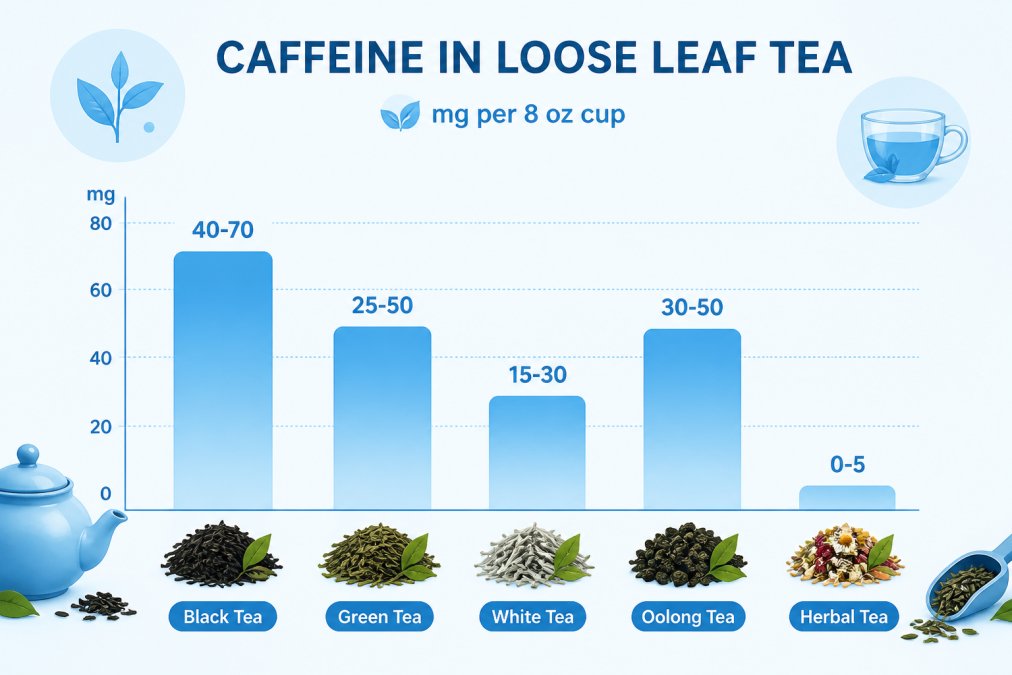
Caffeine Ranges by Tea Type
Different tea types contain dramatically different amounts of caffeine. Black tea, which undergoes full oxidation, typically delivers the highest caffeine content among true teas. Our Masala Chai blend, made from organic Assam black tea with warming spices, provides a strong caffeine boost alongside its complex flavor profile.

These ranges exist because caffeine is naturally present in the tea plant itself, specifically in the Camellia sinensis plant that produces all true teas. The processing method determines how much of that natural caffeine remains in the final leaf.
Black, Green, White, and Oolong Compared
Black tea leaves undergo complete oxidation, which doesn't destroy caffeine but does alter how it's released during brewing. Our Jasmine blend, which combines green tea with jasmine blossoms, delivers a softer caffeine experience than black tea, usually 25 to 50 milligrams per 8-ounce serving.

White tea undergoes minimal processing, which many assume means less caffeine. Herbal infusions like our Apple Cider Rooibos, technically not true tea since it doesn't come from Camellia sinensis, contain virtually no caffeine, making them ideal for evening enjoyment.

Caffeine content varies significantly across tea types, with black tea delivering the most and white tea the least.
| Tea Type | Caffeine per 8 oz | Processing Level |
|---|---|---|
| Black tea | 40-70 mg | Full oxidation |
| Oolong tea | 30-50 mg | Partial oxidation |
| Green tea | 25-50 mg | Minimal processing |
| White tea | 15-30 mg | Minimal processing |
| Herbal infusions | Virtually none | No Camellia sinensis |
Loose Leaf Tea vs Tea Bags: Caffeine Differences
Most comparisons of loose leaf and bagged tea are not actually comparisons. They change several variables at once, leaf mass, particle size, water volume, and steep time, then attribute the difference to "loose leaf vs. bag." A fair test holds everything constant except the one variable you want to isolate. Here is a repeatable framework.
The Controlled Comparison
To compare fairly, fix these four variables:
- Leaf mass. Weigh both samples to the same gram amount. A standard tea bag often holds about 2 grams; a typical loose-leaf serving is 2.5 to 3 grams. If you do not equalize mass, you are measuring serving size, not leaf form.
- Water volume and temperature. Use the same 8 ounces at the same temperature for both.
- Steep time. Use the same clock for both, and note the time at first taste.
- Leaf particle size. This is the variable you are actually testing. Keep everything else identical.
When you run this test, a consistent pattern emerges: at equal leaf mass and equal steep time, the finer-particle sample (bagged fannings or dust) releases a larger share of its caffeine earlier in the steep. Learn more about the advantages of loose leaf tea vs tea bags when selecting tea for your needs. The whole-leaf sample catches up with more time, but its curve is flatter.
What This Means for Your Cup
The practical implication is not that one form is "stronger." It is that particle size changes the extraction curve, and the extraction curve is what you control. With bagged tea, the steep time printed on the box is doing most of the work for you.
A second, often-overlooked variable is leaf consistency. Premium loose leaf tends to be sorted for uniform leaf size, so a given scoop brews predictably from batch to batch. Lower-cost bags can blend particle sizes, which makes the cup less repeatable.
A Caveat on "Decaffeinated"
Decaffeination reduces but does not always eliminate caffeine. A cup of decaffeinated true tea commonly retains a small residual amount, so anyone strictly avoiding caffeine should confirm the process and residual level with the supplier rather than assuming zero.
For small business, employee kitchen benefits, or corporate pantry selections, this framework matters: a pantry stocked with consistent, well-sorted loose leaf lets a whole team brew predictably, and wholesale options make it practical to keep several styles on hand for holiday gift selections and everyday office use.
How to Measure Caffeine in Tea Accurately
Measuring caffeine in tea accurately requires understanding several variables that influence extraction. The most practical approach is to control the factors you can manage: leaf quantity, water temperature, and steeping time.
Tea-to-Water Ratio and Serving Size
The amount of tea leaves you use directly determines potential caffeine content. A standard brewing ratio uses approximately 2.5 grams of loose leaf tea per 12 ounces of water.
If you prefer a stronger cup with more caffeine, increase the leaf quantity rather than extending steeping time, this gives you more control over the final result. If you're sensitive to caffeine, reduce the leaf quantity. A half-teaspoon of loose leaf tea weighs roughly 1 to 1.5 grams, making it easy to measure adjustments.
Leaf Quantity and Brew Strength
Doubling your leaf quantity doesn't quite double your caffeine, but it does increase it significantly. The relationship is roughly proportional but not perfectly linear because caffeine extraction has limits, eventually, additional leaves don't extract proportionally more caffeine into the same amount of water.
This is where loose leaf tea shines compared to tea bags. You can precisely adjust leaf quantity in small increments. Start with the recommended amount, then adjust by a quarter-teaspoon at a time until you find your preference. This method is far more precise than trying to control caffeine by adjusting steeping time alone.
Does Steeping Time Affect Caffeine in Tea?
Steeping time absolutely affects how much caffeine ends up in your cup. Caffeine is one of the first compounds to extract from tea leaves, which means significant caffeine release happens in the first minute of steeping. However, the relationship between time and caffeine isn't linear, most caffeine extracts quickly, then extraction slows considerably.
First Steep vs Multiple Infusions
A common question among loose leaf tea enthusiasts involves resteeping the same leaves. The first infusion extracts the majority of available caffeine, typically 70 to 80 percent of the total. A second infusion of the same leaves yields noticeably less caffeine, usually 10 to 20 percent of what the first steep contained.
This matters if you're managing caffeine intake. If you resteep leaves for a second or third cup, you're getting progressively less caffeine with each infusion. Many tea drinkers appreciate this natural progression, especially when enjoying loose leaf tea in the afternoon or evening.
Water Temperature and Extraction
Water temperature dramatically influences how quickly caffeine extracts. Hotter water accelerates extraction, while cooler water slows it down. Black tea typically brews at 195 to 212 degrees Fahrenheit, extracting caffeine quickly and completely. Green tea brews at a lower temperature, around 160 to 180 degrees, which slows caffeine extraction slightly.
If you're sensitive to caffeine, brewing at lower temperatures within the recommended range gives you slightly less caffeine while maintaining flavor. The difference isn't dramatic, but it's measurable.
Caffeine-Free Herbal Tea Options
Herbal infusions offer a way to enjoy the ritual of loose leaf tea without caffeine concerns. True herbal teas don't come from Camellia sinensis, so they contain no natural caffeine.
Other caffeine-free options include chamomile, peppermint, rooibos blends, and herbal infusions made from flowers, roots, and spices. These work beautifully for evening enjoyment or for anyone managing caffeine sensitivity. The flavor profiles can be just as complex and satisfying as caffeinated teas, simply without the stimulant effect.
Loose Leaf Tea vs Coffee: Caffeine Reality
The comparison between tea and coffee often comes down to caffeine content. A typical 8-ounce cup of brewed coffee contains 95 to 200 milligrams of caffeine, depending on brewing method and coffee type.
This difference makes loose leaf tea an excellent choice for people seeking a gentler caffeine lift or those who want to reduce overall caffeine intake without eliminating it entirely.
Practical Tips for Controlling Caffeine in Your Cup
Managing caffeine in loose leaf tea comes down to intentional choices across several variables. Start by selecting your tea type based on your caffeine preference.
Next, measure your leaf quantity precisely. Use a kitchen scale if possible, or count teaspoons consistently.
Steeping time matters less than most people think, but it still influences the result. Stick to the recommended steeping time for your tea type.
Water temperature should match your tea type's recommendation. Don't use boiling water for delicate teas like white or green tea; use cooler water as specified on the package.
For small business, employee kitchen benefits, or corporate pantry selections, loose leaf tea offers a versatile option that accommodates diverse caffeine preferences across your team. Brewtiful Coffee US offers wholesale options that make it practical to stock premium loose leaf tea for office environments or holiday gift selections.
Frequently Asked Questions
How much caffeine is in a cup of loose leaf tea?
Caffeine content varies significantly by tea type. Black tea typically contains 40-70 mg per 8-ounce cup, while green tea ranges from 25-50 mg. White tea is lower at 15-30 mg, and oolong falls between green and black at 30-50 mg. Herbal infusions like rooibos contain zero caffeine. The exact amount depends on leaf variety, steeping time, water temperature, and how much tea you use.
Does loose leaf tea have more caffeine than tea bags?
Loose leaf tea and tea bags contain similar caffeine levels when brewed with the same amount of dry leaf. The difference lies in quality and extraction: loose leaf tea often uses whole leaves that release caffeine more evenly, while tea bags may contain broken pieces and dust that can over-extract. For consistent results, measure your loose leaf by weight rather than volume.
Does steeping tea longer increase its caffeine content?
Yes, longer steeping extracts more caffeine from the leaves. Most caffeine releases in the first 3-5 minutes, but continued steeping pulls additional caffeine and flavor compounds. For controlled caffeine intake, stick to shorter steeps (3-5 minutes) and use a timer.
What herbal teas are caffeine-free?
True herbal infusions contain no caffeine because they don't come from the Camellia sinensis plant. Rooibos, chamomile, peppermint, ginger, and hibiscus are all caffeine-free options. These work well for evening drinking or anyone sensitive to caffeine. Brewtiful Coffee offers Apple Cider Rooibos, a caffeine-free blend combining rooibos with cinnamon and orange peel for a naturally sweet, warming cup.
Understanding caffeine content in loose leaf tea empowers you to make choices that align with your daily routine and sensitivity. Whether you're seeking an afternoon energy boost, a morning ritual, or an evening wind-down, loose leaf tea offers the control and transparency to get exactly what you need from your cup. Brewtiful Coffee US provides premium loose leaf teas with clear brewing guidance so you can achieve consistent results every time you brew.
