

Coffee Beans and Grinder: The Complete Brewing Guide
Table of Contents
- Why Coffee Beans and Grinder Quality Matter
- Burr vs Blade Grinder: Which One Transforms Your Brew
- Grind Size Settings for Different Brewing Methods
- How to Store Fresh Roasted Coffee Beans Online Purchases
- Fresh Roasted Coffee Beans Online: What to Look For
- Common Grinding Mistakes That Ruin Flavor
- Dialing In Your Grind: From Bitter to Balanced
- Frequently Asked Questions
Last Updated: October 3, 2026
Why Coffee Beans and Grinder Quality Matter
Great coffee depends on two essential components: coffee beans and grinder quality working together. Most home brewers overlook this connection, spending money on fancy equipment while grabbing whatever beans are on sale.
Grinding fresh beans right before brewing unlocks aromatics and oils that stale pre-ground coffee cannot deliver. Grind size determines extraction speed, get it wrong and your brew tastes thin and sour or heavy and bitter.
Premium beans deserve a quality grinder. This guide walks you through what to look for in both.
Burr vs Blade Grinder: Which One Transforms Your Brew
The type of grinder you own determines whether you're getting consistent particles or a chaotic mix of dust and chunks. This is where most home brewers make their first critical mistake.
How Burr Grinders Achieve Consistency
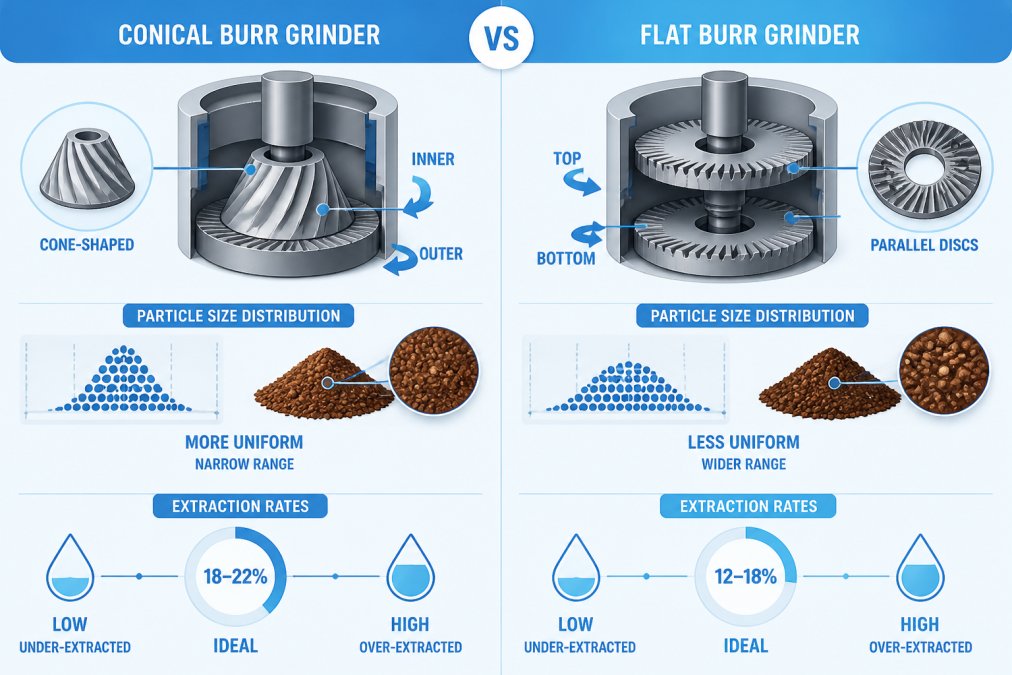
A burr grinder uses two abrasive surfaces, flat or conical burrs, that crush beans uniformly. The distance between burrs controls coarseness. Uniform particle size ensures even water contact and predictable extraction, delivering a balanced cup. The key advantage: burr grinders give you control to dial in grind size and achieve consistency batch after batch.
Why Blade Grinders Fall Short
Blade grinders use a spinning blade to chop beans, offering no control over particle size. You get powder-fine fines and chunky boulders in the same grind, destroying extraction balance. Blade grinders also generate heat that damages delicate oils and aromatics. Skip them entirely if you care about flavor.
Grind Size Settings for Different Brewing Methods
The brewing method you use determines the grind size you need. Get this wrong, and even excellent beans and a quality grinder won't save your cup.
Coarse Grinds for French Press
French press requires a coarse grind (sea salt size) for its 4-minute immersion. Coarse grounds extract slowly, delivering balanced flavor without bitterness. Fine grounds over-extract and create sediment.
Medium Grinds for Drip Coffee
Drip coffee requires a medium grind (sand-like) for quick extraction without bitterness. It's forgiving, if timing is slightly off, the cup usually still tastes decent. Start with the grind-size guide on your filter basket and adjust based on taste.
Fine Grinds for Espresso
Espresso requires a fine grind (nearly powder-like) for high-pressure extraction in 25-30 seconds. Fine particles pack tightly and resist water flow, creating concentrated shots. Too coarse and extraction suffers; too fine and the shot chokes. Dialing in takes practice.
How to Store Fresh Roasted Coffee Beans Online Purchases
Fresh roasted coffee beans online arrive at peak flavor, but that window is narrow. Understanding post-roast changes is the difference between a vibrant cup and a flat one.
The Degassing Window and CO2 Release
Beans degas for 5-14 days post-roast. Specialty roasters recommend waiting 5-7 days before brewing; brewing too soon results in a flat cup, while brewing after 30 days means oxidation has degraded brightness. When you order fresh roasted coffee beans online, shipping time works in your favor if it takes 3-5 days. Check the roast date on arrival and brew within the optimal 5-30 day window.
Airtight Containers and Oxygen Exclusion
After day 14, minimize oxygen exposure to prevent oxidation. Use an airtight container with minimal headspace, a canister with a one-way valve is ideal. Avoid clear containers; light accelerates oxidation. If using the original bag, ensure it has a resealable zipper and press out air before sealing.
Temperature, Humidity, and the Freezer Debate
Keep beans in a cool, dark, dry place at room temperature (65-75°F). Avoid freezing and refrigeration, condensation accelerates staling. A cool, dry kitchen cabinet or pantry is ideal.
Shelf Life and Freshness Degradation
Beans are best between 5 and 30 days post-roast. After 30 days, flavor noticeably declines. After 60 days, the cup is noticeably flat and dull. After 90 days, beans are stale by specialty standards, though still technically drinkable.
For small business pantry selections or employee kitchen benefits, buy in quantities that will be consumed within 3 to 4 weeks. Wholesale sourcing for corporate clients should prioritize roasters who offer frequent delivery schedules rather than bulk purchases that sit in storage. specialty coffee sourcing for workplace programs recommend rotating stock weekly for the best employee experience.
Once you open a bag, use the beans within 2 weeks for peak flavor. After opening, oxygen exposure accelerates, and the clock moves faster. Store opened bags in an airtight container to extend usability by a few days, but don't expect the same brightness you had on day one.
Fresh Roasted Coffee Beans Online: What to Look For
Not all coffee beans labeled "fresh roasted" are actually fresh. Not all online sellers prioritize quality the same way.
Roast Date and Freshness Indicators
The roast date matters more than the sell-by date. Coffee is best between 5 and 30 days after roasting. When you order fresh roasted coffee beans online, look for roast dates within the past week. Reputable roasters print the roast date prominently. If a seller hides it, that's a red flag.
Single-Origin vs Blended Options
Single-origin beans come from one farm, region, or country and let you explore regional flavor characteristics. Blends combine multiple origins for balance and consistency. For home brewers, start with single-origin to learn regional differences; choose blends for reliable, balanced flavor. Brewtiful Coffee US offers both, including whiskey barrel-aged varieties and beans from Uganda, Kenya, Sumatra, Peru, Mexico, and Bali.
Common Grinding Mistakes That Ruin Flavor
Even with a quality grinder and fresh beans, technique and understanding matter. These mistakes are common because their causes aren't obvious.
Grinding Too Far in Advance
Ground coffee oxidizes much faster than whole beans due to increased surface area. Grind immediately before brewing. For corporate offices or employee kitchen benefits, store grounds in an airtight container and use within 2-4 hours maximum. For small business pantry selections, consider a grinder with a timer or hopper cover to minimize air exposure. Brewtiful Coffee US offers a convenient wholesale program for small businesses, employee kitchen benefits, corporate clients, pantry selections, and holiday gift ideas. You can learn more about our wholesale options here: [WHOLESALE_LINK].
Using the Wrong Grind Size for Your Brewing Method
Each brewing method requires a specific grind range: French press (coarse), drip (medium), espresso (fine), pour-over (medium-fine), and Moka pot (medium-fine). Using the wrong grind size ruins extraction, coarse grounds in espresso produce thin, sour shots; fine grounds in French press create harsh, over-extracted cups with sediment. Know your brewing method before adjusting your grinder.
Grinding Inconsistently
Consistency is the foundation of repeatability. Burr grinders with numbered settings let you dial in and return to the same grind. Write down the number that produced your best cup as your baseline. Small adjustments account for variations in bean age or roast profile.
Fines Generation and Over-Extraction
Fines (ultra-fine particles) are unavoidable but manageable. Burr grinders produce fewer fines than blade grinders. In espresso, fines over-extract and add bitterness; some use WDT (Weiss Distribution Technique) to redistribute them. In drip or pour-over, fines settle at the bottom and add astringency. Minimize impact by using a burr grinder and being intentional about brew technique.
Retention and Static Electricity
Retention is the amount of ground coffee that clings to the interior walls of your grinder instead of falling into your cup or portafilter. Static electricity causes grounds to stick together and to the grinder's surfaces.
Some grinder designs minimize retention through smooth internal surfaces and optimized chute angles. Others are notorious for retention. A grinder that retains 0.5 grams per grind is acceptable.
Static is worse in dry climates and with certain bean types (especially light roasts, which have less oil). You can reduce static by:
- Grinding beans that are 1-2 weeks post-roast (slightly more oil than very fresh beans)
- Lightly misting beans with water before grinding (controversial; do this only if your grinder can handle moisture)
- Using a grinder with a static-reducing design (some models use conductive materials or special burr coatings)
For corporate clients or small business pantry selections, choose a grinder with low retention and a design that minimizes static. This ensures consistent doses and reduces waste, which matters when multiple people are using the same equipment.
Ignoring Burr Wear and Calibration Drift
Burrs wear over time. As they dull, they require finer settings to achieve the same grind size. This drift is slow, it takes months or years, but it's real.
If your grinder suddenly requires a much finer setting to achieve the same cup quality, your burrs may be wearing. Some grinders have replaceable burrs; others don't. When shopping for a grinder, check whether burrs can be replaced affordably.
For holiday gift ideas or corporate pantry selections, a grinder with replaceable burrs is a thoughtful choice because it signals longevity and care, the opposite of throwaway blade grinders that must be replaced entirely when they wear out.
Dialing In Your Grind: From Bitter to Balanced
"Dialing in" means adjusting your grind size until your brew tastes balanced. This is where patience and tasting notes matter.
If your cup tastes bitter or harsh, your grind is too fine. Water is over-extracting. Move your grinder setting coarser and brew again.
This process takes a few brews, especially with espresso. Each adjustment is small. Taste after each change.
Most home brewers never dial in properly. They assume their equipment is wrong when really their grind is off.
For corporate clients, employee kitchen benefits, or small business pantry selections, specialty coffee sourcing guides recommend focusing on freshness and grind consistency as the two highest-impact factors for workplace coffee quality.
Frequently Asked Questions
What's the difference between blade and burr grinders for coffee beans and grinder setup?
Burr grinders produce uniform particle sizes by crushing beans between two surfaces (conical or flat burrs), which improves extraction and flavor consistency. Blade grinders chop beans randomly, creating uneven particles that lead to over-extraction in some areas and under-extraction in others, resulting in bitter or sour coffee. For specialty coffee, burr grinders are the standard choice.
How should I store fresh roasted coffee beans to keep them fresh?
Store beans in an airtight container away from direct sunlight, heat, and moisture. Keep them at room temperature (around 60-70°F). Avoid the refrigerator or freezer unless storing for several months. Whole beans stay fresh for 2-4 weeks after the roast date; once ground, use within 15 minutes for best aroma and flavor. Check the roast date when ordering fresh roasted coffee beans online.
Does grinding your own coffee beans save money compared to pre-ground?
Yes, buying whole beans and grinding at home is more economical than buying pre-ground coffee or frequent cafe visits. Whole beans retain flavor longer, so you waste less. A quality burr grinder is a one-time investment that pays for itself within months if you drink coffee daily. Fresh roasted coffee beans online often cost less than specialty cafe prices while delivering superior flavor.
How does grind size affect the flavor of my coffee?
Grind size controls how quickly water extracts flavors from the beans. Too coarse, and extraction is incomplete, resulting in sour, weak coffee. Too fine, and over-extraction produces bitter, harsh flavors. The right grind size for your brewing method (coarse for French press, medium for drip, fine for espresso) ensures balanced extraction and smooth, rich flavor. Dialing in the correct grind is the fastest way to improve taste at home.
The right coffee beans and grinder combination transforms your morning ritual from a chore into something you actually look forward to. Fresh roasted coffee beans online from Brewtiful Coffee US arrive at your door within days of roasting, giving you the freshness advantage. Pair them with a quality burr grinder, dial in your grind size for your brewing method, and you'll taste the difference immediately. No fancy equipment needed, just fresh beans, consistency, and attention to the basics.