

Easy Loose Leaf Tea Brewing Guide
Table of Contents
- Why Loose Leaf Tea Tastes Better Than Bags
- Essential Brewing Equipment for Loose Leaf Tea
- Getting the Loose Leaf Tea to Water Ratio Right
- Water Temperature and Quality Matter
- How Long to Steep Loose Leaf Tea by Type
- Best Tea Infusers for Beginners
- Step-by-Step Brewing Process
- Troubleshooting Bitter or Weak Tea
- Frequently Asked Questions
Last Updated: August 31, 2026
Why Loose Leaf Tea Tastes Better Than Bags
Loose leaf tea delivers richer flavor than tea bags because whole leaves expand fully and release their essential oils into the water. Tea bag leaves are often broken into small pieces or fannings (processing dust) that extract too quickly, leading to over-extraction and bitterness before complex flavors develop. Whole leaves in an infuser move freely, allowing complete water circulation and even extraction.
At Brewtiful Coffee US, we focus on premium loose leaf teas because whole leaves deliver the full spectrum of flavor. A properly brewed cup fills the air with fragrance that tea bags cannot match.
Essential Brewing Equipment for Loose Leaf Tea
You need four essentials: a tea kettle, an infuser or strainer, a brewing vessel, and a way to measure your tea.
A reliable tea kettle heats water evenly and ideally allows temperature control. Some kettles have built-in thermometers; a simple kitchen thermometer works fine if yours doesn't. You're aiming for 175°F for green tea or 200-212°F for black tea (peer-reviewed research).
Your brewing vessel should be ceramic, glass, or porcelain, these materials don't absorb flavors or leach unwanted compounds. A 12-ounce cup is a good standard size for personal brewing.
An infuser holds leaves while allowing water to flow freely around them. Strainers work differently, you brew directly in your cup or pot and strain out leaves afterward. Infusers give leaves more room to expand, generally leading to better extraction.
A simple kitchen scale or measuring spoon helps you get the ratio right. Most loose leaf teas follow one teaspoon per 8 ounces of water, though this varies by tea type.
Getting the Loose Leaf Tea to Water Ratio Right
The standard starting point is one teaspoon of loose leaf tea per 8 ounces of water. This ratio balances flavor intensity with smoothness, too little leaf and your tea tastes weak; too much and you risk over-extraction and bitterness.
Different tea types call for slight variations. Green and white teas, which are delicate, sometimes use one teaspoon per 10 ounces because they can become astringent if over-extracted. Black teas and oolongs can handle the standard ratio or slightly more. Herbal infusions are forgiving and can lean toward one and a half teaspoons per 8 ounces because they contain fewer tannins.
Leaf size and density also matter. Larger, fluffier leaves take up more volume but contain less actual tea material, so you might need slightly more by volume. Tightly rolled leaves contain more material in less space.
Start with the standard ratio and adjust from there. If your tea tastes weak, add more leaf next time. If it tastes bitter, reduce the leaf amount or shorten steeping time. Keep notes on what works for you.
Tea Type |
Ratio (per 8 oz) |
Notes |
|---|---|---|
Green Tea |
1 teaspoon |
Can be delicate; watch steeping time |
Black Tea |
1 teaspoon |
More forgiving; can handle slightly more |
Oolong Tea |
1-1.5 teaspoons |
Depends on leaf size and density |
Herbal Infusion |
1-1.5 teaspoons |
Hard to over-extract; very forgiving |
White Tea |
0.75-1 teaspoon |
Subtle flavors; less is often more |
Water Temperature and Quality Matter
Water temperature has an enormous impact on flavor. Different teas extract best at different temperatures, and using the wrong temperature can either under-extract or over-extract.
Hotter water extracts compounds faster. Delicate teas like green and white tea contain volatile aromatic compounds that can be destroyed by boiling water. Brewing green tea at 175°F allows delicate floral and vegetal notes to shine. Boiling green tea often results in a grassy, astringent cup.
Black teas and oolongs are more robust. Their oxidized leaves resist heat damage and benefit from water closer to boiling, typically 195-212°F. Herbal infusions almost always do well with boiling or near-boiling water.
Water quality is equally important. Tap water that's heavily chlorinated or mineral-heavy can mask tea flavors. Filtered water is ideal. If your tap water tastes off, your tea will too.
If you don't have a thermometer, observe the water: small, slow bubbles indicate 160-170°F; steady rising bubbles indicate 175-180°F; large bubbles forming rapidly indicate 195-200°F; rolling boil indicates 212°F.
How Long to Steep Loose Leaf Tea by Type
Steeping time depends on the tea type, water temperature, and your personal taste. Steeping too briefly leaves tea weak; steeping too long pulls out excessive tannins and creates bitterness.
Green tea typically steeps for 2-4 minutes at 160-180°F (peer-reviewed research). Start at 2-3 minutes and taste as you go. Black tea steeps for 4-5 minutes at 195-212°F (peer-reviewed research). Black tea's oxidized leaves can handle longer steeping without becoming astringent.
Oolong tea varies depending on oxidation level. Lightly oxidized oolongs steep for 3-5 minutes at 175-195°F; heavily oxidized oolongs steep for 4-6 minutes at 195-212°F. Herbal infusions are most forgiving, steeping for 5-7 minutes or longer at 200-212°F. White tea is most delicate, steeping for 4-5 minutes at 160-175°F.
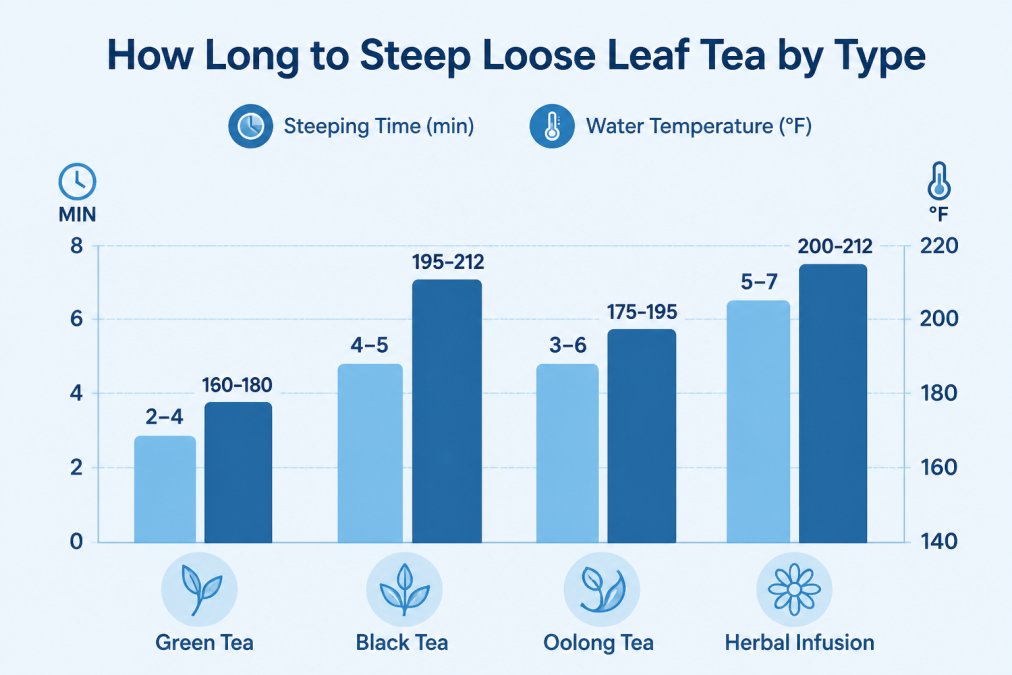
Bar chart comparing steeping times and water temperatures: Green Tea 2-4 min at 160-180°F, Black Tea 4-5 min at 195-212°F, Oolong Tea 3-6 min at 175-195°F, Herbal Infusion 5-7 min at 200-212°F
Many loose leaf teas can be re-steeped 2-4 times. Subsequent infusions often require just 30-60 seconds because leaves have already begun releasing compounds. This is a major advantage of loose leaf tea over bags.
Best Tea Infusers for Beginners
A mesh infuser basket is the most popular choice for beginners. This small metal basket holds loose leaves and sits inside your cup or pot. Fine mesh allows water to flow freely while catching leaf particles. Mesh baskets are affordable, durable, and easy to clean.
A ball infuser is a spherical metal container that opens like a locket and hangs from a chain into your cup. Ball infusers work well for smaller cups and are portable, but leaves have limited room to expand inside, which can slightly compromise extraction.
A tea strainer is a simple metal or nylon cone that sits on top of your cup. You brew directly in the cup and place the strainer over it to catch leaves as you pour. Strainers are cheap but require more hands-on attention.
A teapot with a built-in infuser basket is ideal for brewing multiple cups. The infuser basket sits inside the pot, and you pour hot water directly over leaves. These pots are often beautiful enough to serve at the table but cost more and require storage space.
For beginners, a simple mesh basket infuser offers the best balance. It's affordable (usually $5-15), works with any cup, and gives leaves plenty of room to expand.
Step-by-Step Brewing Process
Step 1: Heat your water to the target temperature. Use your kettle to heat water to the appropriate temperature for your tea type. If you have a thermometer, check before brewing. If not, use visual cues: steam rising for 160-180°F; more vigorous steam for 195-212°F.
Step 2: Measure your loose leaf tea. Use one teaspoon per 8 ounces of water as your starting point. Scale up for larger pots accordingly.
Step 3: Place the tea leaves in your infuser. Don't pack them tightly; leaves need room to expand and move as they steep.
Step 4: Pour the hot water over the leaves. Pour slowly and steadily, making sure all leaves get wet. Fill your cup about three-quarters full to give leaves room to expand.
Step 5: Steep for the recommended time. Set a timer so you don't forget. This is when extraction happens.
Step 6: Remove the infuser and pour. When the timer goes off, remove the infuser. This stops the steeping process immediately.
Step 7: Enjoy and consider re-steeping. Drink your tea while hot. To re-steep, return the infuser to your cup, add fresh hot water, and steep for 30-60 seconds.
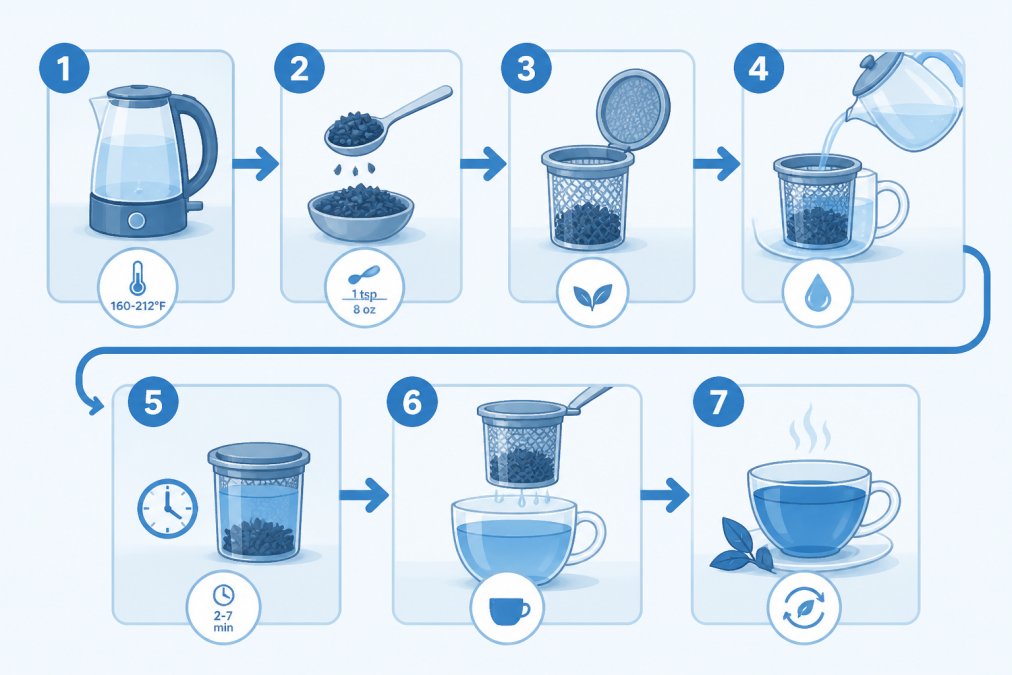
Flowchart showing 7-step brewing process: 1) Heat water to target temperature (160-212°F), 2) Measure 1 teaspoon tea per 8 oz, 3) Place leaves in infuser, 4) Pour hot water over leaves, 5) Steep for recommended time (2-7 minutes), 6) Remove infuser and pour, 7) Enjoy and consider re-steeping
The entire process takes about 10-15 minutes. Most of that time is waiting for water to heat and tea to steep.
Troubleshooting Bitter or Weak Tea
If your loose leaf tea isn't tasting right, the fix usually comes down to temperature, steeping time, or leaf quantity.
Bitter or harsh tea almost always means over-extraction. Try reducing steeping time by 30-60 seconds on your next brew. If it still tastes bitter, lower water temperature by 10-15°F. If you're brewing green tea with boiling water, drop to 175°F and you'll notice immediate improvement.
Weak or flavorless tea usually means under-extraction. Add more leaf (increase from one teaspoon to 1.25 teaspoons), extend steeping time by 30-60 seconds, or increase water temperature slightly. Start with steeping time first, that's the easiest adjustment.
Flat or dull flavor sometimes points to water quality. If your tap water is heavily chlorinated or mineral-heavy, try filtered water. This single change solves the problem for many people.
If your tea tastes stale or has no aroma, the issue is likely tea freshness or storage. Loose leaf tea loses flavor over time, especially if exposed to light, air, or heat. Store tea in an airtight container away from light and strong-smelling foods. Brewtiful Coffee US ships fresh-packed teas to ensure you're starting with vibrant leaves.
Keep simple notes on what works. Write down the tea type, water temperature, steeping time, and your impression. After a few brews, you'll develop intuition for adjusting variables to match your preferences.
Brewing loose leaf tea becomes intuitive once you've done it a few times. The fundamentals are simple: the right water temperature, appropriate steeping time, and fresh leaves make all the difference. At Brewtiful Coffee US, we source premium loose leaf teas like our Jasmine blend and English Breakfast that reward careful brewing with exceptional flavor. Start with quality leaves, follow the guidelines in this guide, and adjust based on your taste. You'll quickly discover why loose leaf tea brewing has become the preference for anyone serious about their daily cup.


Frequently Asked Questions
What is the ratio of loose leaf tea to water?
The standard ratio is 1 teaspoon of loose leaf tea per 8 ounces of water. For stronger tea, use 1.5 teaspoons; for lighter tea, use three-quarters teaspoon. This ratio works well for most tea types, though delicate green teas may need slightly less, while robust black teas can handle a bit more. Adjust based on your taste preference and the specific tea grade you're brewing.
Can I brew loose leaf tea without an infuser?
Yes. You can use a fine mesh strainer, a French press, or even a small cup with a saucer placed over the top to contain the leaves while steeping. Pour the water directly over the leaves in your cup, steep for the recommended time, then carefully pour into another cup through a strainer to catch the leaves. A tea kettle with a built-in infuser basket also works well for beginners.
How does water temperature affect loose leaf tea flavor?
Water temperature directly controls extraction speed and flavor intensity. Boiling water (212°F) extracts quickly and suits robust black teas, but can scald delicate green teas, making them bitter. Green teas brew best at 160-180°F, while oolong prefers 195-205°F. Cooler water extracts more slowly, creating smoother, sweeter profiles. Using filtered water at the correct temperature prevents off-flavors and bitterness from minerals or chlorine.
How many times can you re-steep loose leaf tea leaves?
Most high-quality loose leaf teas can be re-steeped 2-4 times, depending on leaf grade and type. Premium whole leaves expand with each infusion and release new flavor layers. Add 30 seconds to the steeping time with each re-steep. Re-steeping works best with oolong and high-grade black teas; lower-grade teas may only yield one good cup. Stop re-steeping when the brew becomes weak or flavorless.