

Espresso Machine Maintenance Tips for Home Users 2026
Table of Contents
- Espresso Machine Maintenance Tips: Daily and Weekly Routines
- How to Descale an Espresso Machine Without Damaging It
- Espresso Machine Backflushing Frequency: How Often Is Enough?
- Espresso Machine Cleaning Supplies: What You Actually Need
- Thermoblock vs. Boiler Machines: Maintenance Differences That Matter
- Eco-Friendly Cleaning Alternatives and Long-Term Storage Care
- Frequently Asked Questions
Last Updated: September 16, 2026
Espresso Machine Maintenance Tips: Daily and Weekly Routines
Espresso machine maintenance is the practice of cleaning, purging, and descaling your machine on a set schedule to protect extraction quality and prevent scale buildup. Consistent daily habits keep a home machine pulling cafe-quality shots for years. A Specialty Coffee Association resource library notes that water quality and routine cleaning are the two biggest factors in cup consistency. Below, we'll show you exactly how to build a routine that takes minutes a day and pays off in every shot.
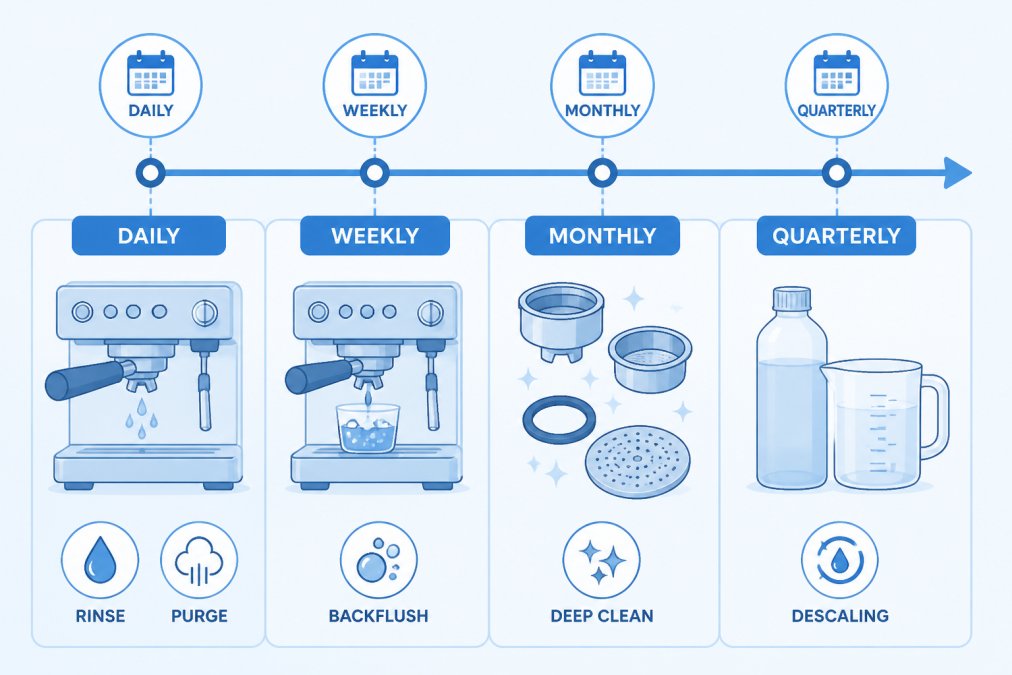
Daily: Rinse, Purge, and Wipe
Daily care takes about two minutes. Rinse the portafilter and filter baskets under hot water after your last shot, then purge the group head for a few seconds to flush out coffee oils and loose grounds. Wipe the steam wand immediately after steaming, and purge it before and after use so milk residue never dries inside the tip.
Weekly: Backflush and Deep Clean the Group Head
Backflushing is the weekly reset your machine needs. Insert a blind basket into the portafilter, add espresso machine detergent, and run several five-second cycles, then rinse with plain water cycles until the water runs clear.
- Remove and scrub the shower screen
- Soak the portafilter and baskets in warm detergent solution
- Brush the group head gasket and wipe the brew group
- Rinse the drip tray and water reservoir with fresh water
How to Descale an Espresso Machine Without Damaging It
Descaling removes the calcium carbonate and magnesium deposits that choke your boiler, narrow your flow path, and throw off brew temperature. Scale acts like insulation on the heating element and grit in the valve, so a scaled machine runs hot, slow, and inconsistent. Most practitioners find that descaling every two to three months keeps extraction steady, but hard water can push that to every four to six weeks.
The Descaling Procedure, Step by Step
- Empty and rinse the reservoir. Remove any inline water filter first, descaler destroys carbon and resin filter media, and a clogged filter will stop the solution from reaching the boiler.
- Mix the descaler to the ratio on the label. For citric acid, a common home ratio is roughly one to two tablespoons per quart of warm water. Commercial descalers usually specify their own dilution; follow it exactly rather than guessing.
- Run half the solution through the group head and half through the steam wand. Alternate between the two so both circuits get treated. On machines with a dedicated hot-water spout, run some through that as well.
- Let the solution sit. Most manufacturers recommend a soak of 10 to 20 minutes, not overnight. This dwell time is what dissolves the scale; the pump cycles alone won't do it.
- Cycle the remaining solution, then flush with a full reservoir of fresh water. Run at least two full reservoirs of clean water through the group head and steam wand, or until the water runs clear and tastes neutral.
- Reinstall a fresh water filter and pull a throwaway shot before drinking.
Choosing a Descaler: Citric Acid vs. Vinegar vs. Commercial Solutions
The right descaler depends on your machine type and how much scale you're fighting.
| Descaler | Best For | Watch Out For |
|---|---|---|
| Citric acid | Budget-conscious users, light to moderate scale | Can corrode some aluminum and brass parts if left too long; rinse thoroughly |
| Vinegar solution | Occasional light descaling | Strong odor, can degrade rubber seals and o-rings over repeated use |
| Commercial descaler | Boiler machines, heavy scale, machines under warranty | Costs more; follow dilution and dwell time exactly |
How to Tell Descaling Worked
After a proper descale, flow rate through the group head should increase noticeably, brew temperature should stabilize, and the water should run clear with no chalky residue or sour smell. If flow is still restricted, the scale may have broken loose and lodged in the shower screen or solenoid, remove and soak those parts separately. If descaling doesn't restore flow, the blockage may be past the point where chemistry can reach it, and the machine likely needs professional service.
Espresso Machine Backflushing Frequency: How Often Is Enough?
Backflush weekly for normal home use, and daily if you pull several shots a day. Espresso machine backflushing frequency depends on volume: a household pulling two or three shots daily can backflush once a week, while heavier use calls for more frequent cycles.
- Light use (1-2 shots/day): weekly backflush
- Moderate use (3-5 shots/day): twice weekly
- Heavy use (6+ shots/day): every other day
Espresso Machine Cleaning Supplies: What You Actually Need
Espresso machine cleaning supplies don't need to fill a cabinet. A few purpose-built items cover daily, weekly, and monthly tasks.
- Group head brush for scrubbing the gasket and shower screen
- Blind basket for backflushing
- Espresso machine detergent for monthly deep cleans
- Descaler for the boiler and internal pipes
- Microfiber cloths for the steam wand and drip tray
- A water filter or softener to reduce ppm hardness
Thermoblock vs. Boiler Machines: Maintenance Differences That Matter
Most maintenance guides give one generic schedule and ignore that a thermoblock and a boiler machine fail in completely different ways. Knowing which heating system you own changes how often you descale, what you descale with, and which parts wear out first.
How Each System Handles Water and Scale
A thermoblock heats water on demand as it passes through a narrow channel wrapped around a heating element. Because the water sits in that channel only briefly but at high temperature, scale deposits form fast and in a tight space, a thin layer can noticeably restrict flow. Thermoblocks are common in single-boiler and entry-level machines, and they generally tolerate citric acid well because the water path is short and easy to flush.
Adjusted Maintenance Schedules by Machine Type
- Thermoblock: Descale every four to eight weeks in hard-water areas and every two to three months with soft water. Use filtered water without exception, the narrow channel is unforgiving. Backflush weekly.
- Single boiler: Descale quarterly, or every six to eight weeks with hard water. Backflush weekly and purge the steam wand after every use to prevent milk being drawn back into the boiler.
- Dual boiler / heat exchanger: Descale quarterly, running solution through both the brew and steam circuits. Budget more flush water, often three or more reservoirs, to clear both boilers.
Preventative Care for Seals and Gaskets
This is the part most guides skip entirely. Group head gaskets, o-rings, and silicone seals harden and flatten with heat cycling and age, and they are the leading cause of leaks, pressure loss, and portafilter wiggle that no amount of cleaning fixes.
- Group head gasket: Inspect every six months. A gasket that has gone hard, cracked, or no longer grips the portafilter basket needs replacing. A common sign is water escaping around the portafilter rim during a shot, or the portafilter locking in too easily.
- O-rings and seals: Check the steam valve, water inlet, and any visible connections for weeping or mineral crust. Replace o-rings at the first sign of stiffness rather than waiting for a leak.
- Replacement cadence: Many home users replace the group gasket every 12 to 18 months and o-rings on a similar or slightly longer interval, depending on use and water hardness. Gaskets and o-rings are inexpensive and widely available, and replacing them on schedule is far cheaper than repairing water damage or a seized valve.
Eco-Friendly Cleaning Alternatives and Long-Term Storage Care
Eco-friendly cleaning is possible without sacrificing results. Citric acid is biodegradable and effective for light to moderate scale. Warm water with a small amount of baking soda handles everyday residue on baskets and the drip tray. For routine backflushing, look for plant-based detergents formulated for espresso machines.
Frequently Asked Questions
How often should I backflush my espresso machine?
Backflush your espresso machine at least once a week if you use it daily. If you pull multiple shots per day, backflush every two to three days. Use a blank filter basket and a dedicated espresso cleaning detergent. For machines with a three-way solenoid valve, backflushing removes coffee oils and residue that build up in the group head. Without regular backflushing, those deposits harden and restrict water flow, which hurts extraction quality and can lead to costly repairs.
What is the best way to descale a home espresso machine?
The best way to descale a home espresso machine depends on your machine type and water hardness. Start by checking your manual for manufacturer-approved descaling solutions. For most home machines, a citric acid solution or a commercial descaler works well. Run the solution through the machine following the cycle instructions, then flush with fresh water at least twice. If your water is above 150 ppm hardness, descale every two to three months. Below that, every four to six months is usually enough.
Do I need to use filtered water for my espresso machine?
Yes, using filtered water is one of the most effective espresso machine maintenance tips you can follow. Tap water often contains calcium and magnesium that leave scale buildup inside the boiler, pipes, and group head. Scale reduces flow rate, affects temperature stability, and shortens your machine's lifespan. A simple carbon filter or a water softener pitcher can reduce hardness significantly. Test your water with a ppm hardness strip; aim for 50 to 150 ppm for optimal espresso extraction and machine health.
Can poor maintenance affect the taste of my espresso?
Absolutely. Stale coffee oils, scale buildup, and dirty group heads all transfer unpleasant flavors into your shot. Rancid oils from old coffee residue create bitterness and a flat, muddy taste. Scale alters brewing temperature and pressure, leading to under-extracted or over-extracted espresso. Even a dirty steam wand can introduce sour milk residue into your drink. Regular cleaning of the portafilter, filter baskets, and shower screen keeps flavors clean and preserves the bright, sweet notes in fresh-roasted beans.