

Fair Trade vs Direct Trade Coffee: Key Differences
Table of Contents
- What Is Fair Trade Coffee?
- What Is Direct Trade Coffee?
- Fair Trade vs Direct Trade: Side-by-Side Comparison
- Fair Trade Coffee Certification Requirements and Standards
- Wholesale Coffee Beans for Offices: Which Model Works Best?
- The Greenwashing Risk and Trust Gap in Direct Trade
- Which Model Should You Choose?
- Frequently Asked Questions
Last Updated: September 22, 2026
What Is Fair Trade Coffee?
Fair trade direct trade coffee represents two distinct sourcing models; Fair Trade is a certification system ensuring farmers receive a minimum price regardless of market fluctuations. Third-party auditors verify that farms meet strict labor, environmental, and social standards. Farmers know upfront what they'll earn per pound, providing economic stability. The guaranteed minimum price protects them during downturns, though certification fees and paperwork can burden smaller producers.
What Is Direct Trade Coffee?
Direct Trade skips certification entirely. Roasters build personal relationships with specific farms and negotiate prices directly, often exceeding Fair Trade minimums. This appeals to specialty roasters who control quality and storytelling. The trade-off is trust: without third-party verification, you rely on the roaster's integrity. Some honor commitments beautifully; others use the label loosely to justify higher prices without delivering real farmer benefits.
Fair Trade vs Direct Trade: Side-by-Side Comparison
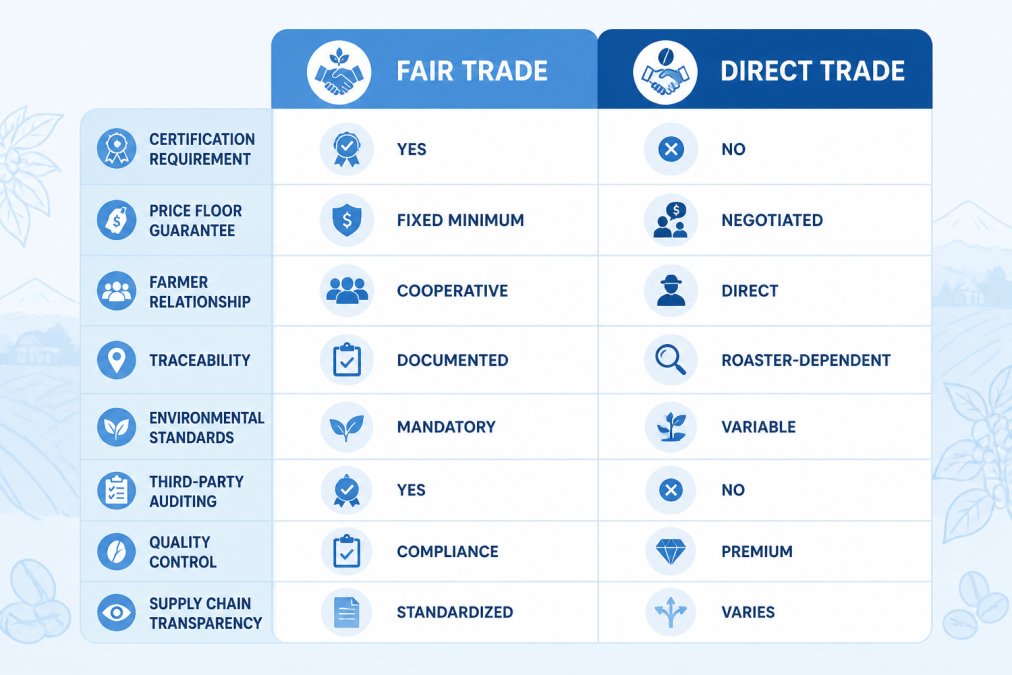
The core difference: Fair Trade uses certification bodies to enforce standards; Direct Trade relies on personal connections and roaster accountability.
| Dimension | Fair Trade | Direct Trade |
|---|---|---|
| Certification Required | Yes, third-party auditing | No formal certification |
| Price Guarantee | Minimum floor set by Fair Trade | Negotiated directly with farmer |
| Farmer Relationship | Cooperative or farm group | Direct roaster-to-farm connection |
| Traceability | Documented supply chain | Roaster's sourcing records |
| Environmental Standards | Mandatory audited compliance | Roaster-dependent standards |
| Supply Chain Transparency | Standardized reporting | Varies by roaster |
| Quality Control | Baseline compliance focus | Often higher quality emphasis |
| Certification Costs | Farmer pays audit fees | Roaster bears sourcing costs |
Fair Trade excels at scale and protection: thousands of certified farms are easy to find, protecting vulnerable farmers from exploitation. Direct Trade excels at quality and storytelling, with roasters paying premiums for exceptional beans. Fair Trade's auditing provides objective verification; Direct Trade's relationships can deliver better outcomes only if the roaster is honest.
Fair Trade Coffee Certification Requirements and Standards
The Certification Process
Farms must join cooperatives to distribute audit costs. Independent auditors (accredited by Fair Trade USA) conduct site inspections reviewing payroll, contracts, safety, and environmental practices, interviewing workers privately. Audits cost $2,000-$5,000 for small cooperatives. Farms must document labor records, environmental practices, and pesticide use, a burden that sometimes requires dedicated administrative staff.
Labor and Wage Standards
Fair Trade mandates wages meeting or exceeding local legal minimums, plus a "living wage" benchmark accounting for basic needs. Child labor is prohibited; workers under 18 cannot perform hazardous tasks. Workers have rights to organize and bargain collectively. Auditors verify wage documentation through payroll records and worker interviews; discrepancies result in certification failure.
Environmental Standards
Fair Trade mandates sustainable practices: protecting water sources, reducing pesticide use, maintaining biodiversity, and shade-growing coffee. Farms must have documented environmental management plans verified by auditors. Climate adaptation is increasingly required, with farms adjusting practices as weather patterns shift.
The Cooperative Model
Cooperatives (50-500 farmers) pool harvests, share certification costs, and provide training. They offer economies of scale but introduce bureaucracy; some are well-run, others poorly managed or dominated by few voices.
Community Development Fund
Fair Trade requires 5-10% of retail sales fund community development, schools, healthcare, water systems, or training. Over two decades, these funds have built hundreds of schools and clinics. Corporate buyers can cite published reports showing direct community impact.
Recertification and Compliance
Farms undergo recertification every 3 years with annual surveillance audits between. Failures allow grace periods for correction; repeated failures result in decertification. This ongoing independent oversight is Fair Trade's strength versus Direct Trade.
Cost and Accessibility
Certification costs (audit fees, membership, overhead) can consume 10-15% of small farm revenue in year one. This creates a paradox: the poorest producers often can't afford certification, though Fair Trade offers grant programs. For corporate wholesale sourcing, Fair Trade coffee costs more per pound because certification fees are built into the price.
Wholesale Coffee Beans for Offices: Which Model Works Best?
Small businesses, corporate clients, and office managers face a practical question: which sourcing model delivers better value and impact?
Fair Trade works well for corporate programs focused on social responsibility. If your company wants to communicate that you care about farmer welfare, Fair Trade's third-party certification provides proof. Employees see the label and know the purchase supports audited standards. This appeals to companies building sustainability credentials.
Direct Trade suits businesses prioritizing quality and storytelling. If you're sourcing coffee for an employee kitchen benefit or holiday gift baskets, Direct Trade's personal narratives create memorable experiences. You can highlight the specific farm, the farmer's story, and tasting notes that make the coffee feel special.
For pantry selections serving diverse tastes, fair trade direct trade coffee options exist across both models, though Fair Trade offers broader variety. Thousands of certified farms mean you'll find options at different price points and flavor profiles. You're not locked into one roaster's sourcing network.
The wholesale economics differ too. Fair Trade coffee typically costs less per pound because certification is standardized and competition is higher. Direct Trade often commands premium pricing because roasters invest heavily in relationships and quality.
Consider your audience. Socially conscious employees prefer Fair Trade's verified impact. Coffee enthusiasts want Direct Trade's quality and storytelling. Many offices use both, Fair Trade for everyday brewing, Direct Trade for special occasions.
At Brewtiful Coffee US, we work with both sourcing models. Our single-origin beans from Uganda, Kenya, Sumatra, Peru, Mexico, and Bali are sourced with farmer relationships and quality as the priority. We can help corporate clients and small businesses build coffee programs that align with their values and budgets. Learn more about wholesale coffee sourcing
The Greenwashing Risk and Trust Gap in Direct Trade
Why Direct Trade Lacks Oversight
Direct Trade has no central authority, certification body, audit process, or published standards, any roaster can use the term. This flexibility allows innovation but creates a verification vacuum: you cannot confirm claims, see audits, or verify farmer payments exceed Fair Trade minimums.
The Greenwashing Playbook
Some roasters use "Direct Trade" without delivering real farmer benefits. Red flags include: one-time farm visits with no ongoing relationship, vague pricing claims without numbers, storytelling without income verification, informal verbal agreements (versus Fair Trade's written contracts), and assuming quality implies fair sourcing.
Red Flags for Corporate Buyers
When evaluating Direct Trade claims, watch for: no farm names or locations, no pricing transparency, no farm visit documentation, no long-term written commitments, inconsistent sourcing year-to-year, and no community investment. Legitimate roasters proudly name sources, discuss pricing ranges, maintain visit records, commit to multi-year agreements, source consistently, and often invest in farm communities.
How to Verify Direct Trade Claims
To verify Direct Trade claims: ask for farm names and locations, request farm visit documentation (photos, trip reports), ask about pricing ranges, check for third-party audits (Direct Trade Alliance, Specialty Coffee Association), look for published impact reports, and assess coffee consistency batch-to-batch.
The Climate Change Complication
Both Fair Trade and Direct Trade face a shared challenge: climate change is shifting where coffee grows best. Changing rainfall patterns, temperature extremes, and pest pressures are making traditional coffee regions less viable.
Fair Trade's standardized approach struggles to adapt quickly. Certification requirements are designed for stable conditions. When a region becomes unsuitable for coffee, Fair Trade cooperatives must help farmers transition to new crops or regions, a slow, bureaucratic process.
Direct Trade's flexibility is an advantage here. A roaster can shift sourcing to new regions faster than Fair Trade certification can adapt. However, without verification, there's no guarantee that displaced farmers get supported during transitions. A roaster might simply stop buying from a farm affected by climate change and source from a new region, leaving the original farmers without income.
This is where Direct Trade's lack of accountability becomes problematic. Fair Trade publishes reports on how they're supporting farmers through climate transitions. Direct Trade roasters have no obligation to disclose how they handle sourcing disruptions.
Fair Trade's Transparency Advantage
Fair Trade publishes detailed impact reports. Fair Trade USA releases annual reports showing how many farmers are certified, what wages they earned, how much community development funding was distributed, and which environmental practices were adopted. This data is public and audited.
Direct Trade roasters control their own narratives. They decide what information to share and what to withhold. Some are exceptionally transparent. Others share only the information that makes them look good.
For corporate clients building sustainability programs, Fair Trade's transparency is valuable.
The Hybrid Approach
Which Model Should You Choose?
The answer depends on what matters most to you.
Choose Fair Trade if you want audited verification of labor standards and environmental practices. You're supporting a system that protects vulnerable farmers and invests in community development. The certification gives you confidence that your money improves lives.
Frequently Asked Questions
What is the primary difference between fair trade and direct trade coffee?
Fair trade coffee relies on third-party certification and a guaranteed minimum price floor set by certification bodies. Direct trade coffee is built on direct relationships between roasters and farmers, with prices negotiated individually. Fair trade prioritizes transparency through auditing and labeling; direct trade prioritizes relationship-based trust and traceability documentation. Fair trade scales across many producers; direct trade typically involves fewer, longer-term partnerships.
Does fair trade coffee certification guarantee higher quality?
No. Fair trade certification focuses on fair compensation and sustainable agriculture standards, not quality control. Many fair trade coffees are excellent, but certification doesn't require specialty-grade flavor profiles. Direct trade often emphasizes quality premiums and curated sourcing, but lacks third-party auditing. Quality depends on the roaster's sourcing decisions and processing methods, not the trade model itself.
Is direct trade coffee always more expensive than fair trade?
Not necessarily. Direct trade coffee can command higher prices when roasters invest in long-term partnerships and quality premiums for producers. However, some direct trade coffees cost less than fair trade equivalents because there are no certification fees. Fair trade prices vary widely depending on the cooperative and commodity market volatility. Compare specific beans rather than assuming one model is always pricier.
What are the benefits of direct trade coffee for producers?
Direct trade relationships often provide producer empowerment through direct negotiation, eliminating the middleman and allowing farmers to capture more value. Roasters can offer long-term partnerships that provide economic stability beyond commodity market volatility. However, direct trade lacks independent auditing, so verification of fair compensation relies on the roaster's integrity. Fair trade certification offers accountability through external verification, though it may involve certification fees that reduce farmer income.