

How to Brew Specialty Coffee at Home
Table of Contents
- What You'll Need to Brew Specialty Coffee
- Best Coffee Beans for Home Brewing
- Best Coffee Brewing Methods at Home
- Coffee-to-Water Ratio for Pour-Over and Other Methods
- Step-by-Step Brewing Instructions
- Troubleshooting Bitter or Sour Coffee
- Common Mistakes to Avoid
- Storage and Freshness
- Frequently Asked Questions
Last Updated: October 10, 2026
What You'll Need to Brew Specialty Coffee
Brewing specialty coffee at home requires just four essentials: a grinder, a brewing device, a scale, and hot water. A burr grinder is non-negotiable for consistency, blade grinders chop unevenly, leaving chunks and powder mixed together that ruins extraction.
Your brewing device depends on preference. Pour-over drippers, French presses, and AeroPress all produce excellent results. Water quality matters more than most realize; filtered water prevents mineral buildup and off-flavors from tap water.
A kitchen scale transforms guessing into precision. Weight-based measurements give repeatable results every time, while volume measurements introduce error.
Best Coffee Beans for Home Brewing
The beans you choose determine your ceiling for flavor. No brewing technique can fix low-quality beans, but great beans shine through even basic equipment.
Specialty coffee means beans scoring 80 points or higher on the Specialty Coffee Association scale.
Brewtiful Coffee US sources single-origin beans from Uganda, Kenya, Sumatra, Peru, Mexico, and Bali. Ethiopian naturals bring fruity, wine-like notes.

Roast level affects how origins express themselves. Light roasts preserve origin characteristics. Medium roasts balance origin flavor with roasted notes.
Look for a roast date on the bag, freshness matters enormously. When you order Brewtiful Coffee US beans, they arrive fresh-roasted and ready to brew.
Best Coffee Brewing Methods at Home
Three methods dominate home brewing: pour-over, French press, and AeroPress. Each produces different results and suits different priorities, brew time, equipment investment, serving size, and flavor profile.
Quick Method Comparison
| Method | Brew Time | Equipment Cost | Serving Size | Body | Clarity | Effort | Best For |
|---|---|---|---|---|---|---|---|
| Pour Over | 3-4 min | $10-30 | 1-4 cups | Medium | High | Moderate | Tasting origin characteristics; daily brewing |
| French Press | 4-5 min | $20-40 | 3-12 cups | Full | Medium | Low | Bold flavors; larger batches; minimal cleanup |
| AeroPress | 90 sec | $30-50 | 1-3 cups | Medium-Full | High | Moderate | Travel; experimentation; speed |
Pour Over
Pour-over brewing gives complete control. Water flows through grounds in a cone or flat-bottomed dripper.
Pour-over requires attention and hands-on adjustment. You pour water in stages, timing each addition. This approach lets you adjust on the fly if extraction feels off.
Best for: Tasting origin characteristics clearly; daily single-cup or small-batch brewing.
Flavor profile: Clean, bright, tea-like body with pronounced acidity and origin notes.
Grind size: Medium-fine (like sand).
Common equipment: Hario V60, Melitta, Chemex, Kalita Wave. Most cost $10-30 and last years with basic care.
French Press
French press is immersion brewing. Grounds steep in hot water for several minutes.
This method is forgiving. Grind size matters, but timing is less critical than pour-over. The result tastes fuller and heavier than pour-over.
Best for: Dark roasts and bold flavors; larger batches (4-12 cups); minimal equipment investment; corporate pantries and holiday gift selections.
Flavor profile: Rich, full-bodied, heavier mouthfeel with pronounced oils and texture.
Grind size: Coarse (like breadcrumbs).
Common equipment: Standard glass or stainless-steel French press. Most cost $20-40 and are durable enough for corporate pantries.
AeroPress
AeroPress combines immersion and pressure. Grounds steep briefly, then you press a plunger to force water through a paper filter. The pressure accelerates extraction.
This device is compact and portable. It brews fast (around 90 seconds total).
Best for: Travel; rapid brewing; experimentation with different grind sizes and ratios.
Flavor profile: Balanced, smooth, slightly heavier than pour-over with good clarity.
Grind size: Medium (like table salt).
Common equipment: Standard AeroPress or AeroPress Go (portable version). Cost $30-50 and are nearly indestructible.
Coffee-to-Water Ratio for Pour-Over and Other Methods
Ratio determines strength and extraction. The standard starting point is 1:16 (one part coffee to sixteen parts water by weight). This baseline locks in grind size, water temperature, and timing so you can troubleshoot systematically.
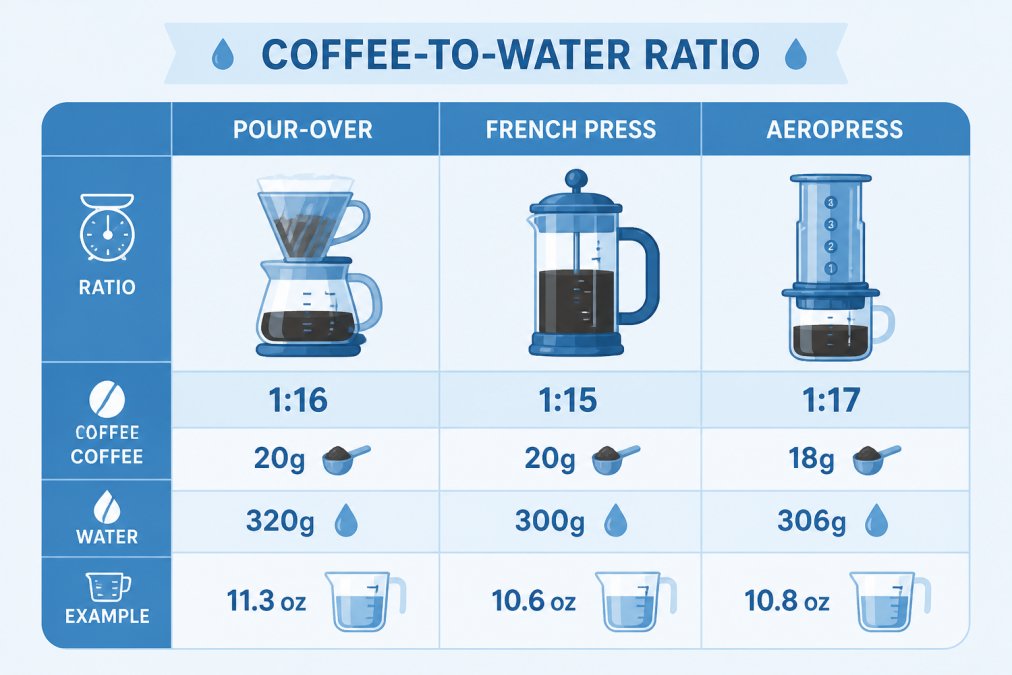
The Baseline Recipe (1:16 Standard)
Use this as your reference point for all three methods:
| Variable | Pour Over | French Press | AeroPress |
|---|---|---|---|
| Coffee (grams) | 20 | 30 | 15 |
| Water (grams) | 320 | 480 | 240 |
| Ratio | 1:16 | 1:16 | 1:16 |
| Grind Size | Medium-fine | Coarse | Medium |
| Water Temp | 200°F | 200°F | 200°F |
| Brew Time | 3-4 min | 4 min | 90 sec |
| Expected Result | Balanced, clean | Full-bodied, rich | Smooth, balanced |
This recipe works across all three methods and produces a balanced cup for most palates. All variables work together, if you change one, you may need to adjust others.
Adjusting Ratio by Taste
Once you've brewed the baseline, adjust ratio based on what you taste:
- Stronger coffee: Use 1:15 (add 5% more coffee)
- Weaker coffee: Use 1:17 (reduce coffee by 5%)
- Bold, concentrated cups: Use 1:14
- Delicate, tea-like results: Use 1:18
The ratio matters more than absolute amounts. Twenty grams of coffee to 320 grams of water tastes identical to ten grams to 160 grams. Keep the ratio constant while scaling up or down.
Adapting for Different Beans and Roast Levels
Different origins and roast levels extract at different rates.
Light roasts (higher density, slower extraction):
- Start at 1:16, but expect to brew 30 seconds longer
- If sour, grind finer or raise water temperature by 5°F
- Light roasts often benefit from slightly hotter water (205°F)
Medium roasts (balanced extraction):
- Use the baseline recipe as-is
- These roasts are most forgiving; small adjustments produce noticeable changes
Dark roasts (lower density, faster extraction):
- Start at 1:16, but expect to brew 30 seconds shorter
- If bitter, grind coarser or lower water temperature by 5°F
- Dark roasts often benefit from slightly cooler water (195°F)
Single-origin beans (pronounced acidity or sweetness):
- Ethiopian naturals and Kenyan coffees: Start at 1:16 with 200°F water. If too acidic, lower temperature by 5°F or shorten brew time by 15 seconds.
- Brazilian and Sumatran coffees: Start at 1:16 with 200°F water. If too muted, raise temperature by 5°F or extend brew time by 15 seconds.
Blends (designed for balance):

- Use the baseline recipe; blends are engineered to work at 1:16
Why Temperature and Grind Matter as Much as Ratio
Ratio is only one variable in extraction. Water temperature and grind size control how fast extraction happens:
- Hotter water + finer grind = faster extraction (use for light roasts or under-extracted cups)
- Cooler water + coarser grind = slower extraction (use for dark roasts or over-extracted cups)
If you adjust ratio without adjusting grind or temperature, you're only solving half the problem. The baseline recipe gives you a starting point; the other variables let you dial in the exact cup you want.
Step-by-Step Brewing Instructions
Step 1: Measure Your Coffee and Water
Weigh your coffee on a scale. Use whole beans from Brewtiful Coffee US. Write down your target water weight (coffee weight multiplied by 16 for standard ratio).
Heat water to the target temperature. Most brewing methods use water between 195-205°F. Let boiled water cool for 30 seconds if you don't have a thermometer.
Step 2: Grind Your Beans to the Right Size
Grind immediately before brewing. Whole beans stay fresh for weeks. Ground coffee stales within hours.
Pour-over requires medium-fine grounds (like sand). French press needs coarse grounds (like breadcrumbs). AeroPress works with medium grounds.
A burr grinder produces uniform particle size. Blade grinders create uneven extraction.
Step 3: Heat Water to the Correct Temperature
Water temperature controls extraction speed. Hotter water extracts faster and stronger. Cooler water extracts slower and lighter.
195-205°F is the sweet spot for most coffees. Below 195°F, extraction happens too slowly. Above 205°F, you risk over-extraction and bitter flavors.
If you don't have a thermometer, let boiling water sit for 30-45 seconds to reach approximately 200°F.
Step 4: Brew and Time Your Extraction
Pour-over: Pour a small amount of water to wet the grounds. Wait 30 seconds (bloom phase). Then pour slowly in circular motions. Total brew time should be 3-4 minutes.
French press: Add grounds and hot water. Stir gently. Place the lid on without pressing. After 4 minutes, press slowly and pour.
AeroPress: Add grounds and water. Stir for 10 seconds. Place the filter cap on. After 45 seconds, press for 20-30 seconds.
Troubleshooting Bitter or Sour Coffee
Bitter coffee means over-extraction. Grounds spent too long in contact with water, leaching harsh compounds.
Sour coffee means under-extraction. Grounds didn't spend enough time extracting, leaving acidic notes behind.
Bitter coffee fixes:
- Grind coarser (larger particles extract slower)
- Shorten brew time by 30 seconds
- Lower water temperature by 5 degrees
- Use less coffee (reduce ratio to 1:17)
Sour coffee fixes:
- Grind finer (smaller particles extract faster)
- Extend brew time by 30 seconds
- Raise water temperature by 5 degrees
- Use more coffee (increase ratio to 1:15)
Start with one change at a time. Adjust grind size first, as it has the biggest impact.
Common Mistakes to Avoid
Using stale beans is the most common mistake. Beans older than 30 days produce flat, dull cups.
Grinding too far in advance kills flavor. Grind immediately before brewing. Pre-ground coffee loses aroma and complexity within hours.
Inconsistent measurements lead to inconsistent results. Use a scale every single time. Eyeballing introduces variables that make troubleshooting impossible.
Using tap water introduces mineral content and chlorine flavors. Filtered water improves every cup.
Skipping the bloom phase wastes potential. The 30-second bloom lets CO2 escape and allows water to penetrate grounds evenly.
Storage and Freshness
Store beans in an airtight container away from light and heat. A sealed bag with a one-way valve works perfectly. Avoid clear containers, as light degrades beans over time.
Room temperature is ideal. Don't refrigerate or freeze beans. Condensation damages flavor.
Grind only what you'll use within a few days. Ground coffee stales faster than whole beans. If you must grind ahead, use within 24 hours.
Whole beans stay fresh longest. Buy whole beans and grind at home. This simple habit makes more difference than expensive equipment.
Brewing specialty coffee at home is simpler than most guides suggest. When you brew specialty coffee with Brewtiful Coffee US beans, like our single-origin Peru or Ethiopia Natural, you're already halfway to a cafe-quality cup.
Frequently Asked Questions
What coffee-to-water ratio should I use for home brewing?
The standard specialty coffee brewing ratio is 1:16 (one part coffee to 16 parts water by weight). For example, use 20 grams of ground coffee with 320 milliliters of water. This works well for pour-over and drip methods. French press typically uses a slightly stronger 1:15 ratio, while espresso uses much finer grounds and higher pressure. Start with 1:16 and adjust based on your taste, use less water for stronger coffee, more for a lighter cup.
How do I fix coffee that tastes bitter or sour?
Bitter coffee usually means over-extraction, caused by water that's too hot, too fine a grind, or too long a brew time. Lower your water temperature to 195-205°F, use a coarser grind, or reduce brew time. Sour coffee signals under-extraction from water that's too cool, too coarse a grind, or insufficient brew time. Increase water temperature, grind finer, or brew longer. Start with one variable at a time to identify the problem.
What brewing method produces the best specialty coffee at home?
The best method depends on your preferences and time. Pour-over offers precise control and bright, clean flavor. French press produces a full-bodied, rich cup with more oils and sediment. AeroPress delivers smooth, balanced coffee quickly with minimal cleanup. All three can produce excellent specialty coffee when you use fresh beans, proper ratios, correct grind size, and the right water temperature. Choose based on the flavor profile you prefer and how much time you want to spend brewing.
Why should I buy specialty coffee beans instead of regular coffee?
Specialty coffee beans are sourced from specific regions and roasted fresh to order, preserving complex flavors and aroma that regular mass-produced coffee loses. Single-origin beans from places like Ethiopia, Peru, and Kenya offer distinct tasting profiles, fruity, chocolatey, or caramel notes, that make each cup unique. Fresh-roasted beans taste noticeably smoother and brighter than stale coffee. The investment in quality beans pays off immediately when you taste the difference in your morning cup.