

How Do You Measure Coffee TDS at Home?
Last Updated: October 31, 2026
Quick Summary
To measure coffee tds at home, brew a cup, cool a small 30-50 ml sample to room temperature, filter out fines, zero your coffee refractometer with distilled water, then place two or three drops on the prism and press read. Record the TDS percentage and read the same sample twice to confirm repeatability.
- Cool and filter your sample first, because hot or cloudy liquid skews the reading.
- Zero the refractometer with distilled water before every session to prevent drift.
- Two readings of the same sample should differ by 0.1% or less.
- Extraction yield equals beverage mass times TDS, divided by dose, times 100.
- Cheap water-quality TDS pens measure minerals, not dissolved coffee solids.
Table of Contents
- What Coffee TDS Actually Tells You
- What You Need to Measure Coffee TDS at Home
- How to Use a Coffee Refractometer Step by Step
- Choosing a Coffee Refractometer That Fits Your Kitchen
- Calculating Coffee Extraction Yield From Your Reading
- How to Measure Coffee TDS Without a Refractometer
- Fixing Inaccurate Readings and Adjusting Your Brew
- Dialing In Your Next Bag of Brewtiful Beans
- Frequently Asked Questions
What Coffee TDS Actually Tells You
Coffee TDS is the percentage of dissolved coffee solids left in your brewed coffee after the water has done its work.
TDS works best as a compass, not a verdict. It points you toward a stronger or weaker cup.
Three things a TDS reading will tell you:
- Brew strength: how concentrated the cup is
- Consistency: whether your routine repeats from bag to bag
- A starting point for extraction yield math
One thing it will not tell you: whether the coffee tastes balanced. A cup can hit a textbook TDS and still taste hollow.
Curious whether caffeine is behind the jitters or the flavor? Our guide to caffeine sensitivity symptoms explains what coffee does to your body and how to tell the difference.
What You Need to Measure Coffee TDS at Home
The basic kit is smaller than many people expect. You need a coffee refractometer, a way to filter fines, a pipette or dropper, and a clean sample cup. A small scale helps if you want repeatable results.
Your gear list:
- Coffee refractometer built for brewed coffee, not a lab or wine model
- Filtered sample: a syringe filter or a fine mesh strainer
- Dropper or pipette for placing drops on the prism
Skip the filters and you get a cloudy sample. Fines scatter light and push the reading off. That single mistake causes more bad data than any other.
How to Use a Coffee Refractometer Step by Step
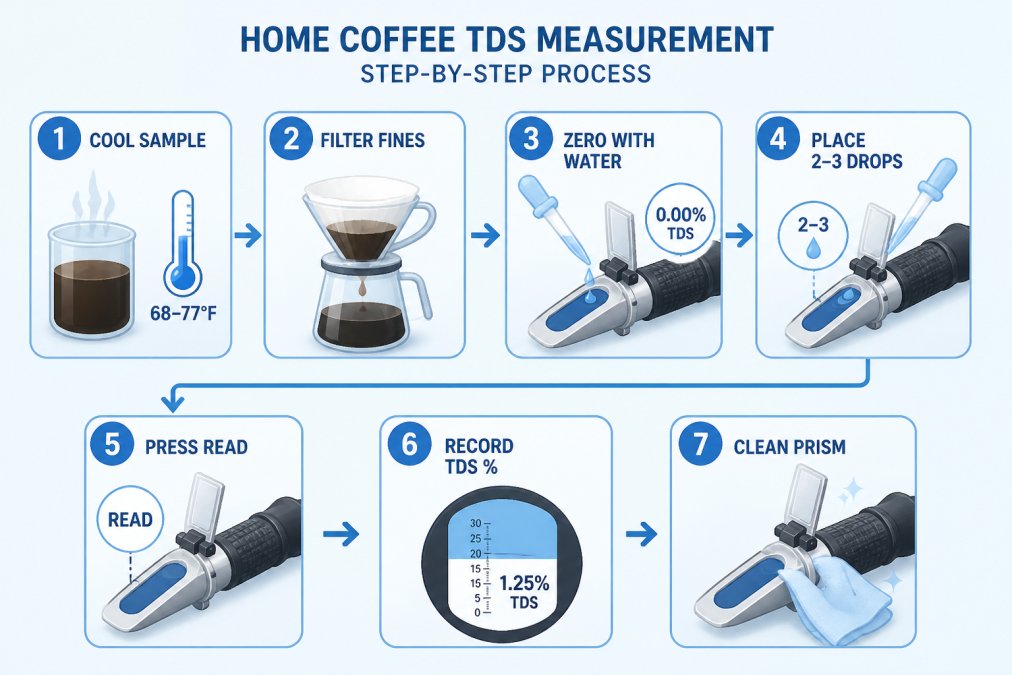
Using a coffee refractometer takes about five minutes once you have a routine. Cool the sample, filter it, zero the device with water, place two or three drops on the prism, press read, and write down the TDS percentage. The sequence matters as much as the steps themselves.
Before You Start: Calibration and Setup
Calibrate the refractometer before your first reading of the session. Most coffee refractometers use a simple zeroing procedure: place a few drops of distilled water on the clean prism, close the cover, and press the zero or calibrate button until the display reads 0.0%.
Keep the prism spotless. A lint-free cloth and a drop of distilled water are enough to wipe away residue between samples. Never touch the prism with your fingers; skin oils leave a film that scatters light.
Step-by-Step Measurement
- Stir the brew so the sample represents the whole cup. Dissolved solids settle, and a sample pulled from the top can read lower than the actual brew.
- Take a small sample in a clean cup or glass. About 30-50 ml is plenty.
- Cool it to room temperature. Hot liquid fogs the prism and skews the read. A quick way is to set the sample cup in a bowl of cool water for a minute or two, or simply let it rest for five to ten minutes. Most refractometers with automatic temperature compensation still perform best when the sample is near room temperature.
- Filter out fines with a syringe filter or a fine mesh strainer. Fines scatter light and push the reading off. If you use a syringe filter, discard the first few drops that pass through, as they can carry concentrated residue.
- Zero the refractometer with distilled water and dry the prism with a lint-free cloth.
- Place two or three drops on the prism and close the cover gently. Avoid air bubbles; they read as false solids.
- Press read and record the TDS percentage. Read the same sample twice to check repeatability. If the two readings differ by more than about 0.1%, clean the prism and try again.
- Clean the prism with a lint-free cloth and distilled water before the next sample.
A Note on Sample Representativeness
For immersion brews like French press, stir before sampling so the liquid is uniform. For pour-over and drip, the brew that lands in the carafe is already mixed, but a quick swirl helps.
A consistent routine is what makes the numbers useful, whether you are dialing in a single bag or comparing coffees side by side.
Here is the measurement routine in order, from stirring the brew to cleaning the prism.
| Step | What to do | Note |
|---|---|---|
| 1 | Stir the brew before sampling | Dissolved solids settle |
| 2 | Take a small sample | About 30-50 ml is plenty |
| 3 | Cool it to room temperature | Hot liquid fogs the prism |
| 4 | Filter out fines | Syringe filter or fine mesh strainer |
| 5 | Zero with distilled water | Dry prism with lint-free cloth |
| 6 | Place two or three drops | Avoid air bubbles |
| 7 | Press read and record TDS | Read twice; differ by 0.1% or less |
| 8 | Clean the prism | Before the next sample |
Choosing a Coffee Refractometer That Fits Your Kitchen
Pick a refractometer made for coffee, with a scale that covers typical brew strength and a clear digital display. A dedicated coffee model beats a general-purpose optical unit every time.
What to check before buying:
- Coffee-specific scale: the range should match brewed coffee, not wine or antifreeze
- Digital display: easier to read and faster to log than an optical eyepiece
- Automatic temperature compensation: helps when samples are not perfectly cool
What most reviews miss: accuracy claims matter less than repeatability. A device that reads the same sample the same way twice is more useful than one with a fancy spec sheet and jumpy results.
Calculating Coffee Extraction Yield From Your Reading
Extraction yield tells you how much of the ground coffee actually made it into the cup.
The math:
- Beverage mass in grams, from your brewed coffee output
- TDS percentage from the refractometer, as a decimal
- Dose in grams of dry ground coffee
Extraction yield = (beverage mass × TDS) ÷ dose × 100
A worked example: 300 grams of brewed coffee at 1.3% TDS holds 3.9 grams of dissolved solids. Divide that by a 20 gram dose and you get about 19.5% extraction yield.
Run the numbers once and the reading stops being abstract. Now it tells you whether the water pulled too little or too much from the grounds.
How to Measure Coffee TDS Without a Refractometer
You can measure coffee TDS without a refractometer using a few indirect signals, but none of them give you a true percentage.
The practical alternatives:
- Taste calibration: note sourness for under-extraction and bitterness for over-extraction
- Brew ratio tracking: keep dose and water weight steady and adjust one variable at a time
- Yield checks: weigh your output to confirm the brew finished where you planned
A common mistake is buying a cheap TDS meter built for water quality. Those pens measure mineral content in drinking water, not dissolved coffee solids.
Treat taste and ratio notes as your stand-in refractometer. They cost nothing and build the same habit: change one thing, then check the result.
Fixing Inaccurate Readings and Adjusting Your Brew
Inaccurate readings usually come from four places: an unfiltered sample, a hot sample, an unzeroed device, or a dirty prism. Fix those first before you blame the coffee. Once the numbers are trustworthy, the real work begins: translating a reading into a specific change.
Troubleshooting Checklist
- Zero the refractometer with distilled water before each session
- Cool samples to room temperature
- Filter fines with a syringe filter
- Wipe the prism clean and dry between reads
If readings still jump around, check the syringe filter. A clogged filter can let fines through or concentrate the sample. Replace it if the plunger feels stiff. Also confirm that your distilled water is truly distilled; mineral water or tap water will not zero the device correctly.
From Reading to Adjustment: Worked Examples
The extraction yield formula gives you a number, but the adjustment depends on both taste and the reading.
Drip or pour-over, low TDS and sour taste. Suppose a 300-gram brew at 1.2% TDS with a 20-gram dose yields about 18% extraction.
Immersion brew, high TDS and bitter taste. A French press at 1.5% TDS with a 20-gram dose and 300 grams of water yields about 22.5% extraction.
Espresso, inconsistent shots. Espresso is concentrated and small, so sample handling matters even more.
Taste Remains the Final Judge
A TDS reading is a compass, not a verdict. Use it to confirm what your palate already suspects, then adjust one variable at a time. If the cup tastes balanced and the reading is in a reasonable range for the brew method, you are done.
A shared log and a consistent routine turn measurement into a repeatable skill, whether you brew at home or in a shared kitchen.
Dialing In Your Next Bag of Brewtiful Beans
Measurement only pays off when the beans are worth the effort. Fresh-roasted specialty coffee gives you a stable base, so the variables you change actually show up in the cup.
That is where fresh-roasted specialty coffee fits in. For a curated selection to practice on, explore the Single Origin Favorites Sample Pack. Readers who want variety to test their new TDS skills can try the Flavored Coffees Sample Pack.
Frequently Asked Questions
What does TDS mean in coffee?
TDS stands for total dissolved solids, the percentage of your brewed coffee's mass made up of dissolved coffee compounds. A reading of 1.35% means 1.35 grams of dissolved solids in every 100 grams of liquid. It measures concentration, or brew strength, not flavor quality. A coffee can hit a textbook TDS and still taste flat if the compounds extracted are the wrong ones, which is why TDS is best read alongside extraction yield and your own palate.
Do you need a refractometer to measure coffee TDS?
No. A refractometer gives you a fast, repeatable number, but you can estimate coffee TDS without a refractometer by tasting and adjusting your brew ratio. Start with roughly 60 grams of coffee per liter of water for filter coffee, then tighten the ratio if the cup tastes weak or loosen it if it tastes heavy. It is less precise, but it trains your palate and costs nothing. Many home brewers use taste first and borrow a refractometer later to confirm what they already suspected.
What is a good TDS reading for brewed coffee?
Most filter coffee lands between 1.15% and 1.45% TDS, and espresso typically reads much higher because it is concentrated. Treat those as starting ranges, not pass/fail grades. A whiskey barrel-aged bean or a bright Kenyan single origin may taste best at a different strength than a Sumatra. Record the reading next to your tasting notes so you learn which numbers match the cups you actually enjoy, then brew to that target instead of chasing a chart.
What is the difference between coffee TDS and extraction yield?
TDS measures how concentrated the finished cup is. Extraction yield measures how much of the ground coffee's mass actually made it into the cup, expressed as a percentage. You calculate it by multiplying beverage mass by TDS percentage, then dividing by dose. A cup can be strong (high TDS) but under-extracted if you used very little water. That is why the two numbers belong together: TDS tells you strength, extraction yield tells you whether you pulled the right flavors out of the grounds.
Learning to read a refractometer is easy. Trusting the number more than your own tongue is the trap. Use TDS to guide your adjustments, then let taste decide.
Brewtiful Coffee makes that practice enjoyable, with fresh-roasted beans, whiskey barrel-aged options, and single origins from six regions, all shipped free nationwide. Get started with Brewtiful Coffee and dial in a cup that tastes the way you want it to.
