

How to Measure Loose Leaf Tea Per Cup
Table of Contents
- The Golden Ratio: Tea to Water
- Measuring Tea by Weight vs Volume
- Loose Leaf Tea Brewing Ratio by Type
- How Long to Steep Loose Leaf Tea
- Adjusting Measurements for Personal Strength Preference
- Measuring Without a Scale: Visual and Volume Methods
- Troubleshooting Bitter or Weak Brews
- Frequently Asked Questions
Last Updated: September 20, 2026
The Golden Ratio: Tea to Water
The foundation of great tea starts with the right ratio. Most tea drinkers eyeball it and hope for the best. That approach leaves you with either weak, forgettable tea or something so bitter you can't finish the cup.
The standard brewing ratio is simple: measure loose leaf tea at 1 teaspoon per 8 fluid ounces of water. This works as a starting point for most tea types. But here's where precision matters. Different teas have different densities, and personal taste varies widely. That single ratio won't deliver cafe-quality results for every cup you brew.
Understanding the underlying principle beats memorizing a single number. The goal is extracting the right amount of flavor compounds without pulling out too many tannins, which create that harsh, astringent taste. Think of it like seasoning food. A pinch of salt enhances flavor. Too much ruins the dish.
The weight-based approach is more reliable than volume. A gram scale gives you consistency that teaspoons can't match. But if you don't have a scale, there are proven visual methods that work surprisingly well once you understand what you're looking for.
Measuring Tea by Weight vs Volume
Why Gram Scales Are More Accurate
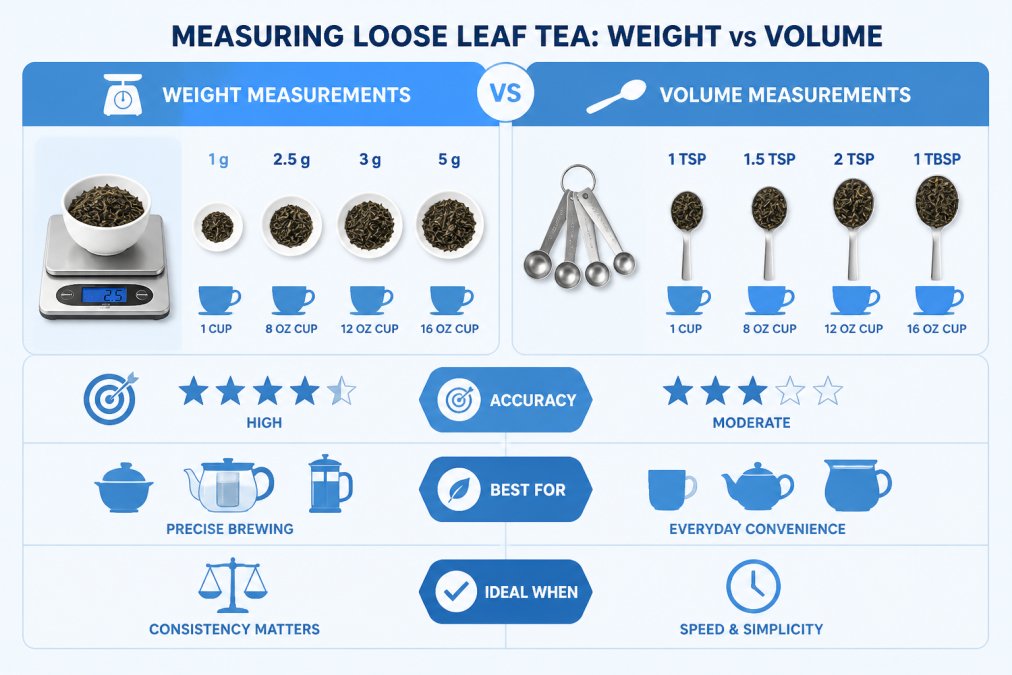
Loose leaf tea varies in density. Finely chopped fannings pack tighter than whole leaves. A teaspoon of one tea might weigh 2 grams while another weighs 4 grams. This density difference is why volume measurements fail.
A digital gram scale removes the guesswork. Weigh your tea to 0.1-gram precision and you get the same result every single time. This consistency is what separates a good cup from a great one.
The ideal measurement is 2 to 3 grams of loose leaf tea per 12 ounces of water. Brewtiful Coffee US's premium blends like Jasmine and Masala Chai perform best in this range. If you're using whole leaf tea, aim for the lower end. If you're using finely cut leaves or fannings, go slightly higher.

Why 12 ounces instead of 8? That's the standard serving size for specialty tea. A typical mug holds 10 to 12 ounces, and brewing vessels like teapots work better with this volume.
Common Measuring Tools: Teaspoons and Tablespoons
Not everyone owns a gram scale, and that's fine. A standard teaspoon holds about 5 milliliters of volume. For loose leaf tea, one teaspoon typically weighs between 2 and 4 grams depending on the tea type.
A tablespoon holds 15 milliliters, roughly three teaspoons. Use this for brewing larger quantities in a teapot. The conversion isn't perfect, but it's close enough for most home brewing.
The real limitation of volume measurement is consistency. Your teaspoon might be slightly different from someone else's. You might pack the leaves down one day and leave them loose the next. These small variations add up over multiple cups.
For best results with volume measurement, use a consistent technique. Don't press down or compress the leaves. Let them settle naturally in the spoon. Fill level with the rim, not heaping.
Loose Leaf Tea Brewing Ratio by Type
Black Tea and Leaf Density
Black tea leaves are typically larger and less dense than green tea. This affects how much you need to measure.
For black tea varieties like Brewtiful Coffee US's English Breakfast blend, use 2.5 grams per 12 ounces of water. Steep at 195°F for 5 to 7 minutes. Black tea is forgiving. If you steep it a minute longer than planned, the cup won't turn undrinkably bitter.

The larger leaf size means less surface area exposed to hot water, which slows extraction. This gives you a wider window for getting the steep time right.
If you're using Masala Chai, which combines black tea with spices, follow the same 2.5-gram ratio. The spices actually benefit from slightly longer steeping. Five to seven minutes lets the cardamom, cloves, and ginger fully infuse into the water.
Green Tea and Herbal Blends
Green tea is delicate. The leaves are often smaller and more tightly rolled. They extract faster, which means you need less leaf and less steeping time.
Use 2 grams of green tea per 12 ounces of water. Steep at 175°F for 3 to 4 minutes. Water that's too hot burns the leaves and creates a grassy, unpleasant flavor. If you don't have a thermometer, let boiling water cool for about 5 minutes before pouring.
Brewtiful Coffee US's Jasmine blend pairs delicate green tea with jasmine blossoms. The recommended brewing is 4 to 6 minutes at 175°F with 2.5 grams per 12 ounces. The jasmine flowers need extra time to release their fragrance into the water.
Herbal blends, technically infusions rather than true tea, contain no tea leaves, just dried flowers, fruits, and herbs. Use 2.5 to 3 grams per 12 ounces and steep for 5 to 7 minutes at 195°F or even boiling water. Longer steeping just makes them stronger, not bitter.
How Long to Steep Loose Leaf Tea
Steeping time controls extraction. The longer your tea sits in hot water, the more compounds dissolve into your cup. At some point, you extract too many tannins and the tea becomes astringent.
Standard steeping times are:
- Black tea: 5 to 7 minutes
- Green tea: 3 to 4 minutes
- Herbal blends: 5 to 7 minutes
- Oolong tea: 3 to 5 minutes
These times assume you're using the correct water temperature for each tea type. A black tea steeped at 195°F for 5 minutes tastes different from the same tea steeped at 212°F for the same time.
The leaf size also matters. Whole leaf tea steeps longer than broken leaf or fannings. Whole leaves unfurl slowly, so it takes more time for hot water to reach the inside. Fannings are already broken into tiny pieces, so they extract much faster.
Start with the recommended time for your tea type. Taste it. If it's too weak, add 30 seconds to your next brew. If it's too strong or bitter, reduce by 30 seconds. Your preferences are unique, what matters is finding your sweet spot through small adjustments.
Adjusting Measurements for Personal Strength Preference
The standard ratio produces a balanced cup. But balanced doesn't mean it's right for you.
If you prefer stronger tea, add 0.5 grams more leaf rather than extending steep time. This gives you more flavor without the bitterness that comes from over-extraction. You could also use 2.5 grams instead of 2 grams for green tea, or 3 grams instead of 2.5 for black tea.
If you prefer lighter tea, reduce the leaf amount by 0.5 grams. Don't shorten the steep time, that prevents the tea from fully opening and releasing its flavor. You want the full extraction, just less of it.
Some people adjust water temperature instead. Cooler water extracts more slowly. If you like your black tea less intense, try brewing at 185°F instead of 195°F and steeping for the full 7 minutes. This gives you gentler extraction.
The Peach Paradise blend from Brewtiful Coffee US is naturally sweet with high sweetness scoring. If that's too much, use 2 grams per 12 ounces instead of the standard 2.5. The sweetness will still come through without overwhelming your palate.

Measuring Without a Scale: Visual and Volume Methods
You don't need fancy equipment to measure loose leaf tea well. Visual methods work if you understand what you're looking for.
The leaf pile method is straightforward. Spread your measured tea on a white plate or saucer. For a 12-ounce cup, you want a pile roughly the size of a grape. This is approximately 2 to 2.5 grams for most teas. It looks small, that surprises people, but remember that loose leaf tea expands significantly when it hydrates.
The spoon method uses a standard teaspoon. Fill it level with the rim, don't compress.
Troubleshooting Bitter or Weak Brews
Bitter tea usually means over-extraction. The most common causes are too-hot water, too much leaf, or too long steeping.
Frequently Asked Questions
How much loose leaf tea should I use for one cup?
The standard ratio is 2.5 grams of loose leaf tea per 8 fluid ounces of water. If you don't have a gram scale, use one heaping teaspoon per 8 oz cup. This baseline works for most black teas and flavored blends. Adjust up or down by 0.5 grams based on whether you prefer a stronger or lighter infusion. Whole leaf teas require less volume than fannings because of their density.
Should I measure loose leaf tea by weight or volume?
Weight measurement using a digital gram scale is more accurate and consistent, especially for loose leaf tea brewing ratio variations across different tea types. Volume measurements (teaspoons) are convenient but less precise because leaf size and density vary significantly. For cafe-quality results, a basic digital scale ($10-20) eliminates guesswork and ensures the same flavor profile every brew.
How long should I steep loose leaf tea?
Steeping time depends on tea type. Black teas typically steep 5-7 minutes at 195°F. Green teas steep 3-5 minutes at 160-180°F. Herbal blends often need 5-7 minutes at 195°F. Over-steeping increases astringency and tannins, making tea bitter. Under-steeping produces weak, watery results. Start with the lower end of the range and add 30 seconds if needed. Use a timer to avoid guessing, consistency matters more than perfection.
Does the type of tea change how much I should measure?
Yes. Black teas and herbal blends typically use 2.5 grams per 8 oz. Green teas and delicate blends like jasmine may need only 2 grams per 8 oz to avoid over-extraction. Whole leaf teas occupy more space than fannings, so volume measurements differ even when weight is the same. Check the brewing instructions on your loose leaf tea package, premium blends often specify their ideal ratio for optimal flavor profile.