

How to Store Fresh Roasted Coffee Beans Long Term
Table of Contents
- Why Fresh Roasted Coffee Requires Careful Storage
- Best Coffee Storage Containers for Long-Term Freshness
- Freezing Coffee Beans for Long Term Storage
- How Long Does Roasted Coffee Stay Fresh
- Controlling Temperature, Moisture, and Oxygen Exposure
- Portioning Beans and Daily Use Strategy
- Signs Your Coffee Beans Have Gone Stale
- Frequently Asked Questions
Last Updated: September 19, 2026
Why Fresh Roasted Coffee Requires Careful Storage
Store fresh roasted coffee beans properly because they are alive. They release carbon dioxide for days after roasting, and their flavor compounds are volatile. Without proper storage, you lose what makes specialty coffee worth buying.
The moment beans cool after roasting, oxidation begins. Oxygen, light, heat, and moisture are the enemies. Each one degrades flavor and aroma at different rates. Most home brewers don't realize how quickly their beans stale because the decline is gradual. One week in, the coffee still tastes fine. By week three, the brightness fades. By week six, you're left with flat, bitter notes.
At Brewtiful Coffee US, we source single-origin beans from Uganda, Kenya, Sumatra, Peru, Mexico, and Bali. These beans deserve better than a kitchen counter. How you store fresh roasted coffee beans determines whether you get cafe-quality flavor or a dull cup. The good news: storage is simple once you understand what you're protecting against.
Best Coffee Storage Containers for Long-Term Freshness
The right container is your first line of defense. Not all containers are created equal. Some let oxygen in. Others let light through. The best ones block both while allowing degassing to happen safely.
Airtight Containers and Opaque Canisters
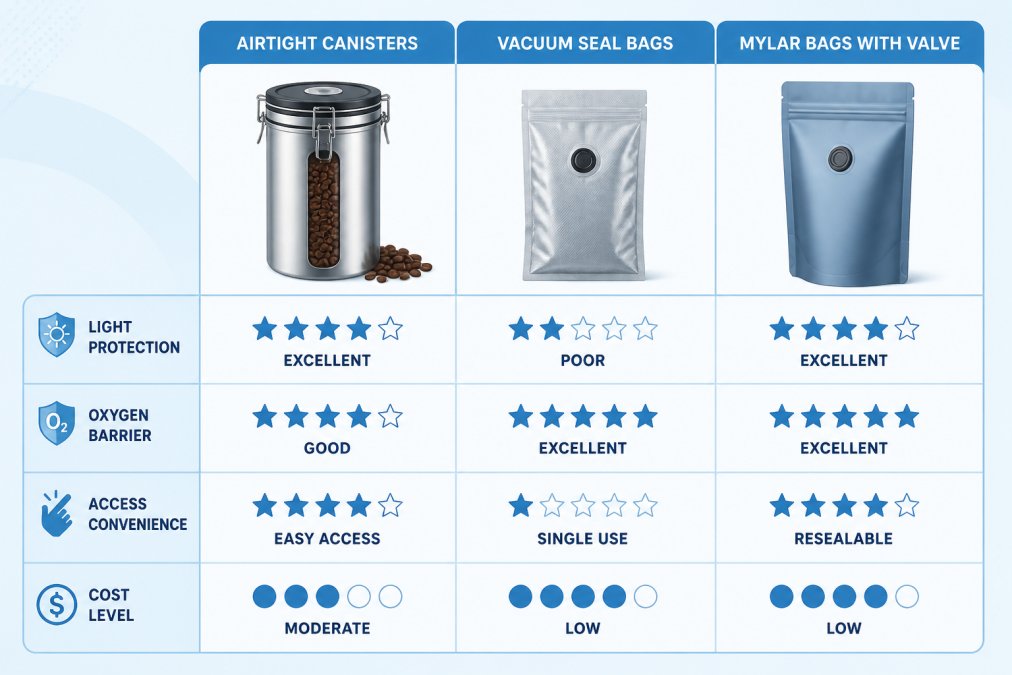
An airtight container with an opaque exterior is the gold standard for most home brewers. Glass or ceramic canisters with rubber seals work well. Metal canisters work even better because they block light completely.
What makes a container truly airtight? A seal that closes with a click or snap, with no gaps. Test it by sealing it, then trying to open it without breaking the seal. If it comes open easily, it's not airtight enough.
Opaque canisters matter because light degrades coffee faster than almost anything else. Ultraviolet rays break down the oils and aromatic compounds. Clear containers look nice on the shelf, but they're working against you. Choose dark glass, ceramic, or stainless steel.
Size matters too. A container that's too large leaves too much headspace. Excess air in the container means more oxygen around your beans. Fill containers so beans take up most of the space, with minimal air gap.
Vacuum Seal Bags vs. Mylar Bags
Vacuum sealing removes air entirely. This is aggressive protection. Vacuum seal bags are thin, flexible, and designed for one-time use. Once you open them, you can't reseal them effectively. They work best if you portion beans into smaller bags and freeze them.
Mylar bags are thicker and often come with a one-way valve. The valve lets carbon dioxide escape during degassing without letting oxygen back in. This is the key advantage over simple vacuum bags. Mylar bags are resealable, so you can open and close them multiple times.
For long-term storage, mylar bags with a one-way valve outperform basic vacuum bags. The valve prevents the bag from bloating as beans degas. You can store them in a cool, dark place and pull out beans as needed without compromising the rest.
Freezing Coffee Beans for Long Term Storage
Freezing extends shelf life significantly. Cold slows oxidation and volatile compound loss. Frozen beans stay fresh for 3-6 months. Room-temperature beans degrade noticeably after 4 weeks.
The catch: freezing introduces new risks. Moisture and thermal shock can damage beans if you're not careful.
Preparing Beans for the Freezer
Portion your beans before freezing. Don't freeze an entire bag and thaw it repeatedly. Each thaw cycle exposes beans to moisture and temperature changes.
Divide beans into weekly or bi-weekly portions. Use small vacuum seal bags or mylar bags. Remove as much air as possible. Seal them tightly.
Label each bag with the roast date and the origin. You'll thank yourself later when you forget which bag is the single-origin Ethiopian versus the blend.
Place sealed bags in an airtight container before freezing. This adds an extra barrier against freezer odors and moisture.
Thawing Protocol: Preventing Condensation and Thermal Shock
This is where most people mess up. Pulling frozen beans straight into a warm kitchen causes condensation. Water forms on the bean surface, and moisture seeps inside.
Thaw beans slowly in the refrigerator. Move a bag from the freezer to the fridge 12-24 hours before you plan to brew. This gradual temperature change prevents condensation.
Once thawed, use the beans within 1-2 days. Don't refreeze. Each freeze-thaw cycle degrades flavor.
If you're in a hurry, you can brew directly from frozen beans. Grind them while still cold. The grinder will generate enough heat to thaw them as you grind. This works better than waiting at room temperature, where condensation forms.
How Long Does Roasted Coffee Stay Fresh
The answer depends on storage conditions and roast level. Properly stored beans stay flavorful for 4-6 weeks. In a freezer, they last 3-6 months. On a kitchen counter, they degrade noticeably after 1-2 weeks.
Roast Level Impact on Shelf Life
Light roasts have more volatile aromatic compounds. These compounds fade faster than the oils in darker roasts. Light roasts are best used within 2-3 weeks of roasting.
Medium roasts split the difference. They hold flavor well for 3-4 weeks with proper storage.
Dark roasts are more stable. The roasting process breaks down some volatile compounds, so there's less to lose. Dark roasts stay good for 4-6 weeks.
This is why roast date matters more than expiration date. A light roast from 3 weeks ago tastes stale. A dark roast from 3 weeks ago still tastes fresh.
Controlling Temperature, Moisture, and Oxygen Exposure
Three factors dominate coffee storage: temperature, moisture, and oxygen. Control these, and your beans stay fresh.
Avoiding Heat and Direct Sunlight
Heat accelerates every degradation process. Every 10-degree increase in temperature roughly doubles the rate of oxidation. Store beans in the coolest part of your kitchen.
Direct sunlight is worse than ambient heat. UV rays actively break down aromatic compounds. Keep beans away from windows and sunny countertops. A dark cabinet or pantry is ideal.
The freezer is cold and dark, which is why it's so effective. A cool, dark closet works almost as well.
Managing Humidity and Moisture
Moisture is the enemy. Humid air around your beans means water vapor can seep in. This triggers mold growth and accelerates staling.
Use airtight containers. Keep them in a dry part of your kitchen. Basements and kitchens near dishwashers have higher humidity. Avoid these areas.
If you live in a humid climate, consider adding a desiccant packet to your storage container. These packets absorb moisture from the air. Replace them every few months.
Minimizing Oxygen and Oxidation
Oxygen exposure is constant if your container isn't airtight. Every time you open the container, fresh air rushes in. Oxidation accelerates.
Use containers that seal completely. Avoid containers where the lid doesn't close snugly. Check the seal regularly to make sure it's still working.
For long-term storage, vacuum sealing or mylar bags minimize oxygen exposure far better than traditional canisters. You trade convenience for preservation.
Portioning Beans and Daily Use Strategy
How you access your beans affects how long the rest stay fresh. A smart portioning strategy keeps most beans protected while you use what you need.
Divide beans into small portions at the time of purchase.
Signs Your Coffee Beans Have Gone Stale
Stale coffee tastes flat and bitter. The brightness and complexity fade. If your coffee tastes dull even when you're brewing it correctly, your beans are likely past their prime.
Frequently Asked Questions
How long do freshly roasted coffee beans stay fresh?
Freshly roasted coffee beans remain at peak flavor for 2-4 weeks when stored in an airtight container away from heat and light. The beans begin degassing immediately after roasting, releasing carbon dioxide. After the first week, flavor starts to decline as oxidation accelerates. Whole bean coffee lasts longer than ground coffee. Proper storage in airtight containers extends freshness significantly, while freezing can preserve beans for several months without major flavor loss if thawed correctly.
Is freezing coffee beans for long term storage better than room temperature storage?
Freezing coffee beans for long term storage slows oxidation and extends shelf life to 3-6 months compared to 2-4 weeks at room temperature. However, freezing requires careful technique: beans must be in airtight, moisture-proof containers to prevent condensation and freezer burn. The key is thawing properly, allow frozen beans to reach room temperature while still sealed to avoid thermal shock and moisture absorption. For most home brewers, room temperature storage in airtight containers works well for regular consumption, while freezing suits beans you plan to use months later.
What happens if I thaw frozen coffee beans incorrectly?
Improper thawing causes condensation to form on the beans, introducing moisture that accelerates staling. Thermal shock from rapid temperature changes can also damage the bean structure. Always thaw frozen beans while they remain in their sealed airtight container at room temperature, this prevents moisture from condensing on the surface. Once thawed and opened, use the beans within 1-2 weeks. Never re-freeze beans after thawing, as repeated temperature cycles degrade flavor and increase condensation risk.
Do I need special containers, or can I store beans in their original bag?
Original coffee bags often have one-way valves that allow degassing but don't provide complete oxygen barriers for long-term storage. For freshness beyond 2-3 weeks, transfer beans to airtight containers like opaque canisters or vacuum-sealed bags. If your original bag has a resealable valve and you consume beans within 2-3 weeks, it's acceptable for short-term storage, but airtight containers are superior for preserving flavor profile and aroma over weeks or months.
Keeping fresh roasted coffee beans at their peak requires intentional storage. An airtight, opaque container in a cool, dark place gets you most of the way there. Freezing extends shelf life dramatically if you thaw carefully. Brewtiful Coffee US ships fresh-roasted beans with a roast date so you know exactly when to use them. Start with proper storage, and you'll taste the difference in every cup.