

Is Shade-Grown Coffee Worth the Extra Cost?
Table of Contents
- What Is Shade-Grown Coffee and How Does It Differ?
- Shade Grown vs Sun Grown Coffee: Key Differences
- Benefits of Shade-Grown Coffee for Quality and Flavor
- Environmental Impact and Sustainability
- Bird Friendly Coffee Certification and What to Look For
- Cost Analysis: Is the Premium Price Justified?
- How to Brew Shade-Grown Coffee for Best Results
- Conclusion: Making Your Decision
- Frequently Asked Questions
Last Updated: September 25, 2026
What Is Shade-Grown Coffee and How Does It Differ?
Shade-grown coffee is cultivated beneath a natural canopy of taller trees, mimicking the coffee plant's native forest habitat. Unlike sun-grown varieties that strip away surrounding vegetation to maximize direct sunlight exposure, shade-grown systems preserve an agroforestry structure where coffee plants thrive under the protective cover of native trees. This fundamental difference shapes everything from flavor development to environmental impact, making the question of whether is shade grown coffee worth the extra cost increasingly relevant to specialty coffee enthusiasts.
Understanding this distinction helps coffee drinkers make informed choices aligned with their values and palate preferences. The shade-grown approach requires more careful management and typically involves smaller harvest yields per acre, which directly influences pricing at retail. The denser canopy slows the ripening process, allowing coffee cherries to develop more slowly and accumulate greater complexity in flavor compounds.
The environmental architecture differs dramatically. Shade-grown farms maintain biodiversity through their forest-like structure, preserving habitat for migratory birds and countless other species. Sun-grown operations, by contrast, function as monocultures with cleared land dedicated almost exclusively to coffee plants. This structural difference extends beyond aesthetics, it affects soil health, water retention, carbon sequestration, and the long-term resilience of the farming system itself.
Shade Grown vs Sun Grown Coffee: Key Differences
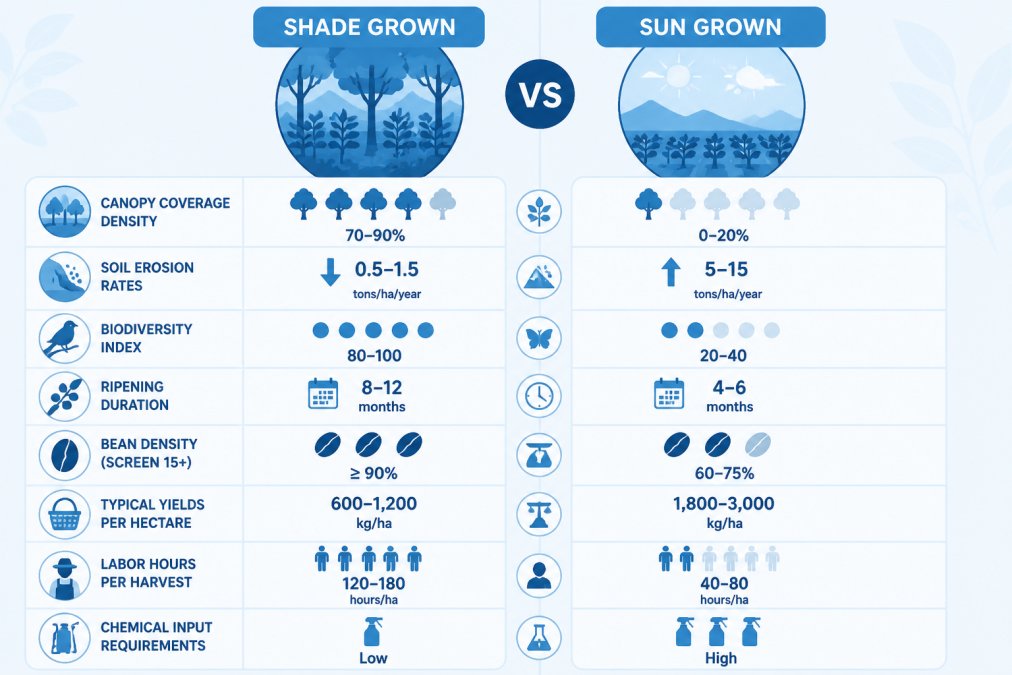
The distinction between shade grown vs sun grown coffee centers on production methods, environmental footprint, and the resulting bean characteristics. Sun-grown coffee receives direct, unfiltered sunlight throughout the day, accelerating plant growth and cherry ripening. This approach maximizes yield per acre and reduces labor costs during harvest, making it the dominant method for commodity-grade coffee production worldwide.
Shade-grown systems operate on a fundamentally different logic. Coffee plants receive dappled, filtered sunlight through the canopy layer above. This slower ripening produces denser beans with more developed flavor compounds, thicker cell walls, and greater complexity during extraction. The trade-off is lower yield per acre and higher labor requirements for harvesting across a more complex terrain.
| Characteristic | Shade-Grown | Sun-Grown |
|---|---|---|
| Canopy Coverage | Dense tree layer above | Minimal vegetation |
| Ripening Speed | Slower (extended development) | Faster (direct sun exposure) |
| Bean Density | Higher (denser cellular structure) | Lower (less compact) |
| Soil Erosion Risk | Minimal (protected by canopy) | Higher (exposed topsoil) |
| Biodiversity | Rich ecosystem preserved | Limited to coffee plants |
| Typical Yields | Lower per acre | Higher per acre |
| Labor Intensity | Higher (complex terrain) | Lower (open fields) |
| Chemical Inputs | Fewer required | More fungicides/pesticides |
The practical implication for home brewers is significant. Shade-grown beans typically require different brewing parameters than sun-grown varieties. The denser cellular structure means water penetration takes longer, favoring slightly hotter water temperatures and extended contact times. Many specialty coffee roasters adjust their roast profiles specifically for shade-grown beans to highlight their natural complexity rather than mask it.
Benefits of Shade-Grown Coffee for Quality and Flavor
The flavor profile of shade-grown coffee reflects its slower development. Extended ripening under filtered sunlight allows sugars to accumulate more gradually and flavor compounds to mature more fully. This produces beans with greater depth, smoother mouthfeel, and more nuanced tasting notes compared to sun-grown alternatives.
Common tasting characteristics in shade-grown coffee include chocolate undertones, subtle fruit notes, and reduced bitterness. The slower ripening process concentrates natural sweetness without the harsh, burnt-edge quality sometimes found in sun-grown beans rushed to maturity. For coffee connoisseurs, this translates to a cup that reveals different layers across multiple sips rather than a flat, one-dimensional profile.
The specialty coffee industry recognizes these quality differences consistently. Single-origin shade-grown beans from regions like Peru, Uganda, and Sumatra command premium pricing specifically because the slower ripening process produces superior cup characteristics. Roasters and home brewers report that shade-grown beans maintain their flavor complexity across multiple brewing methods, from French press to espresso machines, without becoming astringent or over-extracted.
Environmental Impact and Sustainability
The environmental case for shade-grown coffee rests on several interconnected systems. The preserved canopy layer prevents soil erosion, which matters significantly in mountainous coffee-growing regions where heavy rains would otherwise strip topsoil. This protection extends the productive life of the land itself, shade-grown farms can maintain fertility across generations, while sun-grown operations often require increasing chemical inputs to compensate for soil degradation.
Carbon sequestration represents another measurable benefit. The shade trees actively absorb and store atmospheric carbon dioxide, contributing to climate change mitigation at the farm level. Research from the Smithsonian Migratory Bird Center's coffee research program demonstrates that shade-grown systems store significantly more carbon than sun-grown monocultures, making them a legitimate climate adaptation strategy for coffee-producing regions.
Biodiversity preservation is perhaps the most visible environmental distinction. Shade-grown farms maintain habitat for migratory birds, insects, small mammals, and countless other species that have declined dramatically on sun-grown plantations. The canopy structure creates a forest-like microclimate that supports ecological complexity. For bird populations specifically, shade-grown coffee farms represent critical stopover habitat during spring and fall migrations.
The sustainability angle extends to farmer livelihoods. Shade-grown systems reduce dependence on chemical inputs, fungicides, pesticides, and synthetic fertilizers, lowering both production costs and environmental contamination. Farmers growing shade-grown coffee often report greater economic resilience because the diversified canopy provides secondary income from shade-tree products and reduced vulnerability to coffee-specific diseases.
Bird Friendly Coffee Certification and What to Look For
Bird Friendly certification represents the gold standard for shade-grown coffee verification. Established through the Smithsonian Migratory Bird Center, this certification requires rigorous standards beyond simple shade-grown claims. Certified farms must maintain a minimum canopy coverage, preserve native tree species, avoid synthetic pesticides, and meet specific biodiversity metrics verified through on-site audits.
When shopping for coffee, Bird Friendly certification signals that your purchase directly supports habitat preservation for migratory species. The certification process is transparent and independently verified, making it a reliable indicator of genuine environmental stewardship rather than marketing language.
Other relevant certifications include Rainforest Alliance and Fair Trade designations, though these focus primarily on labor practices and broader sustainability rather than specific biodiversity outcomes. Many shade-grown coffees carry multiple certifications simultaneously. When evaluating shade grown coffee options, prioritize Bird Friendly certification if your primary concern is migratory bird habitat protection.
The certification landscape matters because "shade-grown" itself remains an unregulated marketing term. Any producer can claim shade-grown status without independent verification. Third-party certifications provide accountability and ensure your premium pricing actually supports the environmental outcomes you're seeking. Brewtiful Coffee US offers single-origin beans from Uganda, Kenya, Sumatra, Peru, Mexico, and Bali, sourced from certified sustainable farms, ensuring that your choice aligns with stated environmental values.
Cost Analysis: Is the Premium Price Justified?
The price premium for shade grown coffee is worth the extra cost when evaluated across multiple dimensions. Understanding where that premium originates helps contextualize the investment.
Lower yields per acre represent the primary cost driver. A shade-grown farm produces roughly 40-50% less coffee per acre compared to sun-grown operations, meaning fixed costs (land, infrastructure, labor) distribute across fewer bags of finished coffee. The slower ripening process also extends the harvest window, increasing labor costs during picking and processing phases.
Processing and quality control add additional expense. Shade-grown beans require more careful handling to preserve their delicate flavor compounds. Specialty roasters invest in smaller-batch roasting and more precise temperature management to highlight the complexity that shade-grown cultivation develops. This meticulous approach costs more than commodity roasting but delivers substantially better cup quality.
For home brewers, the value proposition hinges on use case and priorities.
How to Brew Shade-Grown Coffee for Best Results
Brewing shade-grown coffee successfully requires understanding how its dense bean structure affects water extraction. The denser cellular composition means water penetrates more slowly than it does with sun-grown beans, necessitating adjusted parameters.
Conclusion: Making Your Decision
Whether is shade grown coffee worth the extra cost ultimately depends on your priorities and brewing habits. The environmental case is substantial, shade-grown systems preserve biodiversity, sequester carbon, protect soil health, and reduce chemical contamination. The flavor case is equally compelling for coffee enthusiasts who appreciate complexity and nuance in their daily cup.
Frequently Asked Questions
Why is shade-grown coffee better for the environment?
Shade-grown coffee systems preserve forest canopy, which protects migratory bird habitats and prevents soil erosion. The shade trees also sequester carbon and reduce the need for chemical inputs like pesticides and fertilizers. Unlike monoculture sun-grown farms, shade-grown agroforestry maintains ecosystem services and biodiversity. This sustainable agriculture approach protects water quality and builds long-term soil health, making it a genuine investment in climate resilience.
Does shade-grown coffee actually taste different than sun-grown?
Yes. Shade-grown beans develop a denser structure because they ripen more slowly under the canopy, creating a more complex flavor profile. The slower ripening allows coffee cherries to accumulate more sugars and acids, resulting in brighter acidity, richer body, and smoother taste without bitterness. Many specialty coffee roasters prefer shade-grown arabica for this reason. The microclimate created by shade trees also influences the bean's unique characteristics, which is why single-origin shade-grown lots command premium prices.
What certification should I look for to ensure my coffee is shade-grown?
Look for Bird Friendly Coffee Certification, the gold standard for shade-grown verification, or Rainforest Alliance certification. These labels guarantee that coffee was grown under sufficient canopy cover with minimal chemical inputs. Organic certification also indicates sustainable practices, though it doesn't specifically verify shade-grown methods. Check the bag for transparency in the supply chain. Certification ensures you're actually getting what you're paying for.
Is shade-grown coffee worth buying if I'm not a coffee connoisseur?
Absolutely. You don't need advanced brewing skills to notice the difference. Shade-grown coffee produces noticeably smoother, less bitter cups with richer aroma, qualities any coffee drinker appreciates. The slower ripening creates naturally sweeter beans that taste better even with basic brewing methods. If you've experienced bitterness with other premium beans, shade-grown varieties often solve that problem. Many home brewers find that the improved taste justifies the cost, especially when bought in quantities that work for your household or shared across a small business pantry.