

Smooth Coffee With No Bitterness: A Subscription Guide
Table of Contents
- What Makes Coffee Smooth Instead of Bitter
- How to Reduce Bitterness in Coffee
- Single-Origin Coffees With Smooth Flavor Profiles
- Signature Blends for Consistent Smoothness
- Best Coffee for Office Kitchens and Pantries
- Coffee Subscription for Businesses and Corporate Gifts
- Specialty Coffee Gift Boxes: Smooth Selections
- Frequently Asked Questions
Last Updated: October 9, 2026
What Makes Coffee Smooth Instead of Bitter
Bitterness in coffee isn't inevitable. Understanding what creates smooth coffee no bitterness is the first step to brewing better cups.
Three factors separate a smooth cup from an astringent one: roast level, bean origin, and freshness.
At Brewtiful Coffee US, we focus on medium-roasted single-origin and blended coffees chosen for smooth flavor profiles. Coffees from Brazil and Peru develop cocoa, caramel, and chocolate notes that feel rich rather than sharp.

The Role of Roast Level and Origin
Medium roasts are the sweet spot for smooth flavor with no bitterness, developing enough body and sweetness to feel substantial while avoiding the harsh compounds of darker roasts.
Single-origin coffees carry their own flavor signatures. Brazilian beans grown in volcanic soil produce low-acid cups with cocoa and nutty undertones; Peruvian coffees develop caramel sweetness and silky texture.
Processing matters too. Our Brazil Santos uses pulped-natural processing to enhance its cocoa notes.

Freshness and Storage Impact on Flavor
Stale coffee tastes bitter. Oxidized beans lose their nuanced flavors and develop harsh, papery notes. Freshness is non-negotiable for smooth coffee no bitterness.
Coffee peaks 5-14 days after roasting, when CO2 has mostly escaped but the beans haven't lost their volatile aromatics. Buy from roasters who date their bags.
Store beans in an airtight container away from heat, light, and moisture.
How to Reduce Bitterness in Coffee
Bitterness is a family of compounds. Caffeine contributes mild, clean bitterness; chlorogenic acid lactones taste sharply bitter; phenylindanes from dark roasts deliver lingering harshness that milk can't hide.
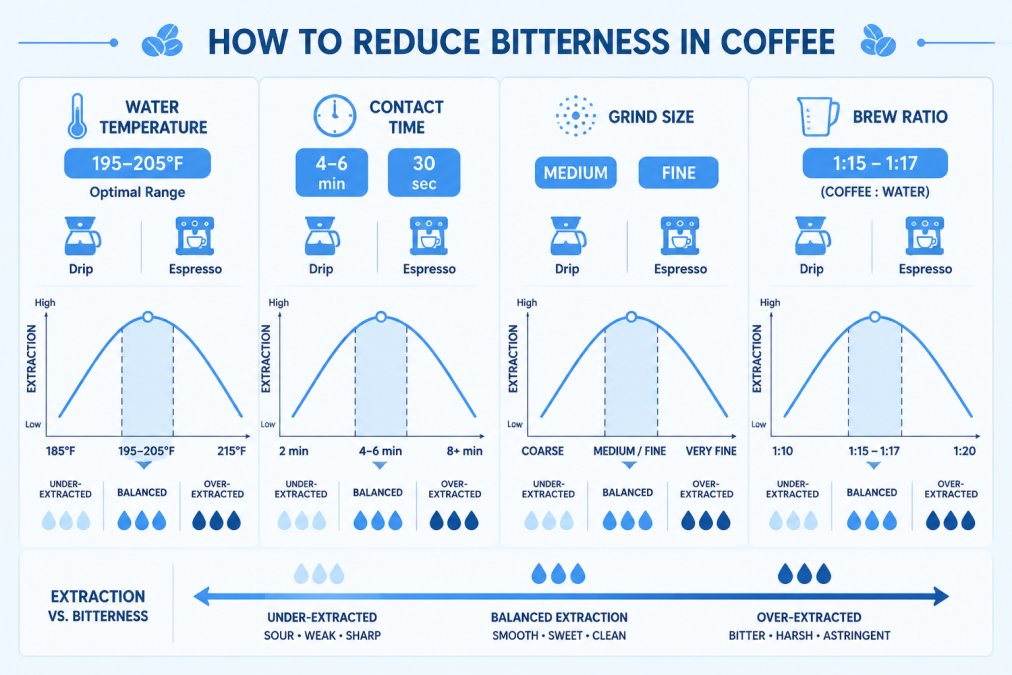
Over-extraction pulls too many compounds from the grounds; under-extraction leaves the cup sour and thin. The goal is even extraction across every particle.
Five variables control that balance: water temperature, contact time, grind size, brew ratio, and agitation. Most people adjust only the first three.
Brewing Temperature and Extraction Time
Water between 195-205°F extracts coffee smoothly. Hotter water pulls bitter compounds faster; cooler water under-extracts, leaving the cup sour and thin.
Aim for 4-6 minutes of contact time for drip, 4 minutes for French press, and 25-30 seconds for espresso.
If coffee tastes bitter, reduce brew time by 30 seconds; if sour or weak, increase time slightly or use hotter water. Most people over-extract, so start by shortening your brew.
Grind Size and Bean Selection
Finer grinds speed extraction; coarser grinds slow it down. Match grind to method: medium-fine for drip, medium for French press, fine for espresso. Too-fine grinds clog drip filters, extend contact time, and produce the bitterness you're avoiding.
Whole beans stay fresher than pre-ground, which oxidizes quickly and tastes stale within days. Grind just before brewing, and choose a subscription offering whole bean or a grind matched to your brewer.
Water Chemistry and Brew Ratio
Water is 98-99% of your cup, so chlorine or sulfur in tap water transfers directly to the coffee.
Brew ratio matters as much as grind. Start at 1:15 to 1:17 (one gram coffee to 15-17 grams water). A 1:12 ratio tastes heavy and bitter; 1:20 tastes weak and sour.
Agitation is the variable most people ignore. Stirring a French press or pouring too aggressively increases extraction.
The bean itself matters. Arabica beans naturally taste smoother than Robusta, and Brewtiful Coffee US uses 100% Arabica across all offerings. For offices and shared kitchens, medium roast Arabica holds up better in a carafe than dark roast because it has fewer phenylindanes.
Single-Origin Coffees With Smooth Flavor Profiles
Single-origin coffees let you taste a specific place. Unlike blends, which balance flavors across sources, single-origins showcase what makes one region distinctive. For smooth flavor with no bitterness, certain origins consistently deliver.
Brazil Santos: Cocoa and Elegance
Brazil Santos is the gold standard for smooth, low-acid coffee.
Medium roast preserves these qualities while developing deeper cocoa notes. It works in drip machines, French press, and espresso, and it's a reliable choice for anyone seeking smooth flavor with no bitterness.
The Fazenda Santa Barbara, where our beans originate, uses pulped natural processing and are dried in the Sun. This elevation and volcanic loam soil create naturally balanced, sweet beans.
Peru: Caramel Sweetness Without the Bite
Peru delivers silky sweetness with a clean finish.
Medium roast enhances the natural sweetness. Traditional gully-washing creates a cleaner cup, translating to smooth flavor with no bitterness where citrus feels refreshing rather than acidic.
This is an excellent single-origin for people exploring specialty coffee, forgiving across brewing methods and exceptional black or with minimal additions.
Peru Decaf: Smooth Flavor, No Caffeine
Peru Decaf proves decaf doesn't have to taste thin or stale. Using the chemical-free Swiss Water Process, it retains the caramel and citrus character of its caffeinated sibling.

Many decafs taste hollow because standard decaffeination strips flavor compounds along with caffeine.
For people sensitive to caffeine or avoiding it after 2 PM, this is a legitimate option that doesn't sacrifice quality, making it an easy addition to any rotation.
Signature Blends for Consistent Smoothness
Blends combine beans from multiple origins for consistent flavor and balance. While single-origins celebrate regional character, blends prioritize reliability, and the best taste the same cup to cup because roasters adjust ratios for seasonal variations.
Breakfast Blend: South American Smoothness
Breakfast Blend is a medium roast built entirely from South American coffees.
Brazil and Peru both produce sweet, full-bodied beans, so blending them amplifies these characteristics while softening individual quirks.
This is an entry point into specialty coffee for people who want smooth flavor with no bitterness without exploring single-origins. It's consistent, forgiving, and works with any brewing method.
House Blend: Balanced and Clean
House Blend combines Central and South American coffees into a medium roast that tastes smooth, clean, and consistent, with nutty, sweet chocolate, mild citrus, and a bright finish.
This blend uses both natural and washed processing. Natural processing adds body and sweetness; washed adds clarity and brightness. Together they create balance: smooth flavor with no bitterness, plus enough complexity to stay interesting.
These blended coffees are both natural/dry processed and wet mill washed/sun dried.
Best Coffee for Office Kitchens and Pantries
Shared coffee spaces have unique demands: the coffee must satisfy diverse palates, hold up in bulk brewing, and taste good whether drunk immediately or 20 minutes later.
Medium roasts work better than dark roasts for office use, tasting less burnt when held at temperature.
For small businesses, employee kitchens, and corporate pantries, our Breakfast Blend and House Blend are ideal.
Consider ordering through our wholesale options for bulk quantities and corporate gifting.
Coffee Subscription for Businesses and Corporate Gifts
A business coffee subscription differs from a personal one. A shared kitchen needs a roast that holds up in a carafe, a grind matching the brewer on site, and a delivery schedule that doesn't leave the pantry empty on Monday. In a corporate setting, smoothness is a logistics problem as much as a flavor problem.
Why Smooth Flavor Matters in Shared Spaces
Bitter coffee creates tension in shared spaces. Upgrading to smooth, quality coffee eliminates that friction while showing employees and clients you care about the details.
Corporate clients appreciate consistency. A subscription ensures fresh coffee arrives on a predictable schedule, so employees experience the same quality every week.
For holiday gifts, smooth specialty coffee signals thoughtfulness: personal without being intrusive, luxurious without being extravagant. A bag of Brazil Santos or Peru says you understand quality.
Matching Grind and Format to Your Brewer
A subscription shipping a single universal grind will taste bitter in a French press and sour in an espresso machine.
If your team is split between drip and espresso, a whole-bean subscription with an on-site grinder gives the most flexibility. Brewtiful Coffee US offers whole bean and ground options and can match the grind to your brewer when you set up a wholesale account.
Delivery Frequency, Bag Size, and Storage
A 5-person office drinking two pots a day goes through roughly 1.5 to 2 pounds weekly; a 20-person office with a single pot uses about 3 to 4 pounds.
Bag size matters too. A 12-ounce bag suits a small pantry; a 5-pound bulk bag lowers cost per cup but needs an airtight container and use within 3-4 weeks of roast.
Flexibility and Cancellation Terms to Check
Before committing a business account, ask three questions: Can you skip a delivery during a holiday week? Pause during a slow season? Change frequency without penalty?
Confirm the roast date policy: shipping within 1-3 days of roasting gives a longer window of peak flavor than shipping from stock. A gift matching the recipient's brewer is more likely to be used.
Wholesale Options for Bulk Orders
Brewtiful Coffee US offers wholesale options for businesses ordering in volume.
Contact our team directly for bulk ordering and customized subscription plans. We work with businesses of all sizes, from 5-person startups to large corporate clients. Wholesale customers receive priority shipping and flexible delivery schedules.
Offering quality coffee to clients creates a better first impression than cheap alternatives, and the perception shift is significant.
Specialty Coffee Gift Boxes: Smooth Selections
Gift boxes combining multiple smooth coffees create a curated experience.
A gift box might include Brazil Santos for cocoa richness, Peru for caramel sweetness, and House Blend for everyday reliability, showing progression from single-origin exploration to blended consistency.
For people who don't identify as coffee connoisseurs, this removes the intimidation factor. Each coffee tastes smooth and balanced, so the recipient can't make a "wrong" choice.
Brewtiful Coffee US packages these selections with care, emphasizing freshness and each origin's story, so a gift box becomes an experience, not just a product.
Smooth coffee with no bitterness comes down to quality beans, a respectful brewing process, and freshness. Our Brazil Santos, Peru, and signature blends deliver the smooth flavor with no bitterness you're seeking, with free shipping nationwide and wholesale options for businesses.
Frequently Asked Questions
What makes coffee taste smooth instead of bitter?
Smoothness comes from medium roasts, proper brewing temperature (195-205°F), and shorter extraction times. Single-origin coffees from regions like Peru and Brazil naturally have lower bitterness due to their altitude and processing methods. Freshness also matters: beans roasted within the past 2-4 weeks deliver cleaner, smoother flavor. Over-extraction and high heat pull out harsh compounds that create bitterness.
How can you reduce bitterness when brewing coffee at home?
Use a coarser grind to slow extraction, brew at 195-205°F instead of boiling water, and limit contact time to 3-5 minutes depending on your method. Choose medium roasts over dark roasts, which contain more bitter compounds. If you use a French press, pour off the coffee before sediment settles. Fresh beans roasted within weeks also taste significantly less bitter than older stock.
What coffee works best for an office kitchen or employee pantry?
Medium roast blends like the House Blend or Breakfast Blend are ideal for shared spaces because they appeal to most palates without harsh aftertaste. They're consistent batch to batch, so employees know what to expect. These blends also work well with standard office equipment. For businesses looking to stock quality coffee, wholesale options make it easy to supply multiple bags while managing costs for employee benefits.
Which coffee roast has the least bitterness?
Light to medium roasts have less bitterness than dark roasts. Medium roasts like Peru, Brazil Santos, and the House Blend strike a balance between flavor complexity and smoothness. Light roasts preserve origin characteristics but can taste sharp to some. Dark roasts develop bitter, charred notes. For subscription boxes focused on smooth flavor, medium roasts consistently deliver the cleanest, least bitter experience.
How fresh should coffee beans be when they arrive in a subscription box?
Beans should be roasted within 2-4 weeks before arrival. Check the roast date on the bag, not just the expiration date. Fresher beans taste noticeably smoother and have more vibrant flavor. Stale beans develop flat, sometimes bitter notes. Store beans in an airtight container away from light and heat. Whole beans stay fresh longer than ground coffee, so whole bean subscriptions deliver better flavor over time.