

Best Water Temperature for Pour Over Coffee
Table of Contents
- Why Pour Over Temperature Decides How Your Coffee Tastes
- The Best Coffee Brewing Temperature Range: 195°F to 205°F
- Water Temperature for Light Roast Coffee
- Water Temperature for Dark Roast Coffee
- A Repeatable Pour Over Temperature Workflow, Step by Step
- Gooseneck Kettle With Temperature Control: What Actually Matters
- Temperature by Brewer and Recipe: V60, Chemex, Kalita, and Flat-Bed Drippers
- Troubleshooting Sour, Bitter, or Weak Pour Over Coffee
- Frequently Asked Questions
Last Updated: October 12, 2026
Why Pour Over Temperature Decides How Your Coffee Tastes
Water that is too cool leaves flavor locked in the grounds. Water that is too hot pulls out bitterness you never wanted. The best water temperature for pour over coffee sits in a narrow band, and staying inside it is the single biggest upgrade most home brewers can make. At Brewtiful Coffee, we roast beans that deserve that care.
Here is the short version: aim for 195°F to 205°F (90°C to 96°C). Miss low and you get sour, thin coffee. Miss high and you get bitter, harsh coffee. Hit the range and the cup tastes sweet, balanced, and clean.
Temperature is not a detail. It is the main dial.
How Heat Pulls Flavor Out of Ground Coffee
Extraction is the process of hot water dissolving soluble compounds from ground coffee. Heat is the engine that drives it.
Hotter water dissolves more, and faster. Cooler water dissolves less, and slower. That is the whole story in two sentences.
Think of it like steeping tea. A quick dip in warm water gives you colored water. A long steep in hot water gives you actual tea. Coffee works the same way, just with more moving parts:
- Acids and fruit notes dissolve first, and they dissolve easily
- Sugars and caramel sweetness come out in the middle of the brew
- Bitter plant compounds dissolve last, and only when pushed
So temperature controls which of those three groups ends up in your mug. That is why a few degrees matter more than most people expect.
The Best Coffee Brewing Temperature Range: 195°F to 205°F
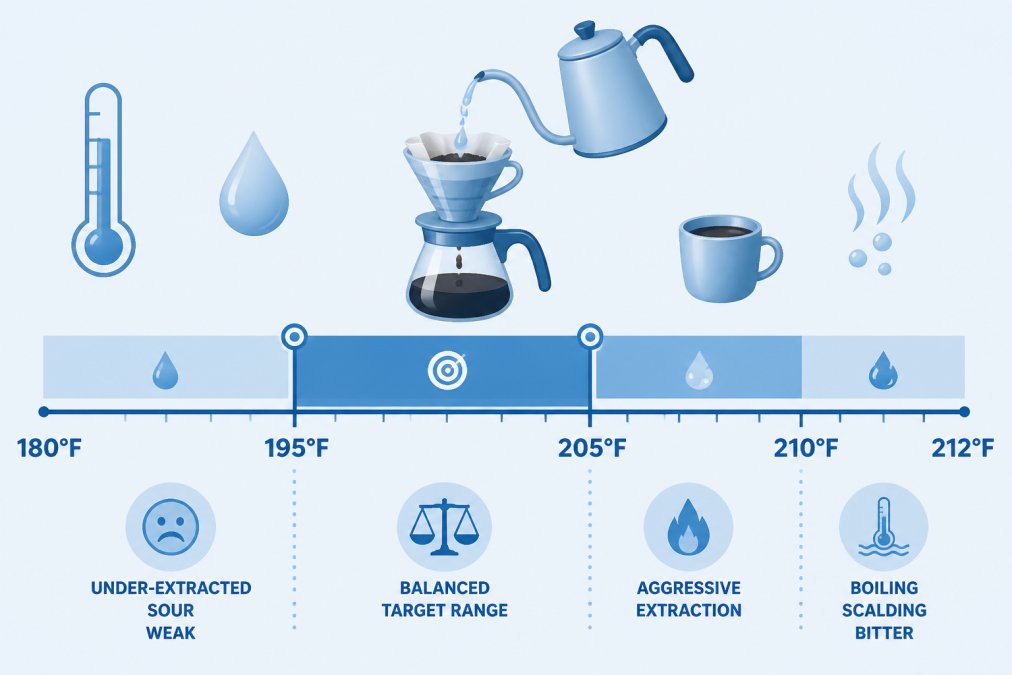
The best water temperature for pour over coffee is 195°F to 205°F (90°C to 96°C). This range, recommended by the Specialty Coffee Association brewing standards, extracts sweetness and acidity without dragging out bitterness. Most pour over recipes land around 200°F.
What Happens Below 195°F and Above 205°F
Below 195°F, water cannot pull the sugars out in time. The result is under-extraction: sour, salty, thin coffee that tastes like it needs another minute. Many people blame their beans. Usually it is the water.
Above 205°F, extraction runs too fast. You get over-extraction: bitterness, dryness, and an ashy finish that lingers. Boiling water at 212°F is the worst offender.
Water Temperature for Light Roast Coffee
Light roasts need the hot end of the range: 200°F to 205°F. These beans are denser and less porous, so water struggles to reach the center of each particle.
A cooler pour leaves light roasts tasting grassy and sharp. Push the temperature up and those bright citrus and berry notes finally show up.
We roast our Colombia single origin to a medium level, with dried orange, berry, and chocolate in the cup. Slightly hotter water for a lighter roast, slightly cooler for a darker one, and the same bean tastes completely different.

Water Temperature for Dark Roast Coffee
Dark roasts want the cooler end: 195°F to 200°F. The roasting process already broke down the bean's structure, so flavor escapes fast.
Too much heat here turns a chocolatey cup into a bitter one within seconds. Drop the temperature and you get smooth, sweet, low-acid coffee instead.
This is the fix for the most common complaint we hear: "my dark roast always tastes burnt." It is usually not the roast. It is 212°F water hitting fragile grounds.
A Repeatable Pour Over Temperature Workflow, Step by Step
This workflow works on any pour over brewer. It takes about four minutes and gives you the same cup every morning.
Total time: 4 minutes You'll need: a gooseneck kettle, a thermometer or variable-temperature kettle, a scale, a dripper, a filter, and 20 grams of coffee
- Heat to 205°F. Start slightly above target. Water cools as it travels through the air and into the slurry.
- Rinse the filter. Pour hot water through the paper, then dump it. This warms the brewer and removes papery taste.
- Add 20g of coffee, medium grind. Level the bed with a gentle shake.
- Bloom with 40g of water. Pour in circles, wait 30 to 45 seconds. Fresh coffee will bubble and puff.
- First pour to 140g. Pour slowly in spirals from the center out. Keep the water level steady.
- Second pour to 320g. Finish the pour, then let it drain.
- Drawdown should finish around 3:00 to 3:30 total.
Bloom, First Pour, Second Pour, Drawdown
Each stage has a temperature job. The bloom releases trapped gas so water can reach the grounds evenly. The first pour does most of the flavor work. The second pour tops off volume without over-extracting. Drawdown is your report card: too fast means too coarse, too slow means too fine.
If your kettle has no thermometer, boil, then wait. Forty-five seconds off the boil lands near 200°F in a typical kitchen.
Gooseneck Kettle With Temperature Control: What Actually Matters
A gooseneck kettle with temperature control is the one piece of gear that changes your results most. The narrow spout gives you a slow, steady pour, and the thermostat holds your target temp instead of guessing.
What matters when you shop:
| Feature | Why It Matters | What to Skip |
|---|---|---|
| Temperature range | Needs to hold 195°F to 205°F | Kettles that start at 160°F |
| Hold function | Keeps temp for 30-60 min | Kettles that cool while you pour |
| Spout shape | Slow, controlled flow | Wide spouts that dump water |
| Capacity | 0.8-1.0 L for 1-2 cups | Oversized kettles that heat slowly |
Skip the smart app features. You will use them twice. Spend the money on a stable hold function instead.
Temperature by Brewer and Recipe: V60, Chemex, Kalita, and Flat-Bed Drippers
Different brewers lose heat at different rates. A thin-walled cone bleeds heat fast. A thick glass brewer holds it. That changes your starting temperature. But temperature alone is not a recipe. Dose, ratio, grind, and pour schedule all interact with heat, so the numbers below are starting points you can reproduce, then adjust one variable at a time.
| Brewer | Starting Temp | Dose | Ratio | Grind | Pour Schedule |
|---|---|---|---|---|---|
| V60 | 200-205°F | 20 g | 1:16 | Medium-fine | Bloom 40 g, 30-45 sec; pour to 160 g; pour to 320 g; drawdown 3:00-3:30 |
| Chemex | 205°F | 30 g | 1:16 | Medium-coarse | Bloom 60 g, 45 sec; pour to 250 g; pour to 480 g; drawdown 4:00-4:30 |
| Kalita Wave | 200-203°F | 20 g | 1:16 | Medium | Bloom 40 g, 30-45 sec; three even pours to 320 g; drawdown 3:00-3:30 |
| Flat-bed drippers | 200-205°F | 20 g | 1:16 | Medium | Bloom 40 g, 30-45 sec; pulse pours to 320 g; drawdown 3:00-3:30 |
The pattern is simple: the more heat your setup loses, the hotter you start. Preheating your brewer and mug closes most of that gap. A thick Chemex filter absorbs heat, so start at 205°F. A thin V60 cone loses heat quickly, so 200-205°F keeps the slurry in range. Kalita's flat bed extracts evenly, so 200-203°F avoids pushing bitterness.
If you are brewing for an employee kitchen benefit or a corporate client pantry, scale the same ratios. For 10 cups at 1:16, use 100 g of coffee and 1,600 g of water, hold the kettle at 200-205°F, and preheat the server. A variable-temperature gooseneck kettle with a 1.0 L capacity handles a small office batch without cooling mid-pour. For holiday gift ideas, pair a brewer with a bag of medium roast and a printed recipe card so the recipient can repeat the cup.
For wholesale inquiries, our wholesale program supplies offices, cafes, and corporate gifting with fresh-roasted beans and brew guides tailored to your equipment.
Troubleshooting Sour, Bitter, or Weak Pour Over Coffee
Taste the cup, then change one thing at a time. That is the whole method. Use this decision tree to move from symptom to fix without guessing.
Step 1: Check brew time. If drawdown finishes before 2:30, your grind is too coarse. If it runs past 4:00, your grind is too fine. Fix grind first, then temperature.
Step 2: Match the taste to the variable.
- Sour or sharp? Water was too cool. Raise it 5°F. If it is still sour after two adjustments, tighten the grind one notch.
- Bitter or dry? Water was too hot. Lower it 5°F. If bitterness persists, coarsen the grind slightly.
- Weak and watery? Either the water was cool or the grind is too coarse. Fix temperature first, then grind.
- Hollow and bitter at once? Your grind is too coarse and your water too hot. Tighten the grind, drop the temp.
- Flat and lifeless? Your water may lack minerals. Try a different source before changing temperature again.
Change one variable per brew. Two changes at once and you learn nothing. Keep a simple log: date, dose, grind setting, temperature, drawdown time, and taste. After three brews you will see the pattern.
Water Composition, Altitude, and Why Your Boiling Point Moves
Two things quietly change your numbers: your water and your elevation.
Water with very low mineral content extracts poorly, no matter the temperature. A pinch of minerals helps. Distilled water makes flat coffee. If your coffee tastes flat and you have ruled out temperature and grind, try a different water source before you buy new beans. Water is the ingredient you never think about.
Altitude matters more. Water boils at a lower temperature the higher you go, so a kettle at 212°F in a lowland kitchen may only reach the mid-190s in the mountains. If you brew above 3,000 feet, your "boiling" water may already be too cool for light roasts. Add a thermometer and adjust upward.
If you are selecting beans for a small business, employee kitchen benefit, or holiday gift, our wholesale program offers curated pantry selections and volume pricing for corporate accounts.
Frequently Asked Questions
What is the best water temperature for pour over coffee?
Most pour over recipes land between 195°F and 205°F. Start at 200°F for a medium roast, then adjust by taste. If the cup tastes sour or thin, raise the pour over temperature by 3 to 5 degrees. If it tastes bitter or drying, drop it by the same amount. A variable-temperature kettle makes those small moves repeatable instead of guesswork.
Should I use hotter water for light roast coffee?
Yes. Light roast beans are denser and less soluble, so the water temperature for light roast coffee usually sits at the top of the range, around 200°F to 205°F. That extra heat helps you pull sweetness and fruit notes out before the brew turns sour. If a light roast still tastes grassy at 205°F, grind finer before pushing the temperature any higher.
How long should I wait after boiling water before pouring?
With a gooseneck kettle with temperature control, no waiting is needed because you set the target directly. If you only have a stovetop kettle, boiling water cools to roughly 200°F in about 30 to 45 seconds when poured into a room-temperature kettle or pitcher. A quick-read thermometer removes the guesswork entirely, since cooling speed shifts with kettle material, volume, and room temperature.
What should I change if my pour over coffee tastes sour or bitter?
Sour, thin coffee usually means under-extraction, so raise the coffee brewing temperature by 3 to 5 degrees or grind slightly finer. Bitter, drying coffee points to over-extraction, so lower the temperature or coarsen the grind. Change one variable at a time and keep the coffee-to-water ratio, pour timing, and brew time steady so you can tell which adjustment actually fixed the cup.