

Brewing Coffee at Home vs Coffee Shop: 2026 Benefits
Table of Contents
- Cost of Brewing Coffee at Home vs Coffee Shop: The Real Numbers
- How to Make Cafe Quality Coffee at Home Without a Barista
- Caffeine Content in Home Brewed Coffee: Why You Get More Control
- Freshness, Customization, and the Sensory Experience at Home
- Sustainability and Waste: Home Brewing vs Disposable Cups
- Morning Routine, Convenience, and the Social Trade-Off
- Frequently Asked Questions
Last Updated: September 13, 2026
Cost of Brewing Coffee at Home vs Coffee Shop: The Real Numbers
Brewing coffee at home costs a fraction of what a coffee shop charges for the same daily habit, and the gap widens every month. This guide from Brewtiful Coffee US breaks down the real numbers behind the benefits of brewing coffee at home vs coffee shop.
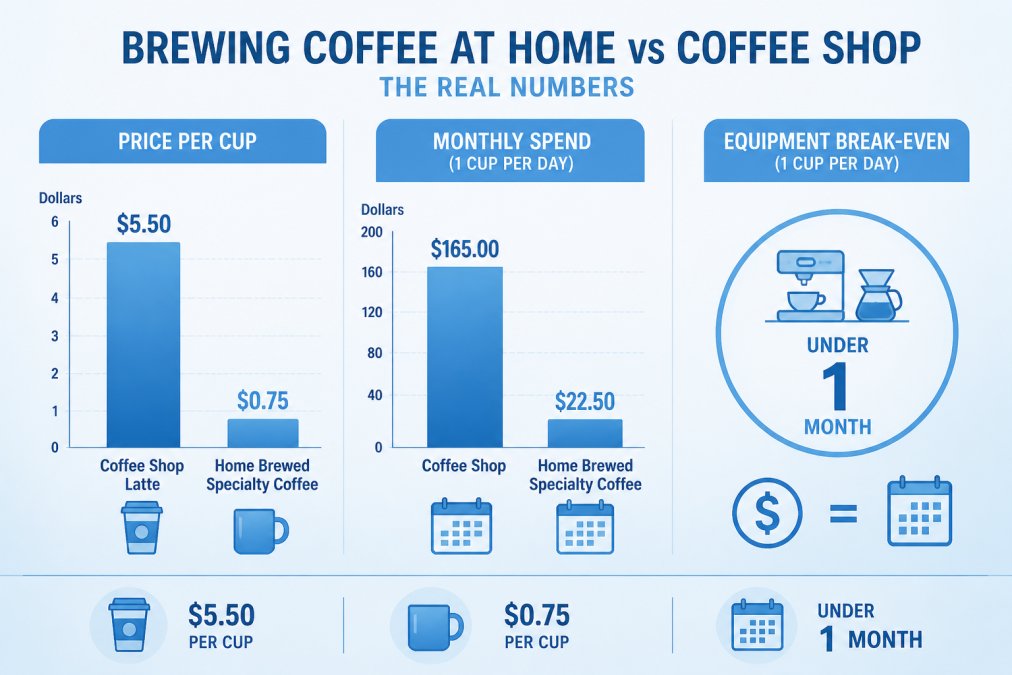
Here's the core math. A daily coffee shop latte runs about $5.50; a home-brewed cup from fresh-roasted specialty beans lands closer to $0.75. Over a month of one cup per day, that's roughly $165 at the shop versus about $22.50 at home, and the equipment usually pays for itself within weeks.
Daily Expenditure and Price Per Cup Breakdown
The price per cup at home depends on three things: what you pay for beans, how much you use per brew, and what you spent on gear. A 12-ounce bag of fresh-roasted specialty coffee typically yields 16 to 20 cups in a drip brewer, putting the coffee cost per cup in the $0.50 to $0.75 range (usda.gov). Add milk, and you're still well under a dollar.
Equipment ROI: What You Spend vs What You Save
Equipment ROI is the part competitors skip.
Spend $120 on a burr grinder and a French press, and at roughly $140 per month saved against daily coffee shop visits, that setup pays for itself in under a month. From month two onward, the savings are yours.
| Setup | Upfront Cost | Cups Per Day | Monthly Home Cost | Monthly Shop Cost | Break-Even |
|---|---|---|---|---|---|
| Drip + pre-ground | Low | 1 | ~$22.50 | ~$165 | Under 1 month |
| French press + burr grinder | Medium | 1 | ~$22.50 | ~$165 | Under 1 month |
| Espresso machine + grinder | Higher | 2 | ~$45 | ~$330 | 2-3 months |
The espresso machine takes longer to pay off, but it replaces the drinks that cost the most at a shop. If your go-to order is a double latte, the math tilts toward home fast.
How to Make Cafe Quality Coffee at Home Without a Barista
Cafe quality coffee at home comes down to four variables a barista controls: bean quality, grind size, water quality, and extraction. Get those right and you don't need a barista, a commercial machine, or a $7 drink.
A common mistake is blaming the beans when the real problem is stale coffee or a grind that's too coarse. Fresh-roasted beans shipped soon after roasting make the biggest single difference.
Bean Quality, Grind Size, and Water Quality
Bean quality sets the ceiling on what your cup can taste like. Specialty-grade beans, roasted recently and stored away from light and air, give you sweetness and clarity commodity coffee can't match. Brewtiful Coffee US roasts fresh and ships nationwide, which matters because coffee starts losing its best flavors within weeks of roasting, not months.
Grind size controls how fast water pulls flavor from the grounds: too coarse gives a weak, sour cup, too fine gives bitterness and a clogged brew. Match the grind to your method: coarse for French press, medium for drip, fine for espresso.
Water quality is the variable nobody talks about. If your tap water tastes off, your coffee will too. Filtered water in the right mineral range lets the coffee's flavor come through instead of fighting it.
Matching Your Brewing Method to Your Flavor Profile
- French press: Full body, rich mouthfeel, oils left in. Best for dark roasts and whiskey barrel-aged beans.
- Pour-over: Clean, bright, highlights acidity and origin character. Best for single-origin light and medium roasts.
- Drip: Consistent and hands-off. Best for daily volume and medium roasts.
- Espresso: Concentrated and intense. Best for milk drinks and dark blends.
If you want to explore without committing to a full bag, a sample pack lets you taste across origins and roast levels before you pick a favorite.

Caffeine Content in Home Brewed Coffee: Why You Get More Control
Caffeine content in home brewed coffee is something you control directly, and that control is the real advantage over ordering blind at a counter. The amount in your cup depends on four levers you set yourself: the dose, the water-to-coffee ratio, the brew time and temperature, and the bean itself.
Start with the bean. Caffeine is present in the green coffee seed before roasting and survives largely intact. What changes is mass: darker roasts lose more water and organic material, so a scoop of dark-roasted grounds weighs less than the same scoop of light-roasted grounds. Measured by volume rather than weight, a dark roast can deliver slightly less caffeine per scoop, which is why the belief that darker equals stronger is misleading.
Now the levers. A standard 8-ounce cup of drip coffee generally lands between 95 and 165 milligrams of caffeine, depending on roast and dose (the FDA). Tighten that spread by weighing your coffee: a common starting ratio is about 1 gram of coffee to 16 grams of water, which for a typical medium roast puts a single 8-ounce cup near the lower-middle of that range. Want more? Increase the dose, not the brew time. Want less? Cut the dose or brew a smaller cup.
Espresso concentrates the same caffeine into a smaller volume, but the total per shot is often lower than people assume. A single shot carries roughly 60 to 75 milligrams, a double lands near 120 to 150 milligrams, comparable to a mug of drip, just in two ounces instead of eight. The intensity is in the concentration, not the total.
Here is where the shop comparison gets interesting. A shop drink's caffeine varies with the barista, the machine calibration, the bean blend, and the day. A large milk drink may carry two or three shots, or one. You cannot see the dose or the ratio, you get a cup and a guess. At home, you decide whether you want a gentle morning cup or a stronger one, and you can repeat it tomorrow because you wrote down what you did.
A few practical moves that give you real control:
- Weigh your beans. A cheap kitchen scale removes the biggest source of variance. Volume scoops of the same coffee can differ by several grams depending on grind and roast.
- Log your dose and ratio. Two numbers per brew. After a week you will know exactly how much caffeine you are drinking and how to adjust it.
- Pick your cup size deliberately. An afternoon cup does not have to be the same size as your morning one. Smaller cup, smaller dose, less caffeine, same ritual.
- Read the label on blends. Some blends mix robusta, which naturally carries more caffeine than arabica. If you are sensitive, arabica-only beans give you a more predictable baseline.
Don't assume a darker roast means more caffeine. Roast level changes flavor far more than caffeine, and because darker beans lose more mass during roasting, a volume scoop of dark roast can actually contain slightly less caffeine than the same scoop of light roast. Judge your intake by dose and cup size, not by how dark the beans look.
Caffeine control at home is not about willpower. It is about measurement. Weigh the dose, fix the ratio, log the result, and you replace a counter guess with a repeatable number.
Freshness, Customization, and the Sensory Experience at Home
Freshness and customization are the two benefits of home brewing that a coffee shop cannot reliably match. The deeper advantage most comparisons skip is the sensory experience itself, plus the nutritional transparency of making your own drink.
Start with freshness. Coffee begins losing its best aromatics within weeks of roasting, not months, and once ground the clock speeds up dramatically. A bag of pre-ground coffee has already spent most of its flavor before you open it. At home, you grind right before you brew, which preserves the volatile compounds that carry aroma and sweetness, a bigger upgrade than any new machine.
Now the sensory breakdown. A coffee shop sells more than coffee. It sells what sociologists call a third place: a space that is neither home nor work, where ambient noise, light, the smell of the grinder, and the hum of other people create a specific mood. That mood is real and worth something, but you do not control it. The music, the temperature, and the pace are chosen for you.
A home kitchen gives you the opposite trade. You lose the social hum but gain total control: the light, the quiet, the mug, the pace. You smell the grounds the moment they hit water, and that smell fills the room instead of vanishing at a counter. For a lot of people, that controlled environment is not a downgrade. The ritual is the product.

Customization is where the two experiences diverge most sharply, and where nutritional transparency becomes a genuine advantage. A shop drink is built to a recipe you usually cannot see. Flavored syrups, whipped toppings, sweet cream cold foam, and sauces add sugar and calories that are easy to underestimate, a large flavored latte can carry more sugar than a can of soda, and the menu board rarely says so. At home, you decide what goes in and see exactly how much.
That control extends to the details that make a cup feel special:
- Strength and temperature. You set the ratio and the serving temp. No guessing whether the barista steamed it too hot.
- Milk and sweetness. Whole, oat, almond, none at all. Sweetened or not. You see every addition.
- Add-ins. A whiskey barrel-aged roast adds a rich, subtly sweet character that is hard to find on a standard cafe menu. Cinnamon, cocoa, or a pinch of salt are yours to experiment with.
- Repeatability. When you land on a cup you love, you can make it again tomorrow. A shop drink depends on who is working.
If you want to see how much sugar and calories you are actually drinking, make your usual shop order at home once and measure every addition. Most people are surprised by how much of the sweetness came from syrup rather than coffee.
For customers who want a cup that feels a little special without a counter between them and the drink, a sample pack is a low-risk way to taste across origins and roast levels before committing to a full bag. The point is not to replicate a cafe. It is to build a cup that is yours, made in an environment you control, with every ingredient visible.
Sustainability and Waste: Home Brewing vs Disposable Cups
Waste management is where home brewing wins by a wide margin, and most comparisons ignore it. A daily coffee shop habit can mean hundreds of disposable cups a year, plus lids, sleeves, and stirrers. Even "recyclable" cups often aren't accepted locally because of their plastic lining (the EPA).
Brewing at home replaces all of that with one mug you reuse. You can also compost your coffee grounds, which return nutrients to soil instead of sitting in a landfill, and choosing beans from growers that prioritize fairtrade practices adds a social dimension to the environmental one.
Morning Routine, Convenience, and the Social Trade-Off
Convenience cuts both ways. A coffee shop saves you the few minutes of grinding and brewing, and it gets you out of the house. For some people, that wait time and the walk are the point.
The trade-off is real. Coffee shops offer socialization, a change of scenery, and someone else doing the work. Home brewing offers calm mornings, a setup tuned to your taste, and no line. Neither is wrong, the question is what you want from your morning.
For remote professionals and anyone building a daily ritual, home brewing tends to fit better. You control the pace, flavor, and cost, and you skip the wait. The one thing you give up is the social buzz of a busy cafe, which you can replace with a standing coffee date or a shared pot at home.
If you're weighing the two, track your real daily expenditure for a week. The numbers usually make the decision obvious.
The hardest part of switching to home brewing isn't the equipment or the technique. It's finding beans fresh enough to reward the effort, because stale coffee makes even good brewing feel pointless. Brewtiful Coffee US roasts fresh-roasted specialty beans and ships them nationwide with free shipping, from single-origin lots out of Uganda, Kenya, Sumatra, Peru, Mexico, and Bali to whiskey barrel-aged varieties that bring something new to your kitchen. If bitterness has burned you before, a sample pack is the low-risk way to find a roast you actually love. Get started with Brewtiful Coffee US and turn your daily cup into a ritual worth keeping.
Frequently Asked Questions
How much money can you save by brewing coffee at home?
The savings depend on your daily habits. A coffee shop latte runs about $5.50, while a home-brewed cup using fresh specialty beans averages $0.75 to $1.25 per serving. At one cup per day, that is roughly $130 to $165 per month at a cafe versus $25 to $38 at home. Even after buying a grinder and brewer, most people break even within three to four months.
Is it healthier to make coffee at home?
Brewing coffee at home gives you full control over what goes into your cup. You decide the caffeine content in home brewed coffee by adjusting grind size, water ratio, and brew time. You also skip the flavored syrups, whipped toppings, and added sugars common in coffee shop drinks. That means fewer hidden calories and a clearer picture of your daily caffeine intake.
Why does coffee shop coffee taste better than at home?
Cafes often use freshly roasted beans, precise grinders, and calibrated water temperature. The gap usually comes down to three things: bean freshness, grind size consistency, and water quality. Once you match those variables at home, the flavor difference shrinks fast. Using freshly roasted specialty coffee and a burr grinder closes most of the gap.
What equipment do I need to get cafe quality coffee at home?
A burr grinder, a scale, and a brewing method you enjoy are the core three. A French press or pour-over setup costs less than $40 and delivers excellent results. If you want espresso drinks, a home espresso machine is the bigger investment. Start with a sample pack of beans to find your preferred flavor profile before committing to a full bag.
Does brewing at home offer more control over caffeine intake?
Yes. When you brew at home, you control the coffee-to-water ratio, grind size, and extraction time, all of which affect how much caffeine ends up in your cup. A standard 8-ounce home brew contains roughly 95 to 165 milligrams of caffeine depending on the bean and method. At a coffee shop, you rely on the barista's recipe and have less visibility into the actual dose.