

How Long to Steep Cold Brew Coffee: A Complete Guide
Table of Contents
- The Ideal Steep Time for Cold Brew Coffee
- 12 vs. 24 Hour Cold Brew: Which Is Right for You?
- Cold Brew in the Fridge or on the Counter: Temperature's Role
- Cold Brew Coffee Ratio: Getting the Strength Right
- How to Strain Cold Brew Coffee Properly
- Grind Size and Its Effect on Steep Time
- Troubleshooting: When Your Cold Brew Doesn't Taste Right
- Frequently Asked Questions
Last Updated: October 18, 2026
The Ideal Steep Time for Cold Brew Coffee
Steep time separates a smooth, balanced cold brew from a flat or bitter one. Steep cold brew coffee is not just grounds sitting in water, timing matters far more than most people realize.

The standard steep time for cold brew coffee ranges from 12 to 24 hours, depending on grind size, water temperature, and desired strength (Physiochemical Characteristics of Hot and Cold Brew Coffee Chemistry).
Why Steep Time Matters
Steep time controls extraction, pulling flavor compounds, oils, and caffeine from the grounds into the water.
Cold water extracts more slowly than hot water, which is what makes cold brew smooth and less acidic, but it demands patience (Physiochemical Characteristics of Hot and Cold Brew Coffee Chemistry).
It works like tea: 30 seconds barely colors the water, 10 minutes turns it strong and sometimes bitter. Cold brew follows the same logic on a longer timeline.
Factors That Influence Extraction
Grind size makes the biggest difference. For cold brew, you want a coarse grind, this is why our Cold Brew Coffee is specifically blended with very coarse grounds.
Water temperature also shifts extraction: warmer water extracts faster, colder water slower.
Coffee-to-water ratio affects how strong your final brew tastes, which can make the same steep time feel under-extracted or over-extracted depending on how much coffee you use.
Batch size matters too, a small jar brews differently than a large bucket because water distribution isn't always even.
12 vs. 24 Hour Cold Brew: Which Is Right for You?
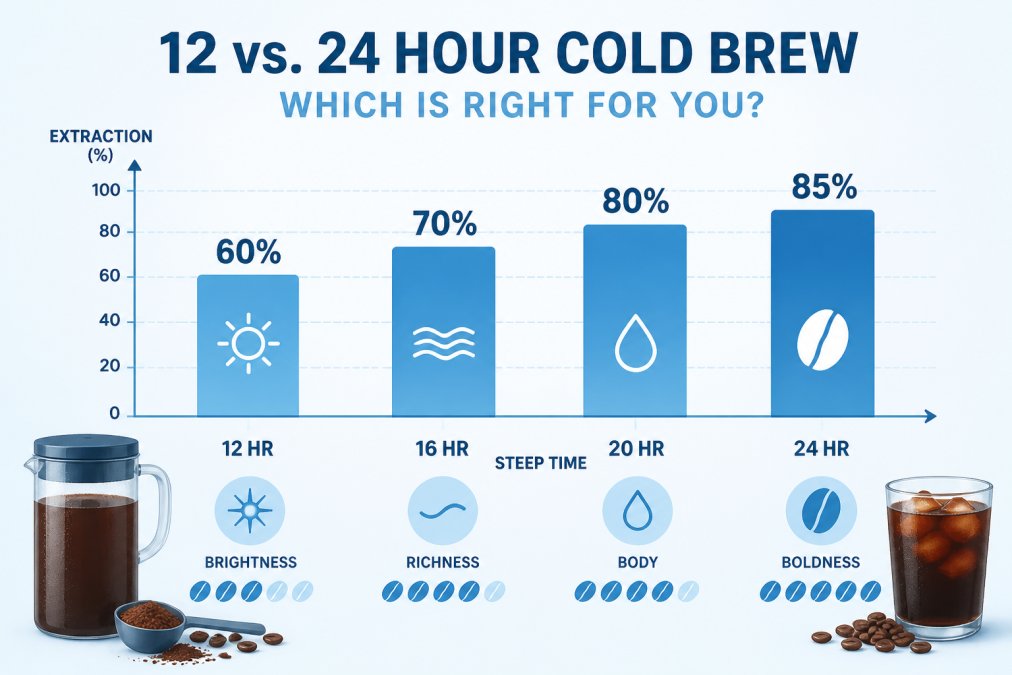
Most guides stop at "12 to 24 hours," a range too wide to be useful. What actually changes between those endpoints? Below is a controlled taste guide for the same recipe steeped at four checkpoints, so you can pick a time by flavor rather than guesswork.
The Controlled Taste Guide: 12, 16, 20, and 24 Hours
Use the same coarse grind, 1:4 ratio, and room-temperature steep for each batch.
| Steep Time | Strength | Acidity | Bitterness | Body | Best For |
|---|---|---|---|---|---|
| 12 hours | Light to medium | Bright, noticeable | Low | Thin to medium | Drinkers who want a clean, tea-like cup and plan to drink it straight |
| 16 hours | Medium | Balanced | Low to moderate | Medium | The everyday sweet spot for ready-to-drink cold brew |
| 20 hours | Medium-bold | Muted | Moderate | Full | Concentrate that will be diluted with water or milk |
| 24 hours | Bold | Low | Noticeable | Heavy | Maximum yield for concentrate; forgiving of small ratio mistakes |
12 hours. Extraction is still climbing, so you get bright fruit and floral notes, but the cup tastes thin undiluted.
20 hours. Darker and heavier, with bright acidity fading, chocolate and caramel moving forward, and bitterness on the finish.
24 hours. Full extraction: bold and concentrated, and the most forgiving if your grind or ratio is slightly off. The trade-off is lost top notes and a firm bitterness on the back of the palate, if it's harsh, you've hit the ceiling for your grind size.
How to Run Your Own Taste Test
Brew one batch at your normal ratio, pull small samples at 12, 16, 20, and 24 hours, and strain each immediately into a labeled glass. Chill before tasting, since temperature changes how you perceive bitterness, and taste side by side rather than from memory.
Concentrate vs. Ready-to-Drink: Does Steep Time Change?
Yes, applying one timing rule to every recipe is a common mistake. For concentrate meant for dilution, lean toward 18 to 24 hours so it holds up when you add water or milk. For ready-to-drink cold brew at 1:5 or 1:6, pull back to 12 to 16 hours; a 24-hour steep at that ratio often tastes over-extracted and bitter.
Cold Brew in the Fridge or on the Counter: Temperature's Role
Temperature is the second-biggest lever after grind size. Warmer water extracts faster; colder water extracts slower. That single principle explains every timing difference below.
Time-and-Temperature Comparison
| Steep Location | Typical Temperature | Practical Steep Range | What to Expect |
|---|---|---|---|
| Countertop (room temperature) | 68-72°F | 12-18 hours | Faster extraction; brighter cup; less margin for error before bitterness sets in |
| Refrigerator | 38-40°F | 18-24 hours | Slower, cleaner extraction; smoother finish; more forgiving window |
| Cool pantry or basement | 60-65°F | 14-20 hours | Middle ground; useful when counter space is limited |
Room-temperature steeping is the fastest route to a finished batch, but the window between "ready" and "over-extracted" is narrower.
Refrigerated steeping trades speed for control. The cold slows extraction, widening the window where the brew tastes good and producing a smoother, less bitter cup.
A common pattern is steeping on the counter for 12 to 16 hours, then straining and refrigerating, balancing speed with safety.
Food Safety and Storage Guidance
Once the grounds are removed, cold brew is a perishable liquid. Treat it like any other refrigerated beverage.
- Strain promptly. Leaving spent grounds in the liquid continues extraction and shortens shelf life.
- Refrigerate immediately after straining. Don't leave finished cold brew at room temperature for more than about two hours.
- Store in a clean, covered container. Glass or food-grade plastic both work; a lid keeps odors out.
Which Should You Choose?
Choose the counter if you want cold brew today and will strain on schedule. Choose the fridge for a smoother cup, a wider margin for error, or a larger batch for a shared kitchen.
If you're outfitting a shared kitchen or building a pantry selection for clients, our wholesale cold brew coffee is ground for the refrigerator method and holds its flavor well over a multi-day batch.
Cold Brew Coffee Ratio: Getting the Strength Right
The coffee-to-water ratio determines how strong your brew tastes, independent of steep time.
Standard Coffee-to-Water Ratios
A common starting point is 1 part coffee to 4 parts water. This gives you a concentrate you can dilute with water or milk to taste.
For a ready-to-drink cold brew (not a concentrate), try 1 part coffee to 5 or 6 parts water.
If you like it bold, go 1 part coffee to 3 parts water. This makes a strong concentrate.
Here's a practical example:
- 1 cup of coarse grounds + 4 cups of cold water = a concentrate
- Dilute 1 part concentrate with 1 part water or milk to serve
Adjusting for Your Taste
Start with 1:4 and taste. Too weak? Use more grounds next time; too strong? Use less. A longer steep doesn't fully replace a higher ratio, a 24-hour steep at 1:6 still yields a lighter brew than a 12-hour steep at 1:3.
How to Strain Cold Brew Coffee Properly
Straining removes the grounds and gives you a clean, clear brew ready to drink or store.
Straining Methods and Equipment
Cheesecloth or coffee filters are simplest: pour the steeped cold brew through into a clean jar or pitcher.
Fine mesh strainer works quickly, set it over your container and pour. Some fine sediment gets through, but most grounds stay behind.
Cold brew maker with built-in filter does the work for you: lift out the metal or nylon basket and the brew is done.
Achieving the Right Clarity
Cloudiness means fine grounds or oils are suspended in the liquid, not bad, just texture. For crystal-clear brew, strain twice: first through a regular strainer, then through fine mesh or cheesecloth. Cloudier brew has more body; both are fine.
Grind Size and Its Effect on Steep Time
Grind size is the single biggest factor you control when brewing cold brew.
Coarse grind (like sea salt) extracts slowly. Use this for 12-24 hour steeps.
Medium grind extracts faster; reduce steep time to 10-16 hours or risk bitterness.
Fine grind (like sand) extracts very quickly, just 6-8 hours, but clogs filters and is hard to strain.
Coarse grind is standard for a reason: forgiving, easy to strain, and it gives a wide window of steep times that work. [Our Cold Brew Coffee blend](/products/cold-brew-coffee-1) is built for this, smooth chocolate, toffee, and floral tones that shine when steeped the traditional way.

Troubleshooting: When Your Cold Brew Doesn't Taste Right
Cold brew goes wrong in predictable ways. Here's how to fix it.
Too Bitter or Over-Extracted
The problem: harsh, astringent, or burnt flavor.
The fix: you steeped too long, used too much coffee, or ground too fine. Next batch, cut steep time by 4-6 hours, use less coffee, or check the grind is truly coarse. Over-extraction happens faster at room temperature, on the counter, try 18 hours instead of 24.
Too Weak or Under-Extracted
The problem: watery, sour, or thin flavor.
The fix: you didn't steep long enough, used too little coffee, or ground too fine. Next batch, add 4-6 hours, increase the coffee, or coarsen the grind. Sourness usually means under-extraction, the acids haven't fully dissolved, and a longer steep fixes it.
Flat or Stale Flavor
The problem: old, dull, or lifeless flavor.
The fix: your beans may not be fresh, cold brew amplifies staleness. Use beans roasted within the last 2-3 weeks; Brewtiful Coffee US ships fresh-roasted beans nationwide.
Getting cold brew right means understanding how steep time, grind size, ratio, and temperature work together. Start with a 12-24 hour steep using coarse grounds at 1:4, taste, and adjust from there.
At Brewtiful Coffee US, we've crafted our cold brew blends specifically for this method. Whether you're brewing for yourself or looking for a premium option to offer corporate clients or in an employee kitchen benefit program, our wholesale link makes it easy to stock quality cold brew supplies.
Frequently Asked Questions
Is it better to steep cold brew in the fridge or on the counter?
Refrigerator steeping is safer and recommended. Cold temperatures slow extraction and reduce the risk of bacterial growth over long periods. Room-temperature steeping works but requires closer attention to timing and carries a higher food safety risk. Most brewers prefer the fridge for overnight or extended steeps because it gives you more flexibility and peace of mind. If you do steep at room temperature, keep your steep time under 12 hours and store the finished brew in the refrigerator immediately.
Is it better to steep cold brew for 12 hours or 24 hours?
The choice depends on your flavor preference. A 12-hour steep produces a smoother, more balanced cup with moderate strength, ideal if you prefer a cleaner taste. A 24-hour steep extracts more fully, creating a bolder, richer concentrate with deeper body and complexity. Neither is objectively 'better'; 12 hours suits those who want quicker results, while 24 hours appeals to those who prefer maximum extraction and don't mind waiting longer.
How does cold brew coffee ratio affect the final strength?
The coffee-to-water ratio directly controls how strong your cold brew concentrate becomes. A 1:4 ratio (1 part coffee to 4 parts water) produces a lighter concentrate, while 1:2 creates a bold, concentrated version. Most brewers start with 1:3 or 1:4 and adjust based on taste. Remember that cold brew concentrate is meant to be diluted with water or milk before serving, so a stronger concentrate during steeping gives you more control over the final cup strength.
Can you let cold brew steep too long?
Yes, but it takes time. Steeping beyond 24-30 hours in the refrigerator can lead to over-extraction, creating excessive bitterness and a harsh taste. The longer coffee grounds sit in water, the more compounds extract, eventually overwhelming the cup. If you forget your cold brew and it steeps for 48 hours or more, taste it first, it may still be drinkable, but it will likely taste flat or overly bitter. Most brewers find the sweet spot between 12-24 hours for balanced flavor.