

Best Coffee Grinders for Home Use 2026
Table of Contents
- Why the Right Coffee Grinder Matters
- Burr Grinders vs. Blade Grinders: What Actually Matters
- Best Burr Coffee Grinder Features to Compare
- Best Budget Coffee Grinder Options
- Coffee Grinder for Espresso: What You Need
- How to Clean a Coffee Grinder Properly
- Choosing Your Grinder: Five Home-Use Scenarios
- Frequently Asked Questions
Last Updated: October 14, 2026
Why the Right Coffee Grinder Matters
Freshly ground coffee tastes dramatically different from pre-ground. The moment you grind, coffee oxidizes and loses aromatic oils that took months to develop during roasting. Finding the best coffee grinders home can offer starts with understanding what makes cafe-quality coffee at home possible.
A good coffee grinder breaks beans into consistent particles that match your brewing method. A poor grinder produces uneven pieces, so water extracts too much from the powder and too little from the chunks, leaving the cup bitter, muted, or sour.
At Brewtiful Coffee US, we've watched customers transform their morning ritual by upgrading their grinder. The same beans that tasted flat in a blade grinder reveal bright, complex flavors when ground properly. Brewing method, bean freshness, and water temperature all matter, but grind consistency is the foundation. Once you have secured a uniform grind, the final step in elevating your cup involves selecting the right beans for home brewing that highlight the unique characteristics of your chosen roast.
Burr Grinders vs. Blade Grinders: What Actually Matters
A burr grinder uses two rotating surfaces, flat or conical, to crush beans between them. A blade grinder spins a propeller-like blade that chops beans chaotically. The difference in the cup is substantial.
Burr grinders produce uniform particle size, so water extracts evenly and flavor stays balanced. Blade grinders create an unpredictable mix of powder and chunks you can't replicate twice.
Burr grinders cost more upfront, while blade grinders run less. But a good burr grinder outperforms a blade grinder every time. If you're serious about tasting what your beans offer, burr is non-negotiable.
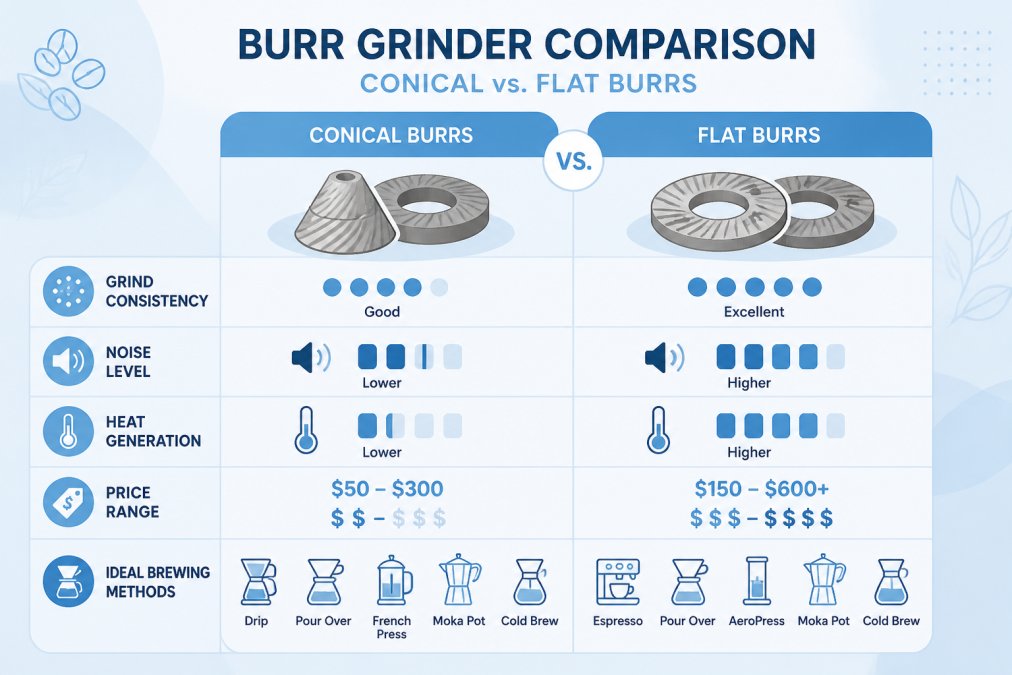
Conical burrs run cooler, protecting delicate flavor compounds. Flat burrs generate more heat but are often more consistent at very fine espresso grinds. For most home brewers the distinction is minor; choose based on brewing method and budget.
Best Burr Coffee Grinder Features to Compare
When evaluating the best coffee grinders home use demands, focus on five factors: grind range, adjustment mechanism, grinding speed, retention, and noise.
Grind range tells you what brewing methods the grinder handles. A wide range, from espresso-fine to French press coarse, means one grinder works for multiple styles. Check actual settings, not marketing claims; some grinders claim 50 settings but bunch them in the medium range.
Adjustment mechanism comes in stepped and stepless types. Stepped clicks between preset sizes and is repeatable and simple. Stepless dials any size smoothly, giving more precision but requiring more attention. For home use, stepped is usually sufficient.
Grinding speed affects heat generation and convenience. Faster burrs finish a dose in 10-15 seconds; slower burrs take 30-45 seconds. Speed matters less than consistency for home brewing.
Retention is the amount of ground coffee that sticks inside the grinder after you stop. High retention means grounds linger and oxidize; low retention means fresher grounds. Look for low retention.
Noise ranges from 70 decibels (quiet) to 90+ decibels (loud). A quiet grinder is worth paying for if you brew early or live with light sleepers. Check reviews for measured noise levels, not just "quiet" claims.
Best Budget Coffee Grinder Options
A budget grinder means finding a tool that transforms your coffee. In this range, you're choosing between manual and electric.
Manual grinders use hand-crank burrs. They're slower, 3-5 minutes per dose, but cheap, portable, and produce excellent grind consistency. Manual works for one or two cups daily; grinding for four people every morning gets frustrating.
Electric grinders in the budget range use burr mechanisms that produce uniform grind in 20-30 seconds. You trade some durability and noise control for speed and convenience, a trade most home brewers find worthwhile.
What to avoid: blade grinders won't deliver the consistency you need, and cheap electric burr grinders often have poor grind range or high retention, undermining what good beans can do.
For small businesses setting up employee kitchen benefits or corporate pantry selections, budget burr grinders offer reliable performance at scale without excessive cost per unit.
Coffee Grinder for Espresso: What You Need
Espresso demands the finest, most consistent grind of any brewing method. Water contacts the grounds for only 25-30 seconds, so particle uniformity determines extraction completely. A grinder that works for drip may fail for espresso.
Espresso-capable grinders must reach very fine settings and hold consistency there. Conical burrs excel because they handle fine grinding without jamming; flat burrs work too but need precise alignment.
Motor power matters for espresso. Underpowered motors struggle with fine grinding and heat up quickly. Look for sufficient wattage so the grinder handles espresso-fine adjustments without straining.
Dose consistency also matters, since espresso is unforgiving about small variations. A grinder with low retention and repeatable settings lets you dial in once and pull shots confidently; some include dosing chambers that dispense the same amount each time.
Budget for espresso-specific grinders: you're compromising on consistency below a certain point. Above that, you're paying for features most home espresso users don't need.
How to Clean a Coffee Grinder Properly
Cleaning is where a grinder's real ownership cost shows up. Two machines at the same price can diverge sharply once you factor in replacement burrs, service, and wasted coffee. Most home grinders need a light cleaning every two weeks and a deeper service once or twice a year.
What actually accumulates, and why it matters
Coffee oils coat the burrs and exit chute, oxidize over days, turn rancid, and change how grounds flow.
The two-week routine (10 minutes)
- Unplug the grinder and empty the hopper. Never clean a plugged-in machine.
- Remove the hopper, the burr carrier, and any removable chute or catch cup.
- Brush the burrs and chamber with a dry pastry brush or the brush that shipped with the grinder. Work from the burrs outward so you push grounds toward the exit, not deeper into the mechanism.
- Wipe the burr faces with a dry microfiber cloth. Do not rinse burrs under water unless the manufacturer explicitly says they are dishwasher-safe; most steel burrs will rust.
- Reassemble and run a small handful of beans through, then discard those grounds. This purges loose residue before your next real dose.
The monthly deep clean
Run a dedicated grinder cleaner through the machine per its instructions to dissolve oils that dry brushing leaves behind. Uncooked white rice run for 20 to 30 seconds absorbs oils and exits as powder, but check your manual first: some manufacturers warn rice is harder than their burrs and can dull them.
When to replace parts instead of cleaning harder
Burrs are consumables. Most conical and flat steel burrs are rated for a significant amount of coffee before the cutting edges dull, which for a household grinding a pound a week is many years, but a small office grinding more frequently reaches that range far sooner.
Warranty and serviceability checklist
Before buying, confirm three things: the warranty length on the burrs versus the motor (they are often different), whether the manufacturer sells replacement burrs and hoppers directly, and whether service is mail-in or handled by a local repair shop.
For small businesses stocking wholesale coffee for employee kitchens or corporate pantry selections, a grinder with published part numbers and a clear service path keeps the program running without surprise replacement costs. Wholesale ordering makes it practical to keep spare burrs on hand so a worn grinder never interrupts the morning rush. You can explore our wholesale options here: [https://brewtifulcoffee.us/wholesale]
Choosing Your Grinder: Five Home-Use Scenarios
Most buying guides sort grinders by price. A more useful sort is by how you brew and how many people you brew for.
1. The single-cup ritualist (one brewer, one method)
A hand grinder is the right tool. You get excellent particle uniformity for the money, no motor to fail, and a small footprint. The trade-off is time: expect 30 seconds to a minute for a typical dose with a good hand grinder, longer with a cheap one.
2. The two-to-three-cup household
An entry electric burr grinder covers this well. Priorities are a repeatable stepped adjustment, low retention so yesterday's grounds do not season today's cup, and a hopper sized to your weekly bean use.
3. The multi-method brewer
If you switch between pour-over, drip, and French press in the same week, grind range and adjustment repeatability matter most. You want a grinder that reaches both fine and coarse settings without the useful range bunched in the middle.
4. The espresso-focused home barista
Espresso is the most demanding target because the grind must be fine and consistent enough to control a 25-to-30-second extraction. Prioritize fine-range consistency, low retention, and a motor that does not bog down at fine settings.
5. The shared kitchen: office, studio, or large household
Once several people grind several times a day, the calculus changes. Durability, retention, and ease of cleaning outweigh fine adjustment. This is also where a grinder becomes part of a broader employee kitchen benefit or corporate pantry program rather than a personal purchase.
A quick decision guide
| Your situation | Grinder type | What to prioritize |
|---|---|---|
| One cup, one method | Hand grinder | Steel burrs, stable shaft, click adjustment |
| Two to three cups daily | Entry electric burr | Repeatable steps, low retention, right hopper size |
| Multiple brew methods | Mid-range electric burr | Wide usable range, easy return to settings |
| Espresso focus | Espresso-capable burr | Fine consistency, low retention, strong motor |
| Shared kitchen or office | Durable electric burr | Build quality, parts availability, simple controls |
Ownership cost, not just purchase price
Two grinders at the same price are not the same value. Ask what replacement burrs cost, how long the warranty runs on the motor versus the burrs, and whether the manufacturer sells parts directly.
For small businesses building employee kitchen benefits or corporate clients curating pantry selections, the shared-kitchen scenario is the one to plan around. Pairing a durable, serviceable grinder with wholesale coffee keeps quality consistent across every desk and makes the program easy to restock.
Frequently Asked Questions
Is a burr grinder really better than a blade grinder for home brewing?
Yes. Burr grinders produce uniform particle size, which is essential for consistent extraction and better-tasting coffee. Blade grinders chop beans unevenly, leading to over-extraction of fine particles and under-extraction of larger pieces. The result is bitter, unbalanced coffee. For any brewing method beyond cold brew, a burr grinder delivers noticeably better flavor from the same beans.
What type of coffee grinder is best for espresso and pour-over brewing?
Espresso requires very fine, consistent grounds and benefits from stepless adjustment for precision. Conical burr grinders excel here. Pour-over and drip coffee are more forgiving and work well with both conical and flat burr grinders. If you brew both, choose a burr grinder with a wide grind range and fine adjustment. Manual grinders can work for pour-over but are impractical for the volume espresso demands.
How often should you clean a home coffee grinder?
Clean your grinder every 2-4 weeks with regular use. More frequent cleaning (weekly) helps if you switch between very different beans or notice static and retention buildup. Wipe the exterior and empty grounds daily. For deep cleaning, use a grinder-cleaning tablet monthly to remove oils and residue from the burrs. Never immerse electric grinders in water.
Will a better grinder actually improve the taste of my coffee beans?
Absolutely. A quality burr grinder unlocks the flavors already in your beans. Fresh, specialty beans like single-origin varieties from Kenya, Uganda, or Peru show dramatic improvement with consistent grinding. Even budget beans taste noticeably smoother when ground uniformly. A good grinder is as important as fresh beans themselves, neither alone is enough for cafe-quality coffee at home.