

Reduce Coffee Acidity for Sensitive Stomach
Table of Contents
- Understanding Coffee Acidity and Your Stomach
- Cold Brew vs. Hot Brew Acidity: Which Method Matters
- Selecting Low Acid Coffee Beans for Gentler Brewing
- Here's what happens during roasting:
- How to Neutralize Coffee Acid with Baking Soda
- Grind Size, Water Quality, and Brewing Ratio
- Adding Milk, Cream, and Plant-Based Alternatives
- Post-Consumption Habits to Protect Your Stomach
- Frequently Asked Questions
Last Updated: September 27, 2026
Understanding Coffee Acidity and Your Stomach
Understanding how to reduce coffee acidity can help, since coffee acidity affects your digestive system more than most people realize. When you drink coffee, acids trigger gastric secretion in your stomach lining (Effects of Coffee on the Gastro-Intestinal Tract: A Narrative Review and Literature Update). For those with a sensitive stomach, this can lead to heartburn or gastrointestinal distress within minutes.
The good news: you can reduce coffee acidity through brewing methods, bean selection, and simple additions. You can reduce coffee acidity through brewing methods, bean selection, and simple additions.
What causes coffee acidity? Coffee naturally contains chlorogenic acid and other compounds that lower pH. Dark roasts tend to have lower acid levels than light roasts. The extraction process also matters, how you brew determines how much acid ends up in your cup.
Cold Brew vs. Hot Brew Acidity: Which Method Matters
Cold brew produces significantly lower acidity than hot brew. The steeping process at room temperature extracts fewer acids compared to hot water extraction.
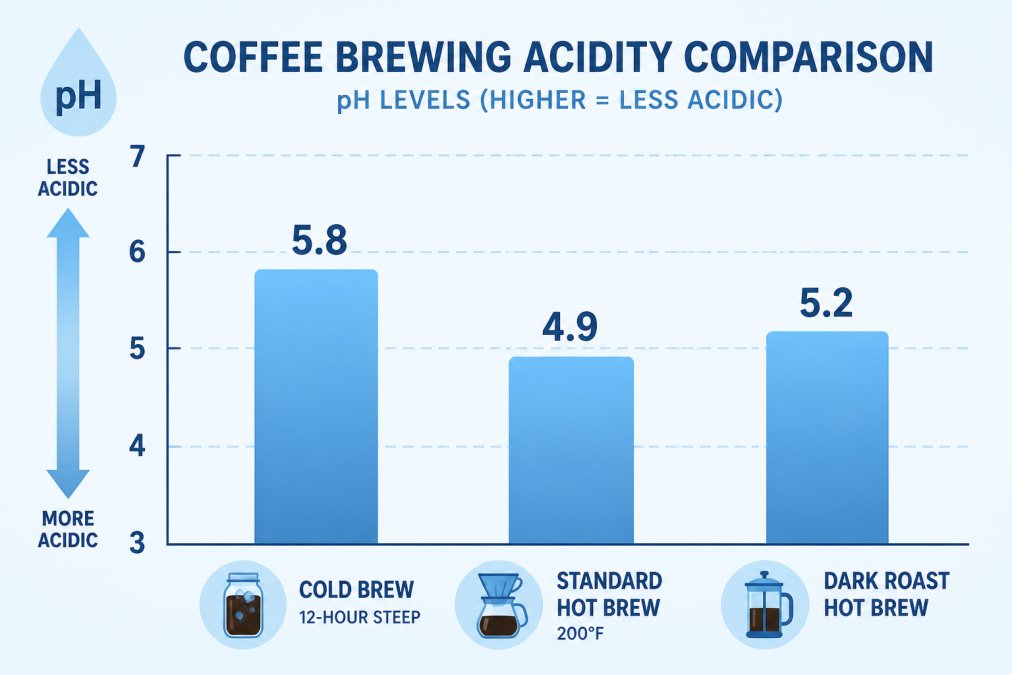
Why Cold Brew Produces Lower Acidity
Cold water steeping takes 12 hours but extracts less acid. Hot water at 200°F pulls out more chlorogenic acid and tannins. The temperature difference is the key factor.
Here's the practical difference:
- Cold brew: smoother, mellow flavor, less stomach irritation
- Hot brew: bolder taste, more acidity, faster preparation
- Dark roast hot brew: middle ground with reduced acidity
Cold brew works because cooler water dissolves fewer acidic compounds. The long steeping time lets flavor develop without aggressive extraction. If you have a sensitive stomach, cold brew is often the easiest fix.
Hot Brew Extraction and Acid Release
Hot brewing extracts more acid in less time. Water above 195°F pulls chlorogenic acid and other compounds rapidly. This is why hot coffee hits your stomach harder.
You can reduce hot brew acidity by:
- Using coarser grounds
- Shortening brew time
- Lowering water temperature to 195°F or below
- Choosing dark roasts over light roasts
Dark roasts have already lost some acid during the roasting process. The longer the beans roast, the more chlorogenic acid breaks down. This makes dark roast hot brew gentler than light roast hot brew.
Selecting Low Acid Coffee Beans for Gentler Brewing
Bean origin matters more than most people know. Some regions naturally produce lower acid beans. Single-origin beans from specific altitudes tend to have different acid profiles.
Roast Profile Impact on Stomach Sensitivity
Dark roasts are gentler on sensitive stomachs. The roasting process reduces chlorogenic acid content. Light roasts retain more acid because they spend less time in the roaster.
Here's what happens during roasting:
Brewtiful Coffee US offers Peru Decaf as a medium roast option. If you're sensitive to caffeine AND acid, decaf beans roasted to medium or dark can help. The decaffeination process removes some acid compounds during processing.

Single-Origin Beans and Shade-Grown Options
Single-origin beans from specific regions have predictable acid levels. Beans grown at higher altitudes tend to have more acid.
Brewtiful Coffee US sources Uganda beans from Sipi, Kapchorwa District at 1,500-2,500 meters altitude. The cupping notes list "mild acidity" as a primary characteristic. This bean works well for people managing digestive sensitivity.

How to Neutralize Coffee Acid with Baking Soda
Adding baking soda directly neutralizes acid. A quarter teaspoon per cup raises pH and reduces stomach irritation.
Here's how it works:
- Baking soda is alkaline (pH 8.3)
- Coffee is acidic (pH 4.9-5.2)
- Mixing them creates a chemical reaction that reduces acidity
The process takes 30 seconds:
- Brew your coffee normally
- Add one-quarter teaspoon baking soda to your cup
- Stir for 10 seconds
- Wait 30 seconds for fizzing to stop
- Drink immediately
You'll notice the coffee tastes slightly less bitter. The bitterness you taste is often acid-related.
Grind Size, Water Quality, and Brewing Ratio
Three technical factors control extraction and final acidity:
- Grind size determines surface area and contact time
- Water chemistry (mineral content and pH) affects how acids dissolve
- Brewing ratio balances strength and acid concentration
Coarse Grind and Steeping Time Adjustments
Coarser grounds extract less acid because they expose less surface area to water. Finer grounds pull more compounds, including chlorogenic acid and tannins, into your cup. A coarse grind used in French press or cold brew reduces extraction speed and acid content.
Steeping time compounds this effect:
- Cold brew: 12 hours at room temperature (lowest acid, ~pH 5.8)
- French press: 4 minutes at 200°F (medium acid, ~pH 5.2)
- Drip coffee: 5-10 minutes at 195-205°F (higher acid, ~pH 4.9)
- Espresso: 25-30 seconds at 200°F (concentrated acids, shorter contact time)
Longer steeping with coarse grounds gives you smooth flavor with less acid because the extended time allows flavor compounds to develop without aggressive acid extraction. This is why cold brew tastes so different from espresso, contact time and temperature work together.
Water Chemistry and Mineral Content
Water quality is one of the most overlooked factors in acid reduction. The mineral content (measured in parts per million, or PPM) and pH of your water directly affect how much acid ends up in your final cup.
How minerals affect extraction:
Practical water adjustments:
Brewing Equipment and Acid Profiles
Different brewers naturally produce different acid levels because of how they control temperature, contact time, and filtration:
- French press: No paper filter, so oils and fine particles remain in the cup. Longer steeping (4 minutes) at high temperature extracts more acid. Medium-to-coarse grind helps, but this method produces higher acidity overall.
- Drip coffee maker: Paper filters trap oils and some fine particles, reducing acid perception. Water temperature is usually 195-205°F, which extracts acid efficiently. Brew time is 5-10 minutes. This is a middle-ground option.
- AeroPress: Short contact time (1-3 minutes), paper filter, and lower water temperature (175-185°F) combine to produce lower acidity than drip. The pressure forces water through grounds quickly, limiting acid extraction.
- Cold brew maker: 12-hour steep at room temperature extracts the least acid. The long time and cool water are a trade-off, you get smoothness, not speed.
- Moka pot or stovetop brewer: High heat and pressure extract acids rapidly. This method produces concentrated, acidic coffee similar to espresso.
If you have a sensitive stomach, an AeroPress or cold brew maker will produce noticeably gentler coffee than a French press or standard drip maker, even with the same beans.
Adding Milk, Cream, and Plant-Based Alternatives
Milk proteins bind to acid compounds. This reduces acid perception. Adding milk is one of the fastest ways to make coffee gentler.
Here's what each option does:
- Whole milk: highest protein, best acid buffering
- Oat milk: creamy texture, moderate acid buffering
- Almond milk: lighter taste, less acid buffering
- Cream: highest fat content, smooth mouthfeel
Post-Consumption Habits to Protect Your Stomach
What you do after drinking coffee, and before, matters as much as how you brew it. The timing and context of coffee consumption directly affect how much acid irritates your stomach lining.
Eat Before, Not After
Drinking coffee on an empty stomach triggers gastric acid secretion within minutes (Effects of Coffee on the Gastro-Intestinal Tract: A Narrative Review and Literature Update). Your stomach lining produces hydrochloric acid in response to the chlorogenic acid and caffeine in coffee, even if there's no food to digest. This is why morning coffee often causes heartburn or nausea.
Timing Relative to Sleep and Meals
Coffee consumed late in the day lingers in your system for 4-6 hours due to caffeine's half-life. Drinking coffee within 6 hours of bedtime increases the risk of acid reflux during sleep, when gravity can't help keep stomach acid down.
Posture and Gravity
Stay upright for at least 30-45 minutes after drinking coffee. Gravity keeps stomach acid in your stomach.
Hydration and Acid Dilution
Drink water throughout the day, especially after coffee. Hydration dilutes stomach acid. Most people need 8-10 glasses of water daily; if you're drinking coffee, add an extra glass of water for every cup of coffee consumed.
The Cumulative Effect
No single habit eliminates acid sensitivity, but combining them dramatically reduces irritation:
- Eat a small meal 15-30 minutes before coffee
- Drink cold brew or dark roast (not light roast)
- Add milk or cream to buffer acids
- Stay upright for 30+ minutes
- Drink water 15 minutes after finishing
- Avoid coffee after 2 p.m. if you're sensitive
Frequently Asked Questions
Does cold brew have less acid than hot coffee?
Yes. Cold brew steeping for 12-24 hours extracts fewer acidic compounds than hot water brewing. The lower temperature and longer contact time reduce chlorogenic acid extraction, resulting in a smoother cup. Most cold brew has a pH around 5.5-6, while hot coffee typically falls between 4.85-5.10. If your stomach is sensitive, cold brew is a gentler option that doesn't sacrifice flavor.
How do you neutralize the acidity of coffee with baking soda?
Add 1/4 teaspoon of baking soda to your brewed coffee and stir well. The baking soda is alkaline and neutralizes acidic compounds. Start with a small amount and adjust to taste, as too much can make coffee taste bitter or salty. This method works best with already-brewed coffee and is a quick fix if you experience heartburn or gastroesophageal discomfort after drinking.
What are low acid coffee beans, and why do they matter?
Low acid coffee beans come from specific origins like Uganda and Peru. Dark roasts also naturally contain less acid than light roasts because heat breaks down chlorogenic acid during roasting. Choosing these varieties reduces the risk of acid reflux and gastrointestinal distress, making your daily coffee ritual more comfortable.
Can adding milk or cream help reduce coffee acidity?
Yes. Milk and cream are alkaline and buffer acidic compounds, reducing their impact. Plant-based alternatives like oat or almond milk also help neutralize acidity, though dairy is slightly more effective. Adding milk doesn't eliminate acidity but significantly softens its effects, making coffee gentler on sensitive stomachs while preserving the flavor you enjoy.