

What's the Best Coffee Bean Roast for Manual Brewing?
Last Updated: October 24, 2026
Quick Summary
The best coffee bean roast for manual brewing is a light to medium roast, because those levels preserve the acidity and origin character that pour-over and French press methods are built to show off. Light and medium-light roasts suit pour-over, while medium to dark roasts flatter the French press.
- Light roasts are denser beans that resist extraction, so they usually want a finer grind and hotter water.
- Medium roasts tolerate a wider range of grind sizes, making them the safest starting point for new manual brewers.
- As roast gets darker, grind gets coarser and water gets cooler to keep bitterness in check.
- Give light roasts a few days to rest after the roast date, and give dark roasts a bit longer.
- A common starting ratio is 1:16, tightening to 1:15 or 1:14 if the cup tastes weak.
Table of Contents
- Why Roast Level Decides Your Manual Brew
- Light Roast vs. Medium Roast Coffee: What Changes in the Cup
- The Best Roast for Pour-Over Coffee
- The Best Coffee Beans for French Press
- Roast Comparison Table for Manual Brewers
- Freshness, Roast Date, and Resting Time
- Dialing In Your Brew by Roast Level
- Choosing Your First Bag from Brewtiful Coffee
- Frequently Asked Questions
Why Roast Level Decides Your Manual Brew
Here's the part most guides get wrong: roast level is not a flavor preference sitting on top of your brewing method.
That means your grind size, water temperature, and brew time all need to shift when your roast shifts. Get that relationship right and a $22.99 bag outperforms a cafe pour-over.
Below, we'll walk through how each roast level behaves in a manual brewer, which beans we'd pick for pour-over and French press, and how to dial in when the cup isn't right.
Light Roast vs. Medium Roast Coffee: What Changes in the Cup
Light roast coffee is roasted to a lower internal temperature and stopped earlier, which keeps more of the bean's original acids and aromatic compounds intact. Medium roast coffee is taken further, caramelizing more sugars and muting some of that brightness in favor of body and sweetness.
The practical difference shows up in three places: acidity, body, and how forgiving the bean is to brew.
Light and Medium-Light Roasts
Light roasts taste brighter and more tea-like, with citrus, floral, and fruit notes up front. They're denser beans, so they resist extraction and usually want a finer grind and hotter water. Our Ethiopia Natural is a medium-light roast with milk chocolate, fruity, and caramel notes, and it rewards a careful pour-over.
Best for: pour-over, Chemex, and anyone chasing origin character. Skip if: you take your coffee with a lot of milk or want a heavy, syrupy cup.
Medium and Medium-Dark Roasts
Medium roasts land in the middle: enough acidity to stay lively, enough body to feel like coffee. Chocolate, caramel, and nut notes move forward. These beans extract more easily, so they tolerate a wider range of grind sizes, which makes them the safest starting point for new manual brewers.
Medium-dark roasts push toward deeper chocolate and warm spice, with lower acidity. They're the bridge between filter brewing and espresso-style intensity.
If you want the full side-by-side on these two levels, our breakdown of light roast vs. medium roast for pour over goes deeper on grind and temperature.
The Best Roast for Pour-Over Coffee
The best roast for pour-over coffee is a light or medium-light roast, because pour-over's slow, controlled water flow rewards the clarity and acidity that lighter roasting preserves.
Pour-over gives you total control over water temperature and pour speed, and light roasts are the beans that respond most visibly to those variables. The tradeoff is forgiveness: a light roast punishes a sloppy grind and a rushed pour.
For a light-roast single origin built for this method, our Ethiopia Natural is the bag we'd hand a pour-over drinker first.

A common mistake is grinding too coarse for a light roast and then compensating with a longer brew. That produces sour, thin coffee.
The Best Coffee Beans for French Press
French press is the most forgiving manual method. Coarse grind, four minutes of steeping, plunge, pour. What it lacks in clarity it makes up for in texture, and texture is where darker roasts shine.
Our French Roast is the natural pairing here: deep, low-acid, and built for a heavy, rounded cup. If you want something with a bit more brightness, a medium roast like our Brazil Santos, with its smooth cocoa notes, splits the difference nicely.
Watch out: over-steeping a dark roast in a French press pulls out bitter compounds fast. Start at four minutes and shorten it if the cup turns harsh.
Roast Comparison Table for Manual Brewers
Here's the quick-reference version. Use it to match roast level to method, then adjust grind and temperature from there. The table below covers pour-over and French press, because each brewer's flow rate and filter type change how a given roast behaves.
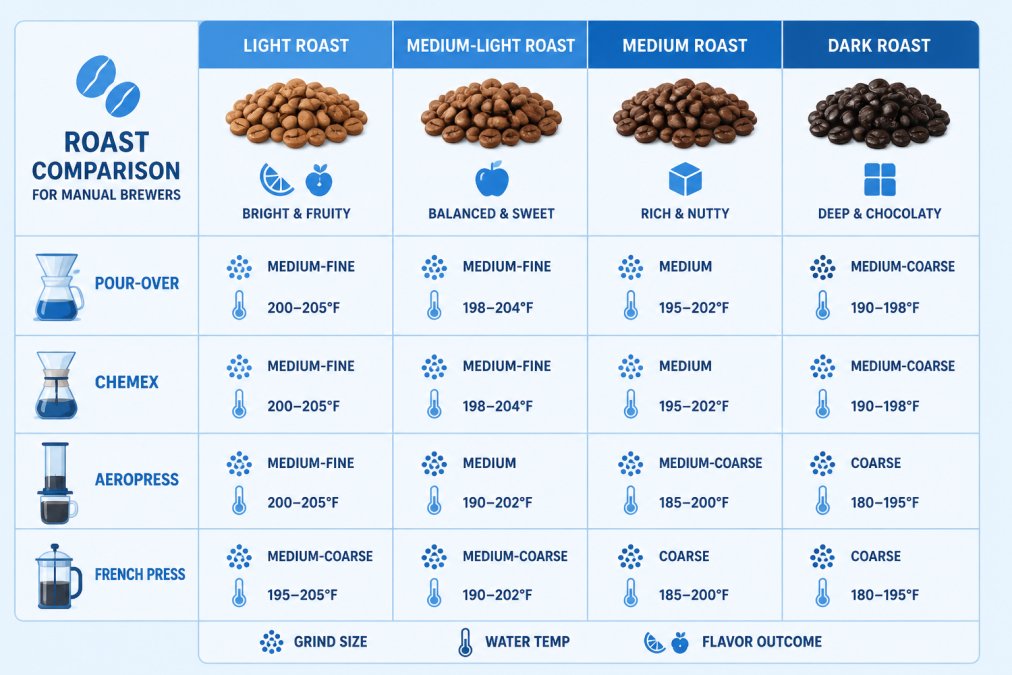
| Roast Level | Best Manual Brewers | Grind Size | Water Temp | Flavor Outcome |
|---|---|---|---|---|
| Light / medium-light | Pour-over, Chemex, AeroPress | Medium-fine (pour-over), medium (AeroPress) | Just off boil (200-205°F) | Bright, fruity, tea-like, high acidity |
| Medium | Pour-over, AeroPress, French press | Medium (pour-over), medium-fine (AeroPress), medium-coarse (French press) | 195-205°F | Balanced, chocolate, caramel, moderate acidity |
| Medium-dark | French press, AeroPress, drip | Medium-coarse (French press), medium (AeroPress) | 190-200°F | Deep chocolate, warm spice, low acidity |
| Dark | French press, AeroPress | Coarse (French press), medium-coarse (AeroPress) | 185-195°F | Heavy body, low acidity, bittersweet |
The pattern to notice: as roast gets darker, grind gets coarser and water gets cooler. That's not arbitrary.
A few method-specific notes that the table can't capture:
- Pour-over and Chemex: These rely on a paper filter and a steady pour. Light roasts shine here because the filter traps oils and fines, letting acidity and origin character come through. If you're brewing a dark roast in a Chemex, expect a thinner body than you'd get in a French press, the paper filter strips some of the oils that give dark roasts their weight.
- AeroPress: The AeroPress is the most flexible manual brewer for roast level because you can adjust steep time, pressure, and filter type. Light roasts work well with a finer grind and a longer steep (2-3 minutes); dark roasts do better with a coarser grind and a shorter steep (1-1.5 minutes) to avoid over-extraction.
- French press: The metal mesh filter lets oils and fine particles through, so darker roasts feel fuller and rounder here. Light roasts can taste thin and sharp unless you grind finer and use hotter water, but even then the press's texture-forward style may not flatter them.
For a deeper dive on matching grind and temperature to specific brewers, our guide to pour-over vs. French press brewing walks through the variables step by step.
Freshness, Roast Date, and Resting Time
Roast date matters more than most brewers realize. Coffee releases carbon dioxide for days after roasting, and that gas interferes with water contact during brewing. Beans roasted too recently brew unevenly and taste flat or sharp.
A practical rule: give light roasts a few days to rest after the roast date, and give dark roasts a bit longer, since they degas more slowly.
Storage matters too. Keep beans whole in an airtight container away from light and heat, and grind right before brewing. Pre-ground coffee loses its aromatics within days.
For more on choosing bags with a real roast date, our guide to buying fresh roasted coffee beans online covers what to look for on the label.
Dialing In Your Brew by Roast Level
When a cup tastes wrong, the roast level tells you which direction to adjust. This is the troubleshooting step most guides skip, and it's where consistent results come from.
Here's a framework that links the most common off-flavors to roast-specific causes and fixes:
- Sour or sharp cup (most common with light roasts): Under-extraction. Light beans are dense and resist giving up their compounds, so the water hasn't pulled enough out. Grind finer first, this is the highest-leverage change. If the cup is still sour, raise water temperature toward just off boil (200-205°F) and extend brew time slightly. Avoid compensating with a coarser grind and longer brew, which can produce a thin, sour cup.
- Bitter or drying cup (most common with dark roasts): Over-extraction. Dark beans are more soluble, so the water pulls out bitter compounds quickly. Grind coarser first, then lower water temperature (try 185-195°F), then shorten steep time. In a French press, start at four minutes and cut back if the cup turns harsh.
- Weak and watery: Increase your coffee-to-water ratio before changing anything else. A common starting point is 1:16 (one part coffee to sixteen parts water by weight); if the cup is weak, tighten to 1:15 or 1:14. This applies across roast levels, but light roasts often need a slightly tighter ratio because their flavors are more delicate.
- Muddy or silty: Your grind is too fine for the filter, or you're pouring too aggressively. For pour-over, a medium-fine grind should look like table salt; if it's finer, back off. In a French press, silt is normal to some degree, but excessive muddiness suggests too many fines, try a coarser grind.
- Hollow or flat (can happen with any roast, but often with stale beans): Check your roast date. Beans roasted too recently (within 2-3 days) release carbon dioxide that interferes with extraction; beans roasted too long ago have lost aromatics. Give light roasts a few days to rest and dark roasts a bit longer, and buy from roasters who print the roast date.
Change one variable at a time. If you adjust grind and temperature together, you won't know which one fixed the cup.
A useful habit: when you open a new bag, brew a small test cup with your standard recipe before you commit to a full pot. Note whether the cup leans sour or bitter, then make one adjustment and brew again.
Choosing Your First Bag from Brewtiful Coffee
If you're new to manual brewing, start with a medium roast. It's the most forgiving across methods, and it teaches you what "balanced" tastes like before you chase extremes. Our Breakfast Blend is the approachable starting point we recommend most often, and every bag ships fresh-roasted with free shipping nationwide.
From there, branch out by method and mood:
- Pour-over drinkers: go lighter, toward the Ethiopia Natural or Tanzania.
- French press drinkers: go darker, toward the French Roast.
- Milk and sugar drinkers: a medium or medium-dark roast holds up better than a delicate light roast.
You don't need a shelf of equipment or a connoisseur's vocabulary. You need beans with a real roast date, a roast level that matches your brewer, and the patience to adjust one variable at a time. That's the whole game.
Frequently Asked Questions
What roast is best for manual brewing?
Medium and medium-light roasts suit most manual brewers because they balance sweetness with enough structure to survive a range of grind sizes and water temperatures. Light roasts shine in pour-over, where you control the pour and can extract their fruit and floral notes. Dark roasts work in a French press, where full immersion softens their bitterness. Your taste preference matters most: if you like bright, tea-like cups, go lighter; if you want cocoa and low acidity, go darker.
Is light or medium roast better for pour-over coffee?
Light and medium-light roasts are the usual pick for pour-over because the slow, controlled pour extracts the citrus, berry, and floral notes that define them. Medium roasts offer a safer middle ground: more caramel and chocolate, less risk of a sour or grassy cup if your grind or water temperature drifts. Try a medium-light single origin first, then move lighter as your pouring gets more consistent.
Can you use dark-roast coffee beans in a French press?
Yes. A French press is one of the friendliest brewers for dark roast because full immersion and a coarse grind keep the bold, smoky, dark-chocolate flavors from turning harsh. Use water just off the boil, a coarse grind, and a four-minute steep, then press slowly. If the cup tastes bitter, shorten the steep time or loosen the grind slightly rather than reaching for sugar.
How does roast level affect coffee flavor and extraction?
Roast level changes both flavor and how easily water pulls compounds out of the bean. Light roasts are denser and more acidic, so they need a finer grind and hotter water to extract fully. Dark roasts are more porous and soluble, so they give up flavor fast and can taste bitter if over-extracted. Match your grind size and brew time to the roast, not the other way around, and you will get a balanced cup from either end of the scale.
Ready to brew a better cup? Brewtiful Coffee roasts to order and ships free nationwide, with single origins from Ethiopia, Kenya, Sumatra, Peru, Mexico, and Bali, plus whiskey barrel-aged varieties for something different. Start with a medium roast, note your grind and water temperature, and let each bag teach you something. Get started with Brewtiful Coffee and taste the difference fresh-roasted beans make in your morning ritual.
