

French Press vs Pour Over: Coffee Taste Comparison 2026
Table of Contents
- French Press vs Pour Over: 2026 Taste Comparison Table
- Taste Profile Differences: Flavor Clarity vs Full-Bodied Richness
- Texture and Mouthfeel: Sediment, Oils, and the Clean Cup
- Brewing Process and Equipment: Immersion vs Percolation
- Pour Over Coffee Grind Size Guide and French Press Coarse Grind
- How Much Caffeine in a Coffee: French Press vs Pour Over
- Cost-Per-Cup, Water Chemistry, and Sustainability
- Advanced Troubleshooting for Both Methods
- Frequently Asked Questions
Last Updated: September 16, 2026
French Press vs Pour Over: 2026 Taste Comparison Table
The french press vs pour over coffee taste comparison 2026 comes down to one trade-off: body versus clarity. A French press delivers a full-bodied, sediment-rich cup with heavy mouthfeel, while a pour over produces a clean, bright cup where single-origin notes come through with precision. At Brewtiful Coffee US, we roast beans that perform well in both methods.
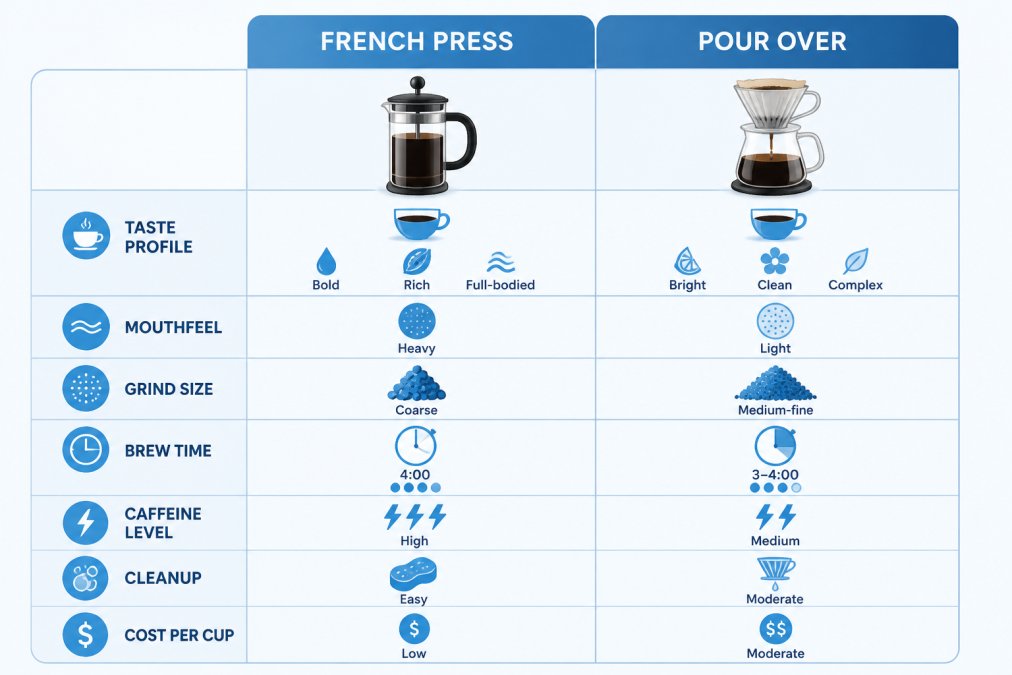
| Factor | French Press | Pour Over |
|---|---|---|
| Taste profile | Full-bodied, rich, cocoa-heavy | Clean, bright acidity, layered |
| Mouthfeel | Heavy, oily, some sediment | Light, tea-like, no sediment |
| Grind size | Coarse grind | Medium-fine grind |
| Brew time | 4 minutes immersion | 3-4 minutes percolation |
| Caffeine | Higher per serving | Slightly lower |
| Cleanup | Rinse and dump grounds | Discard paper filter |
| Cost per cup | Lower (no filters) | Higher (paper filters) |
Taste Profile Differences: Flavor Clarity vs Full-Bodied Richness
A pour over's paper filter traps oils and fines, so bright acidity and delicate aromatics reach the cup intact. A French press keeps those oils in suspension, producing a rounder, heavier cup where sweetness and cocoa notes dominate.
Texture and Mouthfeel: Sediment, Oils, and the Clean Cup
Mouthfeel is where the French press wins for anyone who wants weight in their coffee. The metal mesh filter lets oils and fine particles through, so the cup feels viscous and coats the tongue. The trade-off is sediment: a slight sludge at the bottom that some love and others cannot stand.
Brewing Process and Equipment: Immersion vs Percolation
French press brewing is immersion: grounds steep fully submerged, then you press and pour. Pour over is percolation: water passes through a bed of grounds, extracting as it goes. That difference explains most of the taste gap.
Pour Over Coffee Grind Size Guide and French Press Coarse Grind
Grind size decides whether either method works: medium-fine (table salt texture) for pour over, coarse (coarse sea salt) for a French press.
- Medium-fine (pour over): table salt texture, 3-4 minute draw-down time
- Coarse (French press): sea salt texture, full 4-minute steep
- Too fine in a French press: sludge, bitterness, clogged mesh
- Too coarse in a pour over: weak, sour, fast draw-down
- Consistency matters more than the exact setting: uneven grounds extract unevenly
How Much Caffeine in a Coffee: French Press vs Pour Over
A French press typically delivers more caffeine per cup than a pour over, thanks to contact time and oil retention: a 4-minute full immersion extracts more caffeine, and the metal mesh lets caffeine-bearing oils through that a paper filter would trap. If you are asking how much caffeine in a coffee, the method matters as much as the bean.
Cost-Per-Cup, Water Chemistry, and Sustainability
Here is the actual cost math, plus two variables that quietly change how each method extracts: water chemistry and waste.
Cost per cup, broken down
A French press has one recurring cost: coffee. A pour over adds a consumable per brew. Running the numbers on a 12-ounce cup:
- Coffee (both methods): Roughly 18-22 grams per 12-ounce cup. At a mid-range specialty price of about $16-$20 per 12-ounce bag, that is roughly $0.75-$1.00 per cup, the dominant cost either way.
- Pour over filters: Standard #2 cone filters run about $0.03-$0.08 each in a 100-count box. Reusable stainless or cloth filters cost more upfront (often $10-$25) but drop the per-cup filter cost to effectively zero after a few dozen brews.
- Electricity: Heating 12 ounces of water draws a few cents at average residential rates. Both methods use the same kettle, so this is a wash.
- Equipment replacement: A glass French press carafe is the most fragile part of either setup and the most common replacement item. A pour over dripper rarely needs replacing.
Water chemistry: the variable that changes extraction
Water is roughly 98-99% of your cup by mass, and its minerals interact differently with immersion than with percolation.
- Hard water (high calcium and magnesium): Magnesium helps extract fruity and bright compounds, but excess calcium and bicarbonate buffer acidity and mute aroma. In a French press, hard water plus full immersion tends to flatten the cup into a dull, chalky heaviness. In a pour over, hard water can stall the draw-down and leave the bed muddy.
- Soft or distilled water: Too few minerals and extraction stalls. A pour over with very soft water often tastes hollow and sour because there is nothing to pull the acids and sugars out. A French press with soft water tastes thin despite the heavy mouthfeel, an odd, unsatisfying combination.
- The practical target: The Specialty Coffee Association's water standards publish mineral targets for brew water, and most practitioners aim for water in the middle of that range rather than at either extreme. A simple carbon filter or a pitcher filter gets most tap water into a workable zone before you touch any technique.
Sustainability and waste
- French press: Zero consumables. The only waste is compostable spent grounds, and the metal mesh filter lasts years with rinsing.
- Pour over with paper filters: One filter per brew, 365 a year for daily brewing. Most are compostable and unbleached options exist, but they are still single-use.
- Pour over with reusable filters: Stainless steel or cloth filters eliminate per-brew waste entirely, matching the French press. Cloth needs regular rinsing and occasional replacement; metal lets more oils and fines through, nudging the cup closer to French press texture.
Net: the French press wins on waste by default, but a pour over with a reusable filter closes the gap almost completely. The real environmental lever is the coffee itself, not the filter.
Advanced Troubleshooting for Both Methods
Generic advice, "bitter means too fine, sour means too coarse", is in every comparison post. What those posts skip is the method-specific failure modes: the stalled pour over, the silty French press cup, and temperature problems that masquerade as grind problems.
The stalled pour over
A pour over that stops draining, the bed sits wet and the drip slows to nothing, is one of the most common and least explained failures. Causes, in order of likelihood:
- Too many fines from an inconsistent grinder. Fines migrate to the bottom of the bed and clog the filter pores. Fix: upgrade to a burr grinder, or sift the fines out before brewing.
- Grind too fine for the filter. A medium-fine grind that works in one dripper can choke a thinner filter. Fix: coarsen one or two clicks and re-brew.
- Pouring too aggressively. A hard, fast pour disturbs the bed and drives fines into the filter. Fix: pour in slow spirals and keep the water level steady.
- Filter type. Some paper filters are slower than others by design. If you have ruled out grind and technique, try a different filter brand before changing anything else.
The silty French press cup
A French press is supposed to have some sediment. A genuinely silty cup, grit coating your teeth, sludge at the bottom, is fixable, not a fact of the method.
- Grind too fine. The mesh lets fines through, and a fine grind produces far more of them. Coarsen the grind.
- Plunging too fast or too hard. Slamming the plunger stirs up the bed and pushes fines past the mesh. Press slowly and steadily, then stop at the top of the grounds rather than forcing the plunger down.
- Not letting the bed settle. After the steep, give the crust a gentle stir and wait 30 seconds for the grounds to fall before plunging. This alone cuts sediment noticeably.
- Mesh wear. A stretched or bent mesh filter passes more fines over time. If your press is old and suddenly silty, inspect the mesh.
Temperature problems that look like grind problems
Both methods are sensitive to brew temperature, and cold equipment is the most common cause of a flat, under-extracted cup that no grind adjustment fixes.
- Preheat the French press carafe and the pour over dripper with hot water before brewing. A cold carafe drops the brew temperature several degrees in the first minute.
- Target water just off boil, most practitioners aim for the low-to-mid 200s Fahrenheit for both methods, adjusting down slightly for dark roasts.
- The French press holds heat poorly because glass and thin metal lose temperature fast over a four-minute steep. A preheated carafe and a towel wrapped around it keep extraction stable.
- The pour over loses heat during the pour. A preheated dripper and a steady, not-too-slow pour keep the bed temperature from crashing mid-brew.
The bloom is not optional
The bloom, the first small pour that lets grounds degas, is the step pour over guides mention and French press guides skip. Skipping it causes uneven extraction because trapped carbon dioxide repels water and channels it around the grounds. Pour just enough water to saturate the bed, wait 30-45 seconds while it bubbles, then continue. The French press has no equivalent step because full immersion lets grounds degas on their own, which is part of why it is easier to learn.
Frequently Asked Questions
Is French press more tasty than pour over?
Neither is objectively tastier; they produce different results. French press delivers a full-bodied cup with rich mouthfeel and sediment, highlighting oils and chocolate notes. Pour over yields flavor clarity, bright acidity, and a clean cup. Your preference for richness versus clarity decides which tastes better to you. Try both with the same single-origin beans to compare directly.
Which tastes better, French press or drip coffee?
French press typically tastes richer and heavier than drip coffee because its metal mesh filter lets oils and fine particles through, while drip uses a paper filter that traps them. Drip coffee often tastes cleaner and lighter. For a full-bodied, textured cup, French press wins. For a crisp, tea-like cup, drip or pour over is the better choice.
What are the downsides of using a French press?
French press leaves sediment in the cup, requires a coarse grind, and cleanup takes longer because you must disassemble and rinse the mesh filter. Without careful timing, it can turn bitter or muddy. Pour over avoids most of these issues but demands more pouring attention.
How does filter type affect coffee flavor in pour over vs French press?
Filter type is the biggest flavor variable. French press uses a metal mesh that allows oils, fines, and sediment into the cup, creating a heavy body and rich mouthfeel. Pour over uses a paper filter that absorbs most oils and fines, producing a clean cup with brighter acidity and clearer flavor separation. Metal mesh in pour over sits between the two.
How much caffeine is in a French press vs pour over coffee?
Caffeine content depends on brew ratio, grind, and steep time, not the method itself. A typical 8-ounce French press cup made with a 1:15 ratio and 4-minute steep contains roughly 95-165 mg of caffeine. A pour over cup of the same size with a 1:16 ratio lands in a similar range. French press often extracts slightly more caffeine due to longer immersion.
Choosing between a French press and a pour over comes down to the cup you actually want: heavy and rich, or clean and bright. Brewtiful Coffee US roasts single-origin beans, including our whiskey barrel-aged varieties, that perform in both methods, with free shipping nationwide. Start with a coarse grind and a French press for body, or a medium-fine grind and a pour over for clarity, and let the beans do the rest.