

How to Brew Single Origin Ugandan Coffee at Home
Table of Contents
- Understanding Single Origin Ugandan Coffee
- Coffee Grind Size Guide for Ugandan Beans
- Water to Coffee Ratio for Pour Over Brewing
- Water Temperature and Brew Time Essentials
- Brewing Methods That Highlight Ugandan Flavor
- How to Store Specialty Coffee Beans for Maximum Freshness
- Troubleshooting Flat or Bitter Coffee
- Frequently Asked Questions
Last Updated: September 26, 2026
Understanding Single Origin Ugandan Coffee
When you brew single origin ugandan coffee, you're experiencing some of the most distinctive beans available to home brewers today. Unlike blended coffees, single origin coffee comes from one specific geographic area, allowing you to taste the unique characteristics of that terroir. Ugandan coffee, grown at high altitudes in regions like Sipi in the Kapchorwa District, develops a distinctly different flavor profile.
Most Ugandan coffee is fully washed and sun-dried, creating a cleaner cup with pronounced flavor notes. The altitude of 1,500-2,500 meters develops complex flavors: mild acidity, light body, floral notes, chocolate, and dark fruits. When you brew single origin Ugandan coffee at home, you're experiencing coffee that tells the story of its specific region.
Coffee Grind Size Guide for Ugandan Beans
Grind size directly affects extraction and flavor. Ugandan coffee presents a unique challenge: the country produces both Arabica and Robusta varieties, which require different grind strategies.
Understanding Ugandan Bean Density
Ugandan Arabica, grown at high altitudes (1,500-2,500 meters), develops a harder bean structure. Ugandan Robusta has a denser cellular structure than most coffees worldwide. This density affects how water penetrates the bean during brewing.
Denser beans require a slightly finer grind to achieve proper extraction. Grinding too coarse causes under-extraction, water passes through too quickly, leaving flavor behind.
Grind Size by Ugandan Coffee Type and Brew Method
For Ugandan Arabica (washed, high-altitude):
- Pour-over (Chemex, V60, Melitta): Medium-fine grind, slightly finer than breadcrumbs.
- AeroPress: Medium-fine grind.
- French press: Medium grind (coarser than pour-over).
For Ugandan Robusta (natural or washed):
- Pour-over: Medium grind, slightly coarser than Arabica.
- AeroPress: Medium grind.
- French press: Medium-coarse grind.
- Espresso machines: Fine grind, but not powder-fine.
Why This Matters
The most common mistake is grinding too coarse. When particles are too large, water passes through without extracting enough flavor, resulting in weak, watery coffee. Grind finer and you'll notice more body and clearer flavor notes.
Check the bag label or ask your roaster to confirm the variety. If you're sourcing through a wholesale partner for corporate pantry selections or employee kitchen benefits, confirm the variety when ordering; it directly affects brewing results. You can find more information on our wholesale program here: https://brewtifulcoffee.us/pages/wholesale
Equipment Matters
Invest in a burr grinder, not a blade grinder. Burr grinders produce consistent particle size, critical for dense Ugandan beans. Blade grinders create uneven pieces, causing some grounds to over-extract while others under-extract, resulting in muddy, unbalanced cups.
Use a grinder with adjustable settings to fine-tune for bean density. Start one setting finer than typical, brew, taste, and adjust.
Water to Coffee Ratio for Pour Over Brewing
The water-to-coffee ratio is the foundation of consistent brewing. For pour-over methods, the standard ratio is 1:16, one part coffee to sixteen parts water by weight.
Here's how to use it:
- Weigh your coffee. If you're brewing 20 grams of beans, use 320 grams of water (20 × 16).
- A kitchen scale ensures accuracy. Without one, you're guessing.
- For a typical mug (about 12 ounces), use approximately 0.6 ounces of coffee beans.
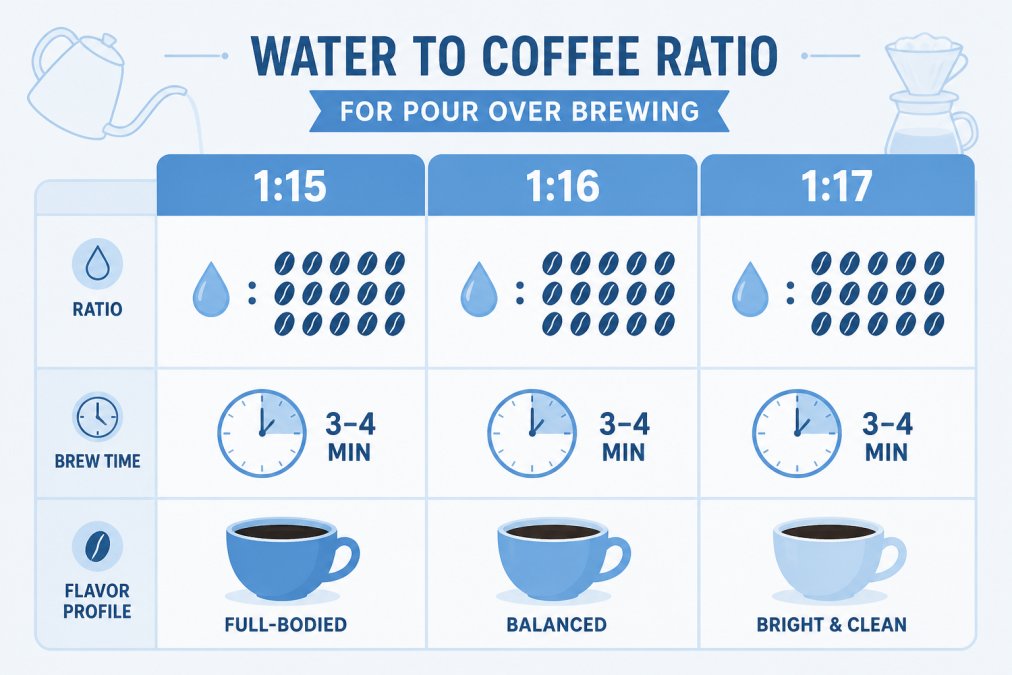
You can adjust this ratio based on what you taste:
- Want more body and sweetness? Try 1:15 ratio (slightly more coffee).
- Want brighter, cleaner acidity? Try 1:17 ratio (slightly more water).
- Happy with balance? Stick with 1:16.
The key is consistency. Use the same ratio for three brewings in a row, and you'll understand how your equipment and technique affect the final cup. Then adjust one variable at a time, ratio, grind size, or water temperature, to dial in your preference.
Water Temperature and Brew Time Essentials
Water temperature controls extraction speed. Ugandan beans' altitude-driven density and acidity profile require temperature precision that accounts for both bean structure and water chemistry.
Temperature Fundamentals for Ugandan Coffee
For single origin Ugandan coffee, the baseline sweet spot is 195-205°F (90-96°C). Most home brewers use water just off boil, around 200°F, which extracts subtle floral and chocolate notes without scorching them.
The optimal temperature depends on bean altitude and water mineral content (Total Dissolved Solids, or TDS).
Altitude-Driven Density and Temperature Adjustment
Ugandan Arabica grown at 1,500-1,800 meters requires 198-202°F. High-altitude Arabica (1,800-2,500 meters) requires 200-205°F; lower temperatures under-extract, producing thin, sour cups. Ugandan Robusta requires 200-205°F; lower temperatures leave the cup flat and one-dimensional.
Water Mineral Content (TDS) and Extraction
Water chemistry is often overlooked but dramatically affects how Ugandan coffee extracts. Hard water (150-300 ppm TDS) extracts slowly; soft water (50-100 ppm TDS) extracts faster. Brewing Ugandan coffee with very soft water at high temperature risks over-extraction of acids, creating sharpness. Hard water at low temperature risks under-extraction, leaving the coffee flat.
Practical Temperature Adjustments
- If your tap water is soft (low mineral content): Use 198-200°F. The soft water extracts aggressively; lower temperature compensates.
- If your tap water is hard (high mineral content): Use 202-205°F. The hard water extracts slowly; higher temperature compensates.
- If you're unsure of your water chemistry: Use 200°F as your baseline. Most municipal water falls in the moderate range (100-150 ppm TDS). Brew, taste, and adjust: if the cup tastes sour or sharp, lower temperature by 2-3°F; if it tastes flat or weak, raise temperature by 2-3°F.
If you're sourcing Ugandan coffee for corporate clients, employee kitchen benefits, or small business pantry selections via our wholesale link (https://brewtifulcoffee.us/pages/wholesale), consider providing brewing guidance that accounts for local water chemistry. Many offices with hard water will see better results at 203-205°F.
Brew Time by Method
Brew time depends on your method:
- Pour-over (Chemex, V60): 3-4 minutes total. At higher temperatures (203-205°F), aim for 3-3.5 minutes. At lower temperatures (198-200°F), aim for 3.5-4 minutes.
- AeroPress: 1-2 minutes steep time, then 30 seconds to press. Use 200°F.
- French press: 4 minutes steep time, then press slowly. Use 200-202°F.
The Bloom Phase
The bloom phase is critical for Ugandan coffee's dense structure.
Temperature Stability Matters
Brewing Methods That Highlight Ugandan Flavor
Pour-over methods like the Chemex and V60 are ideal because they use paper or metal filters that produce a clean cup, letting you taste the floral notes and chocolate that make Ugandan coffee distinctive. Paper filters trap oils and fine particles, creating a bright, clean cup that highlights acidity and subtle fruit notes.
How to Store Specialty Coffee Beans for Maximum Freshness
Freshness is everything with specialty coffee. Store whole beans in an airtight container at room temperature, away from sunlight, heat, and humidity. Never refrigerate or freeze coffee beans; moisture and temperature swings damage structure and flavor.
Here's the timeline:
- Days 1-3 after roasting: Beans are still releasing carbon dioxide. They're not yet at peak flavor.
- Days 4-14 after roasting: Peak freshness window. This is when you want to brew.
- Days 15-30 after roasting: Still good, but flavor fades gradually.
- After 30 days: Beans are stale. Flavor becomes flat and one-dimensional.
Troubleshooting Flat or Bitter Coffee
If your cup tastes flat, weak, or watery, you're under-extracting. The water isn't spending enough time in contact with the grounds, so not enough flavor ends up in your cup.
Under-extraction fixes:
- Grind finer. Smaller particles create more surface area for water to contact.
- Increase brew time. Let water sit with the grounds longer.
- Use hotter water. Higher temperature speeds up extraction.
- Check your ratio. You might be using too much water or too little coffee.
Over-extraction fixes:
- Grind coarser. Larger particles slow extraction.
- Decrease brew time. Don't let water sit as long.
- Use cooler water (but not below 195°F). Lower temperature slows extraction.
- Check your ratio. You might be using too much coffee or too little water.
Frequently Asked Questions
What makes Ugandan coffee unique compared to other single origin beans?
Ugandan coffee, particularly from high-altitude regions like Sipi in the Kapchorwa District (1,500-2,500 meters), produces beans with distinctive characteristics. The washed process and altitude create a mild acidity with light body, delivering floral and chocolate notes with dark fruit undertones. These flavor profiles differ from African coffees grown at lower elevations, offering clarity and complexity that reward careful brewing techniques.
What's the best grind size for brewing single origin Ugandan coffee?
For pour-over methods, use a medium-fine grind—similar to sea salt texture. For immersion brewing like French press, choose a coarser grind to prevent over-extraction. Ugandan beans' light body means finer grinds expose more surface area for extraction, but grind consistency matters more than size. Uneven grinds cause some particles to over-extract (bitter) while others under-extract (sour), masking the coffee's floral and chocolate character.
How do I know if my Ugandan coffee is fresh when it arrives?
Fresh specialty coffee should have a rich, vibrant aroma when you open the bag—you'll notice the floral and fruity notes immediately. Check the roast date on the packaging; coffee is freshest within 2-4 weeks of roasting. Properly stored beans maintain their bloom time (the initial CO2 release during brewing) and flavor clarity. If beans smell flat or stale, contact the roaster about freshness guarantees before brewing.
Can I use the same brewing method for Ugandan coffee as I do for other single origins?
Yes, but Ugandan coffee's light body and washed process make it especially suited to pour-over and immersion methods that preserve flavor clarity. Pour-over brewing (V60, Chemex, Aeropress) highlights the floral and chocolate notes, while French press brings out the full body. Avoid over-extraction by using correct water temperature (195-205°F) and brew time. Espresso machines work but require precise grind and tamping to avoid bitterness, so start with pour-over to learn the bean's true character.