

Whiskey Morning vs Cooper's Cask Coffee
Table of Contents
- What Makes Whiskey Barrel-Aged Coffee Different
- Whiskey Morning Coffee: What You're Getting
- Cooper's Cask Coffee: The Alternative
- How to Brew Barrel-Aged Coffee for Best Results
- Best Coffee Beans for Home Brewing: What to Look For
- Whiskey Barrel-Aged Coffee as Corporate and Holiday Gifts
- Which Coffee Should You Choose
- Frequently Asked Questions
Last Updated: October 17, 2026
What Makes Whiskey Barrel-Aged Coffee Different
Whiskey barrel-aged coffee is aged inside genuine bourbon or whiskey barrels before roasting. The beans absorb the barrel wood's character, picking up vanilla, oak, and caramel notes that set them apart from standard roasts.

The appeal goes beyond novelty: you're experiencing the convergence of coffee roasting and barrel aging. For anyone tired of bitter, one-dimensional coffee, this delivers something genuinely different.
At Brewtiful Coffee US, we've worked with single-origin beans that take on barrel character beautifully. The beans spend weeks inside the barrel, absorbing the wood's complexity without becoming overpowering.
The Aging Process and Flavor Development
Green coffee beans go directly into a barrel that previously held bourbon, whiskey, or sometimes wine. Over 20-30 days, they absorb compounds from the wood and residual spirit, a gradual infusion that changes the bean's chemistry.
Temperature, humidity, and the barrel's previous contents all matter: a bourbon barrel imparts different notes than a wine barrel, and new, used, charred, or uncharred wood shapes the final flavor.
Once aging ends, the beans are roasted to order. Roasting locks in barrel flavors while developing natural sweetness. A medium roast preserves the delicate barrel notes; too dark and you lose subtlety, too light and the barrel character stays muted.
Oak, Vanilla, and Caramel Notes Explained
These tasting notes are genuine flavor compounds present after aging. Oak comes from the barrel wood, vanilla develops as beans absorb compounds from the barrel's interior, and caramel emerges from natural sugars during roasting.
These notes come through as warmth and smoothness rather than sharp flavors. The mouthfeel is fuller than standard coffee, with a slight sweetness that doesn't require added sugar and a lingering "warm finish."
The key is balance: good barrel aging hints at whiskey without overwhelming the coffee, complementing the bean's origin rather than overpowering it.
Whiskey Morning Coffee: What You're Getting
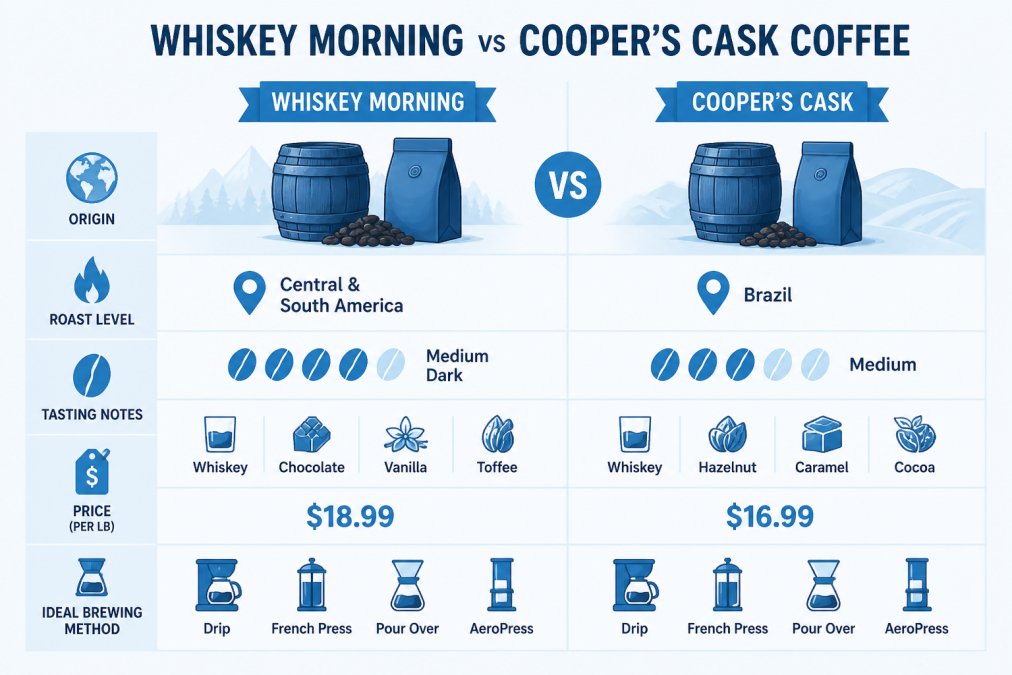
It's positioned as a premium specialty coffee, and the price reflects the barrel aging, single-origin sourcing, and made-to-order roasting, a process that genuinely takes time and care.
Origin, Roast, and Tasting Profile
The vanilla, oak, and caramel notes emerge consistently when brewed properly, present enough that you notice them immediately. If you've only had standard coffee, the first cup often feels like a revelation.
Freshness and Brewing Performance
French press brings out full body and smoothness, pour-over highlights clarity, and espresso concentrates the flavors. Whichever method you use, fresh whole beans give you the best foundation.
Cooper's Cask Coffee: The Alternative
Any barrel-aged coffee competes on similar dimensions: bean origin, roast level, barrel type, aging duration, and freshness at arrival.
Bean Selection and Barrel Character
Quality starts with bean selection: premium single-origin beans take on barrel character more distinctly than commodity blends, and bourbon, whiskey, and wine barrels each impart different flavors.
Aging duration affects intensity: longer aging produces more pronounced barrel notes, shorter aging preserves more of the origin's character. Finding the balance point requires experience and intentional sourcing.
Price and Packaging Comparison
Barrel-aged specialty coffee is a premium product. Both brands position themselves as premium rather than budget options.
Packaging signals freshness commitment: whole-bean bags with one-way valves preserve freshness better, printed roast dates let you verify it, and smaller bags (8-12 oz) suggest more frequent roasting than bulk bags.
How to Brew Barrel-Aged Coffee for Best Results
Barrel-aged coffee's delicate flavors deserve technique that brings them forward, since the wrong method can flatten these notes.
Grinding, Water Temperature, and Timing
Grind beans just before brewing; pre-ground coffee loses aroma and complexity within hours. A burr grinder produces consistent particle size for even extraction.
Water should be 195-205°F: boiling water over-extracts and brings out bitterness, while too-cool water under-extracts. Without a thermometer, let boiling water cool about 30 seconds.
Brewing time depends on method: French press needs about 4 minutes, pour-over 3-4 minutes, espresso 25-30 seconds. Start there and adjust to taste, aiming for sweetness and smoothness without harsh compounds.
French Press vs Espresso vs Pour Over
French press excels with barrel-aged coffee: full immersion extracts the barrel character fully, and the metal filter lets oils through for body and mouthfeel. The result is rich, smooth, and warming.
Pour-over offers clarity and control: adjust water temperature and pour rate to fine-tune extraction, and the paper filter removes oils for a cleaner cup that highlights each tasting note.
Espresso concentrates flavors intensely, making barrel notes prominent and complex. It works well for lattes or cappuccinos, where the barrel character cuts through milk without disappearing.
| Brewing Method | Brew Time | Best For | Flavor Profile |
|---|---|---|---|
| French Press | 4 minutes | Full immersion, rich body | Smooth, warm, full-bodied |
| Pour Over | 3-4 minutes | Control, clarity | Clean, distinct tasting notes |
| Espresso | 25-30 seconds | Intensity, milk drinks | Concentrated, complex |
Best Coffee Beans for Home Brewing: What to Look For
Choosing quality beans comes down to origin, roast level, and, most of all, freshness. Understanding these helps you match choices to your preferences and brewing method.
Single-Origin vs Blended, Roast Level Matters
Single-origin beans come from one country or region and express that place's altitude, soil, and climate: Guatemala brings natural sweetness, Sumatra earthiness and body, Ethiopia bright fruit. You're buying a flavor profile tied to geography.
Blends combine beans from multiple origins for balance and consistency, since the roaster can adjust ratios to maintain a signature flavor year-round. Single-origin coffees vary slightly between harvests.
Roast level determines how much the roasting process influences flavor versus the bean's origin. Light roasts preserve origin characteristics but can taste thin or sour if under-extracted. Medium roasts balance origin and roast flavors, this is where most specialty coffee lives. Dark roasts emphasize roast flavors (chocolate, smoke, caramel) over origin.
For barrel-aged coffee, medium roast is the sweet spot. It preserves the barrel character while developing enough roast flavor to add depth. Light roasts can make barrel notes feel thin. Dark roasts can bury the barrel character under roast flavors.
Freshness, Storage, and Whole Bean Quality
Freshness is non-negotiable for specialty coffee. Coffee peaks in flavor 5-14 days after roasting. It remains good for about a month. After that, flavors fade and staleness creeps in. A roast date on the bag tells you exactly where you stand.
Whole beans stay fresh longer than ground coffee. Once ground, coffee oxidizes rapidly. A bag of whole beans ground the day you brew it tastes noticeably better than pre-ground coffee that's been sitting for weeks.
Storage matters. Keep beans in an airtight container away from light, heat, and moisture. A sealed bag with a one-way valve works well. The freezer extends freshness if you're storing beans long-term, though most people don't need to freeze coffee they'll use within a month.
Bag size signals freshness commitment. Smaller bags (8-12 oz) suggest more frequent roasting. Larger bags (2+ lbs) might sit longer before reaching you. For barrel-aged specialty coffee, smaller bags make sense, you're paying premium prices for quality you want to experience at its peak.
Whiskey Barrel-Aged Coffee as Corporate and Holiday Gifts
Specialty coffee makes an excellent gift for people who appreciate quality rituals. Barrel-aged coffee is especially compelling because it feels intentional and thoughtful. It's not something people typically buy for themselves, which makes it a memorable gift.
Why Specialty Coffee Works for Employee Benefits
Employees appreciate quality perks that improve their daily experience. A selection of specialty coffee, including barrel-aged options, shows that a company values their comfort and satisfaction. It's a small gesture that compounds over time through daily use.
For corporate clients and small business owners, offering quality coffee in the office kitchen signals that the company cares about details. It creates a better work environment. It shows up in employee satisfaction and retention metrics, though those benefits are harder to quantify than the cost.
Wholesale options make sense for businesses buying in volume. Brewtiful Coffee US offers wholesale link for bulk orders, which reduces per-unit cost for corporate clients, employee kitchen benefits, and pantry selections. Buying whole-bean specialty coffee at wholesale pricing makes premium options accessible for businesses that want to offer something better than standard office coffee.
Gift Sets and Wholesale Options for Small Business
Holiday gift sets typically include 2-4 specialty coffees in smaller sizes, packaged attractively. A set might feature a barrel-aged coffee alongside a single-origin option, giving the recipient variety and discovery. These sets work well for corporate gifting, clients, partners, and employees all appreciate quality coffee.
Small businesses can source specialty coffee for resale or employee benefits through wholesale channels. Buying 10+ bags at wholesale pricing makes premium coffee economically viable for businesses that want to differentiate themselves. A coffee shop, office, or corporate pantry offering Brewtiful Coffee US's barrel-aged selection signals quality to customers and employees alike.
For holiday gifting, barrel-aged coffee stands out. It's premium without being pretentious. It's a gift someone can enjoy immediately or save for a special morning. The story behind barrel aging, the process, the craftsmanship, the time involved, adds meaning that standard coffee lacks.
Which Coffee Should You Choose
The choice between barrel-aged options comes down to your priorities: origin preference, roast level, price, and freshness guarantee.
Our Whiskey Barrel Aged coffee delivers on all fronts. Single-origin Guatemala beans offer natural sweetness that pairs beautifully with barrel aging. Medium roast preserves both the origin and the barrel character. At $22.99, it's premium but not excessive. Roasted to order means you receive freshness as a guarantee, not a hope.
If you prioritize simplicity and reliability, our Whiskey Barrel Aged coffee is the clear choice. You know exactly what you're getting: Guatemala beans, 30-day bourbon barrel aging, medium roast, fresh-roasted to order. No guessing. No surprises.
If you want to explore and compare, try different barrel-aged coffees. Side-by-side tasting reveals how different barrel aging approaches produce different results. You might discover you prefer one over the other based on subtle flavor differences.
The real choice isn't between brands, it's between committing to quality coffee and accepting whatever's convenient. Once you experience barrel-aged specialty coffee brewed properly, standard coffee feels flat by comparison. The investment pays for itself through daily enjoyment.
Barrel-aged coffee represents a genuine upgrade from standard morning coffee. The craftsmanship is real, the flavors are distinct, and the freshness matters. Whether you choose our Whiskey Barrel Aged coffee or explore other options, you're investing in a ritual that deserves quality ingredients. Brewtiful Coffee US specializes in exactly this, fresh-roasted specialty beans, including barrel-aged varieties, shipped nationwide. Our commitment to roasting to order and single-origin sourcing means you receive coffee at its peak. Start with our Whiskey Barrel Aged coffee and experience the difference freshness and intentional aging make.
Frequently Asked Questions
How does whiskey barrel-aged coffee taste compared to regular coffee?
Whiskey barrel-aged coffee carries distinct notes from the barrel aging process. You'll notice vanilla, oak, and caramel flavors alongside the coffee's natural characteristics. The barrel contact creates a smoother, warmer finish than standard roasts. Some describe it as having subtle whiskey undertones without any actual alcohol content. The flavor intensity depends on the bean origin and how long the beans spent aging in the barrel.
Does barrel-aged coffee contain alcohol?
No. During the roasting process, any residual alcohol from the barrel evaporates completely. The coffee absorbs the barrel's flavor compounds, vanilla, oak, and caramel, but not the alcohol itself. This makes barrel-aged coffee safe for all audiences, including those avoiding alcohol for dietary or personal reasons. You get the sophisticated flavor profile without any alcohol content.
What's the best way to brew whiskey barrel-aged coffee?
Barrel-aged coffee performs well across multiple brewing methods. For French press, use a coarser grind and steep for 4 minutes to fully extract the barrel notes. Pour-over methods highlight the smooth finish when brewed at 195-205°F. Espresso machines bring out the caramel and oak character. The key is using fresh, whole beans ground just before brewing and avoiding water that's too hot, which can amplify bitterness and mask the barrel's subtle flavors.
Why is specialty whiskey barrel-aged coffee more expensive than standard coffee?
The aging process, barrel sourcing, and single-origin bean selection drive higher costs. Beans spend 20-30 days in genuine bourbon or whiskey barrels, requiring specialized storage and handling. Single-origin beans from regions like Guatemala or Ethiopia cost more than commodity blends. Fresh roasting to order ensures peak flavor but requires smaller batch production. These factors combine to create a premium product that delivers noticeably better flavor and aroma than mass-produced alternatives.